One of the things that has fascinated me about Pentel’s American story is this animation cel from my collection, made for a Pentel America commercial by Duck Soup. It is a small piece of a much larger history: the people, artwork, ideas, and advertising that helped put Pentel pens and pencils into American hands.
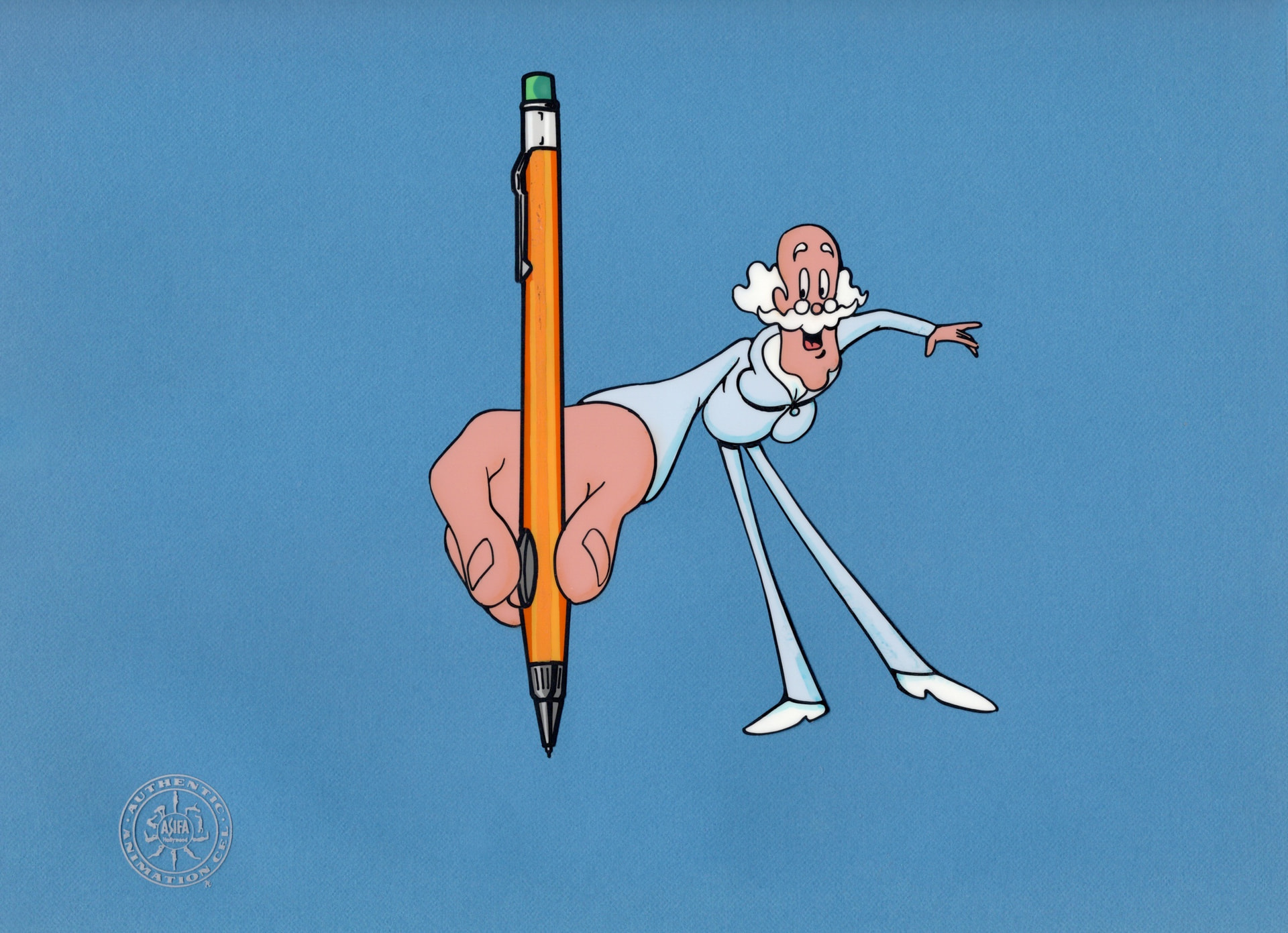
An animation cel from my collection, from a Pentel America commercial made by Duck Soup. The exact commercial title, production date, and individual artist remain open questions in this research.
Below, I have documented, to the best of my ability, how Pentel entered the U.S. market and made its place in American working life. The story follows the products, prices, stores, advertising, and creative people behind the brand, mainly from the 1960s through the 1980s, with a final look at the 1990s.
Mechanical pencils are a particular fascination for many of us here, but the pens belong in the story too. Together, they take us from art-supply counters and architects’ drawing boards to television commercials, school-shopping lists, and college bookstores.
There is plenty still to discover. What follows brings together the evidence I have been able to find, with the original pages close at hand so you can inspect the details, enjoy the artwork, and help fill in the gaps.
In October 1967, Pentel made its case to Boston with four enormous words: “never a dull moment.” Beside them stood a Sharp 5 mechanical pencil. The price was $1.98. The barrel came in brown or green. The intended customers were right there in the copy: architects, draftsmen, and accountants.
A collector might stop at the barrel colors. I want to know how that pencil got into the newspaper.
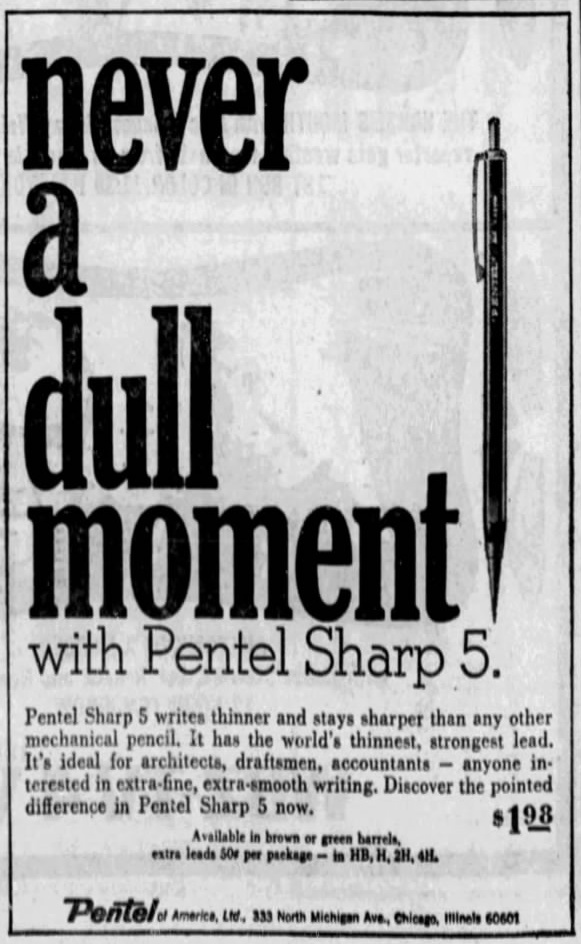
Pentel of America advertisement, The Boston Globe, Boston, Massachusetts, October 14, 1967, p3. Manufacturer advertisement.
Somebody had to bring the product to America, persuade a dealer to stock it, decide whom to sell it to, and find a reason that person should care. The little Boston ad gives us one answer. A finer line and a point that stayed sharp were reasons to spend money on a better working tool. The pun made the promise easier to remember.
That is the Pentel story I want to follow: how a Japanese writing-instrument maker became part of American working life, from the art-supply counter to the drawing board, the office order, the school-shopping list, and the college bookstore.
Along the way we will meet a San Francisco importer, an advertising man in a one-room office, a 49-cent executive fantasy, a free-pen coupon, a professional artist who told Pentel what he wanted, and an animation studio called Duck Soup. There will be a skull on a package and a pencil posing like futuristic architecture. Eventually there will be a website with a visitor counter. Naturally.
Our main territory is the 1960s through the 1980s, with a final look at the 1990s and a firm stop at 1999. Mechanical pencils are the thread running through it, but the pens belong here too. They help explain the audiences, retailers, and reputation the wider brand was building.
A note before we turn the pages: the captions identify dates, places, and sellers, with links to full source PDFs or newspaper pages hosted on Knockology where supplied. The PDF downloads are preserved copies hosted here on Knockology. Large source issues are supplied in numbered parts where needed to fit the forum’s attachment limit. Compressed reading copies retain every page; full-resolution originals are also preserved in my local archive. Later recollections and company histories are identified as such.
Source Note
A dated ad establishes an appearance by that date; it does not necessarily establish a product launch. Source Notes beside individual items explain further limits of the evidence.
Watch the name at the bottom of each ad. Yasutomo the importer, Pentel of America the manufacturer’s subsidiary, and the local retailers speak in different voices. A store’s bargain and the manufacturer’s promise may feature the same pencil, but they tell us different things about how it was sold.
1. A pen arrives before the American company does
Pentel’s U.S. story does not begin with a single ribbon-cutting. Yasutomo dates its importation of the Sign Pen to 1963. Pentel’s corporate chronology places a Chicago branch in 1964 and Pentel of America, Ltd. in 1965. Products, advertising, a branch, and a subsidiary are separate milestones. The contemporary advertising record reaches back before the subsidiary. Yasutomo history · Pentel’s retrospective chronology, printed p17 / PDF p18
Ben Yasutomo’s San Francisco business, established in 1954, already dealt in Japanese goods for American art-material, gift, and stationery stores. Its own history describes trade-only gift shows in San Francisco, Los Angeles, Seattle, and New York, followed by art-material trade-association events. That network matters: an intriguing pen needed somebody who could put it in front of buyers and get it into shops.
American stationery stores were part of this market, but they were only part of the route to a customer. The pages collected here take us through art materials, office equipment, drafting supplies, department-store stationery counters, and school supplies. Pentel could meet an American buyer under any of those signs. Each setting called for a different explanation of the product.
An artist wanted to see the mark. An accountant needed a fine line. A dealer needed something customers would buy again. A parent in August needed to finish the school list. A product could be useful to all four without the same advertisement working for everyone.
1963–64: first, get the artists interested
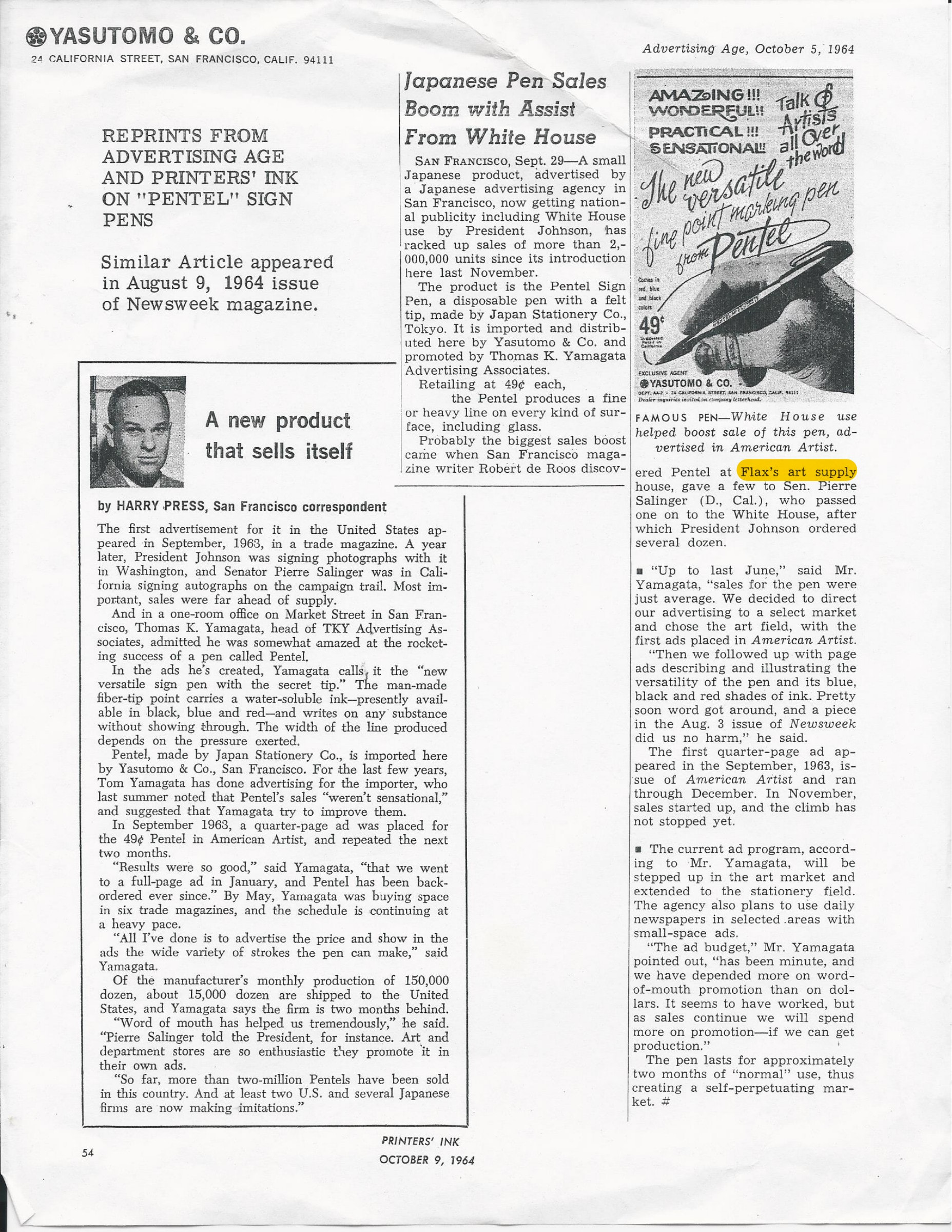
Yasutomo promotional press sheet reproducing coverage from Advertising Age, October 5, 1964, and Printers’ Ink, October 9, 1964. This is a one-page reprint sheet, not either complete magazine issue. Importer/distributor evidence.
Open the complete press-sheet PDF
The cast is unusually easy to identify. There is Yasutomo & Co., at 24 California Street in San Francisco, and Thomas K. Yamagata, head of TKY Advertising Associates. Harry Press’s Printers’ Ink account places Yamagata in a one-room Market Street office. The American sales effort comes into focus at the scale of a small business: an importer, an ad man, and a pen they need people to try.
The campaign began in a place where the mark would matter. The sheet describes a quarter-page advertisement in American Artist in September 1963, repeat insertions, and a full page in January 1964. By May, Yamagata was buying space in six trade magazines. Only American Artist is named in this account.
In the reproduced ad, a hand demonstrates the pen. At 49 cents, the invitation was easy to understand: look at the strokes this thing can make, then try it yourself. Yamagata’s account explicitly identifies the art field as the chosen market. The medium, illustration, and price all serve the same introduction.
Then a pen took a much more glamorous route. According to the reprinted Advertising Age account, writer Robert de Roos encountered it at Flax’s art-supply store, passed examples to Pierre Salinger, and one reached the White House. President Johnson subsequently ordered more. That is the contemporary account preserved here. Later company retellings emphasize trade-fair samples; the surviving versions do not justify stitching together an exact handover scene.
The commercial claims are striking: more than two million pens sold in the United States, approximately 15,000 dozen shipped to the U.S. per month, and a two-month backlog. The larger figure of 150,000 dozen in the article is the manufacturer’s monthly production, not monthly U.S. shipments. These figures survive in the importer’s contemporary promotional reprint.
Yamagata describes a small advertising budget and gives word of mouth a large role. He also talks about more promotion if production permits, including expansion in the stationery field and small newspaper ads in selected areas. No dollar budget is given. It is a wonderfully practical qualification to an advertising success story: publicity is most useful when you have pens to deliver.
The presidential connection is irresistible, but look at the work already underneath it. Specialist advertising introduced the tool. A shop put it within reach of a writer. Personal recommendation and publicity carried the name farther. Dealers could then make their own pitch. Pentel’s early American visibility grew through those connected encounters.
Source Note
The sales and shipment figures are contemporary reported claims, not audited financial statements. The two reprinted accounts are not perfectly consistent about the initial introduction and repeat-insertion sequence. September 1963 advertising is explicitly described; the precise first U.S. sale remains unestablished. The sheet’s own Newsweek date differs from the date in its reproduced article. Neither is used here as a verified Newsweek issue citation.
November 1964: become an executive for 49 cents
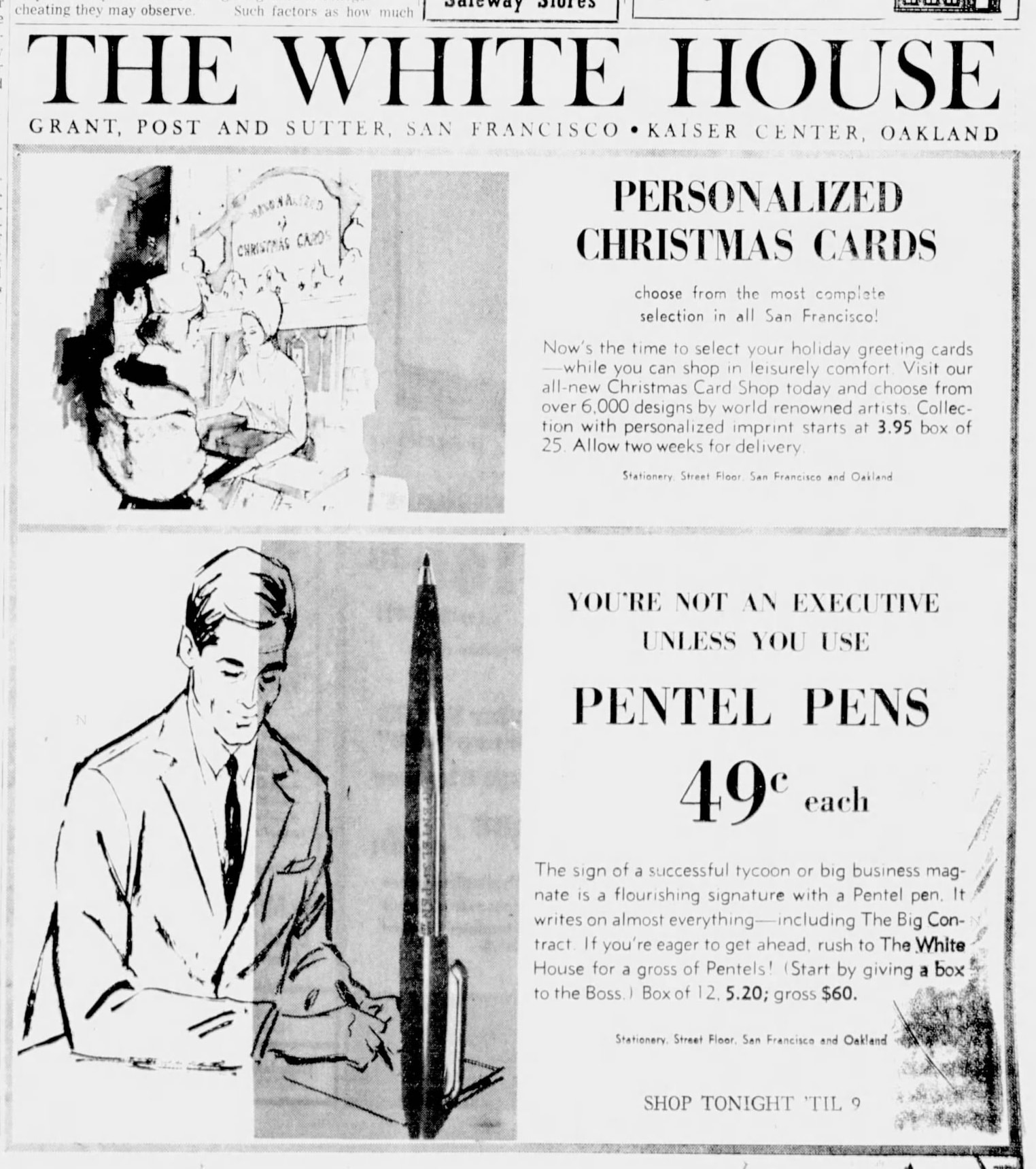
The White House department store, San Francisco Chronicle, November 5, 1964, p9. Retailer advertisement for its San Francisco and Oakland stationery departments.
“You’re not an executive unless you use Pentel pens.” That is a wonderfully extravagant burden to put on a 49-cent writing instrument.
The illustration supplies the rest: a suited man, pen in hand, doing the sort of writing that presumably changes somebody’s business prospects. The copy links a flourishing signature to success and contracts, and suggests giving a box to the boss. One pen costs 49 cents, a box of twelve $5.20, and a gross $60.
There is a second White House in this story. The White House department store is the advertiser here, offering Pentel through its San Francisco and Oakland stationery departments, alongside personalized Christmas cards. The name is a coincidence worth untangling before the department store gets promoted to the presidency.
The artist’s demonstration has become a small fantasy of business success. The point still makes a useful mark, but now it is the signature at the bottom of a contract. Giving a box to the boss is part of the invitation. A cheap pen has acquired an ambitious social life.
That shift shows how a retailer could give the same product a new audience. In this particular store, on this particular day, 49 cents bought the promise of executive style.
November 1964: the red-pen brigade
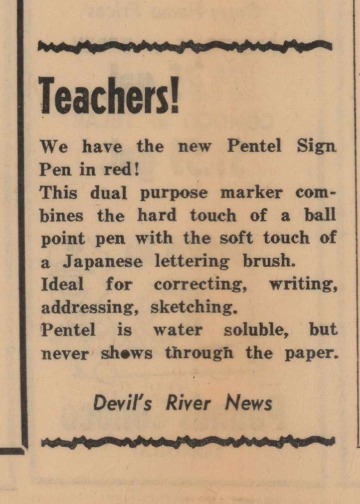
Detail from the Devil’s River News, Sonora, Texas, November 12, 1964, printed page 6-A. The newspaper itself is the seller. Retailer advertisement.
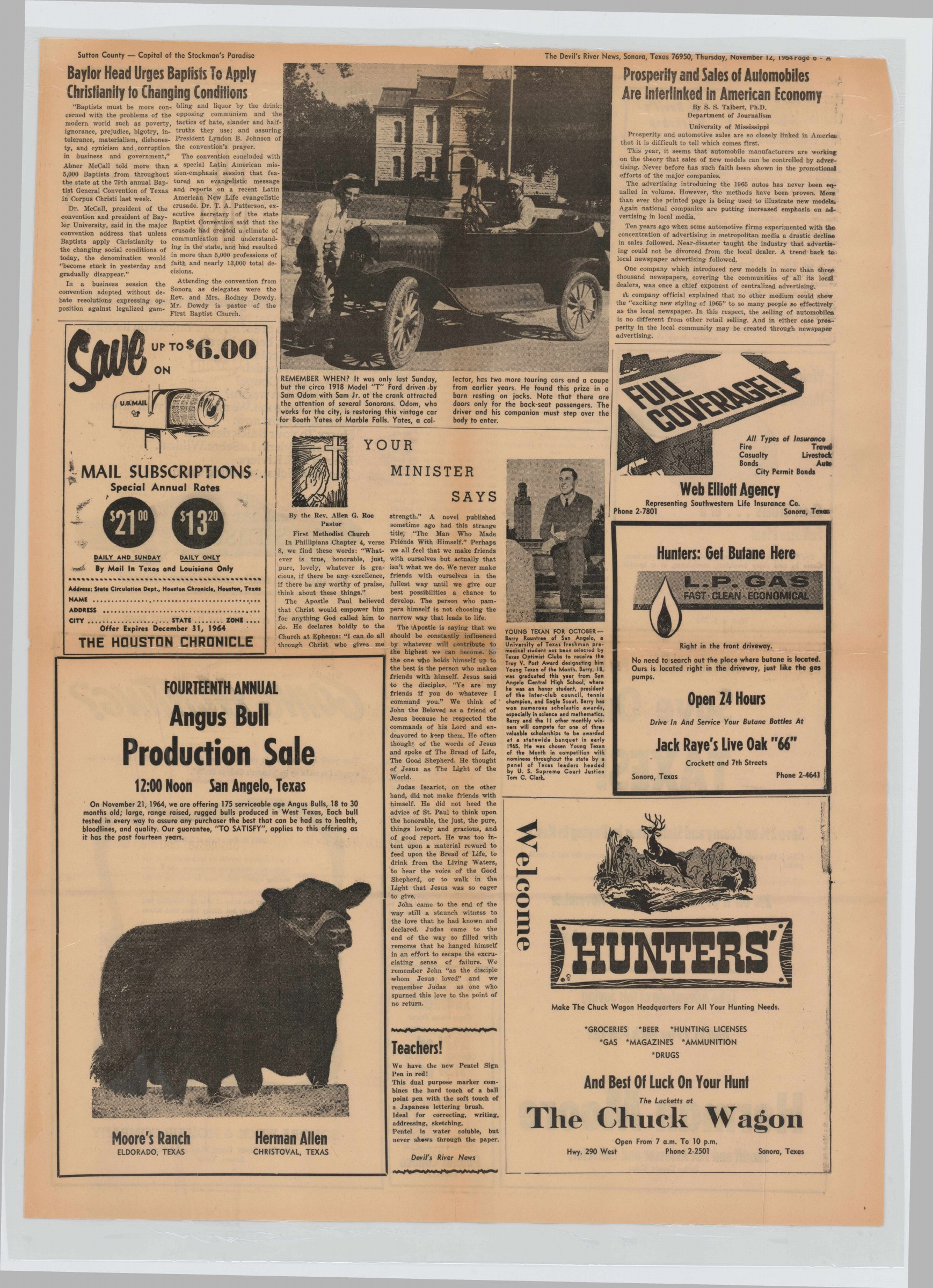
Complete source page; PDF page 8.
Open the complete newspaper PDF
The president may get the publicity, but somebody has to mark the spelling tests. The small advertisement addresses teachers and promotes a red Sign Pen for correcting, writing, addressing, and sketching. Its practical promises concern water-soluble ink and avoiding show-through.
The teacher has a stack of papers to finish. A clear red correction matters more here than an executive flourish. The local seller has translated the pen’s properties into a familiar job, right down to the color of the ink.
The ad is small enough to miss while admiring the rest of the page. Yet it catches Pentel doing something essential to the American story: becoming useful to a particular customer in a particular town. No price is printed in this offer.
February 1965: hanging out with the paints
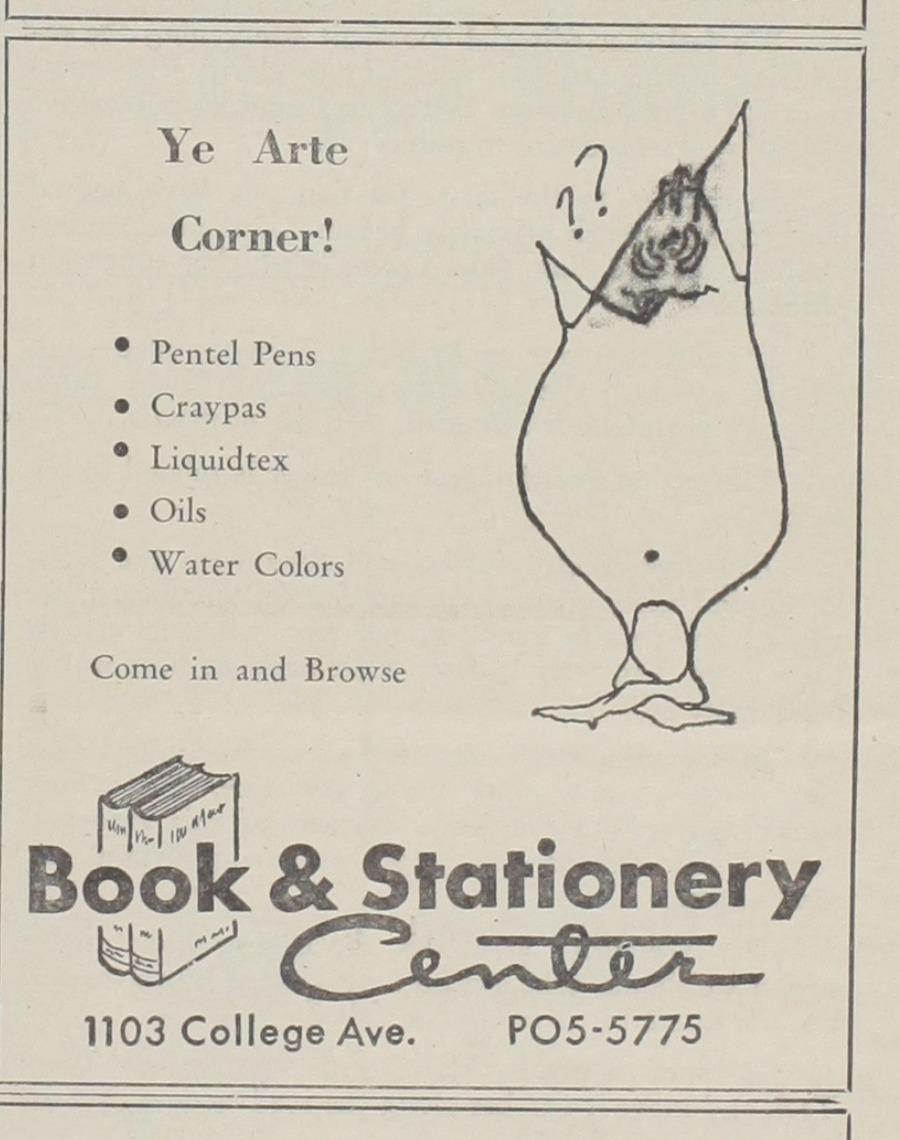
Book & Stationery Center advertisement, Daily Toreador, Lubbock, Texas, February 17, 1965, printed page 3. Retailer advertisement.
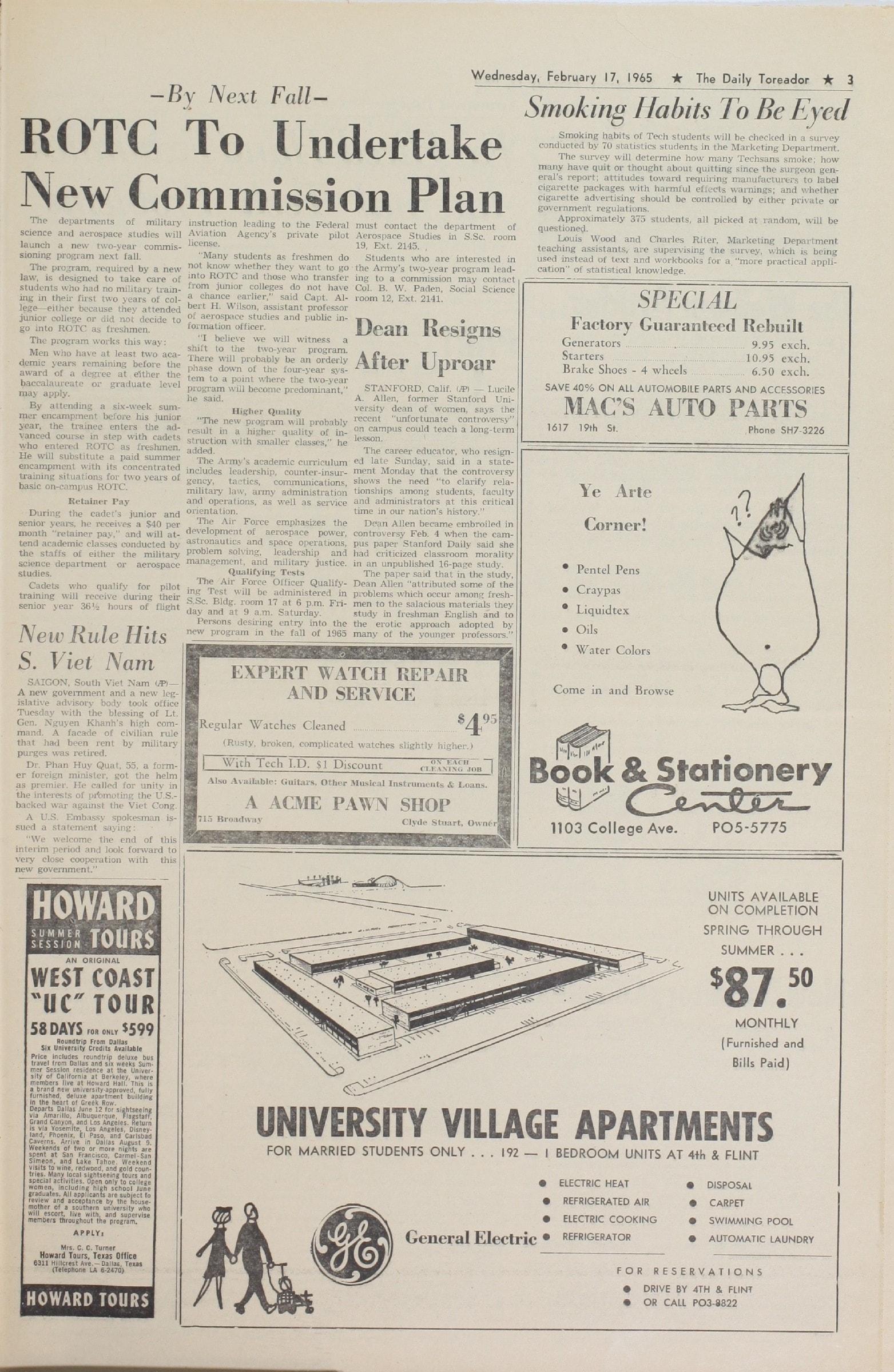
Complete source page; PDF page 3.
Open the complete Daily Toreador PDF
The store’s art-supply section includes Pentel Pens alongside such materials as Cray-Pas, Liquitex, oils, and watercolors. It is an assortment advertisement rather than an explanation of one pen’s mechanism.
The company Pentel keeps on this page is revealing: paints, drawing materials, and the equipment of making pictures. The Book & Stationery Center has already done some of the persuasive work simply by choosing the assortment.
Yamagata’s art-market plan now has a local retail counterpart. Someone reading a campus newspaper in Lubbock could find the brand among the materials available for their next piece of work.
April 1965: a space-age footnote that needs careful reading
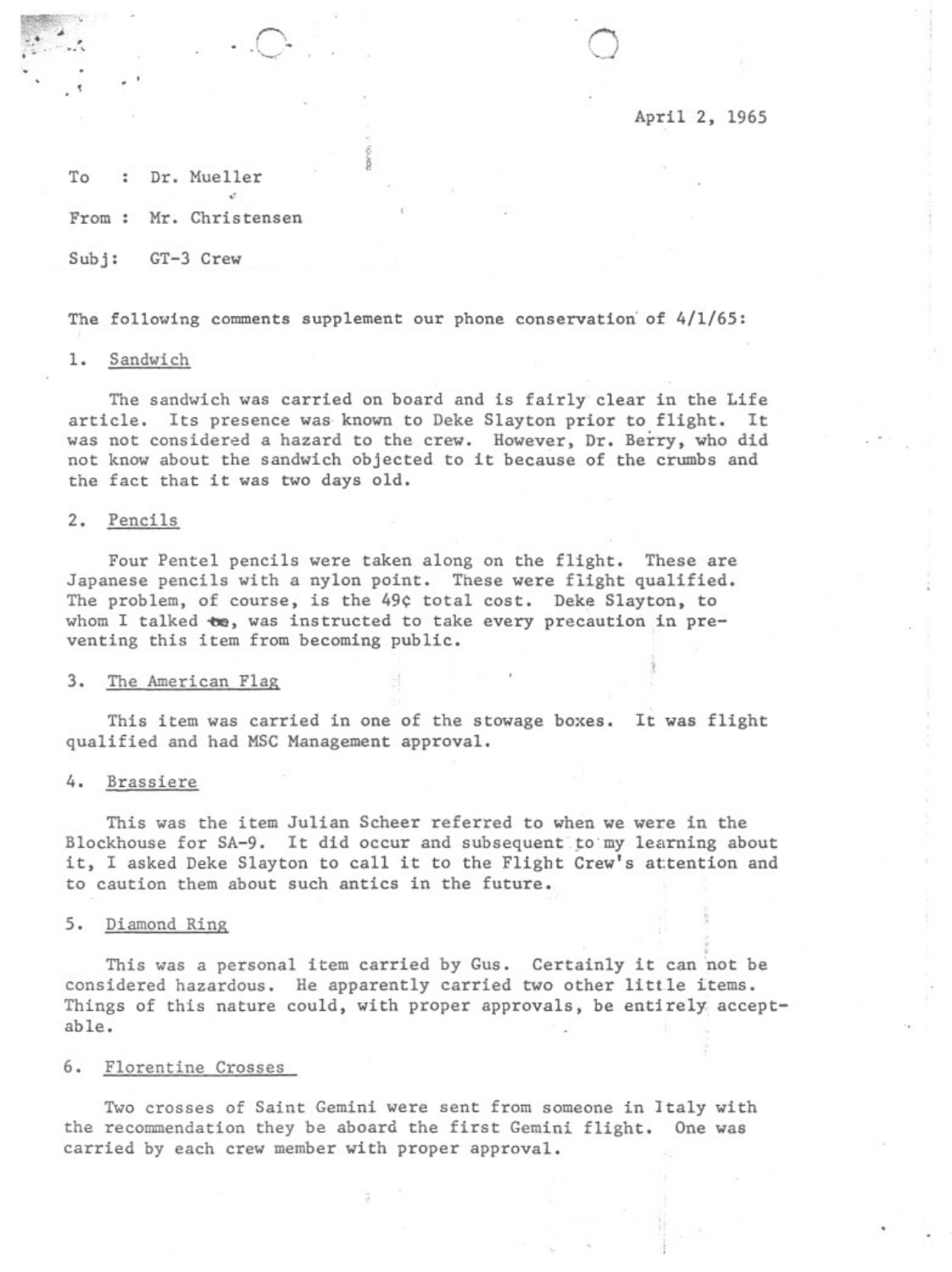
April 2, 1965 memorandum, Mr. Christensen to Dr. Mueller, “GT-3 Crew,” first page of a two-page contemporary document reproduced by The Space Review. Complete memorandum PDF.
The space association deserves more than a repeated brand legend. This memorandum says four Pentel writing instruments were carried on the GT-3 flight and were flight-qualified. It calls them pencils, then describes a nylon point. That wording matters enormously to a pencil collector: it does not establish that these were Sharp 5s or graphite mechanical pencils.
The memo also gives an unusual 49-cent total-cost figure and discusses avoiding publicity. Its wording does not resolve a dependable per-unit purchase price. This is an administrative document, preserved by a later historical publication, rather than a Pentel advertisement.
For pencil collectors, the nylon point is the detail to remember. The word “pencil” in an old document can lead us toward the wrong object if we read past its description. NASA supplies an intriguing 1965 encounter with the brand; this memo alone establishes neither a Sharp 5 in orbit nor a space-themed advertising campaign.
2. The pencil makes its case
By 1965, according to Pentel’s chronology, the American subsidiary was established. Later advertisements in the decade put its name and Chicago address in front of readers. Alongside that company voice, local dealers continued to explain, price, and sell the products. The next two ads let us see both kinds of persuasion at work.
May 1967: a catalog, a newspaper, and a free pen
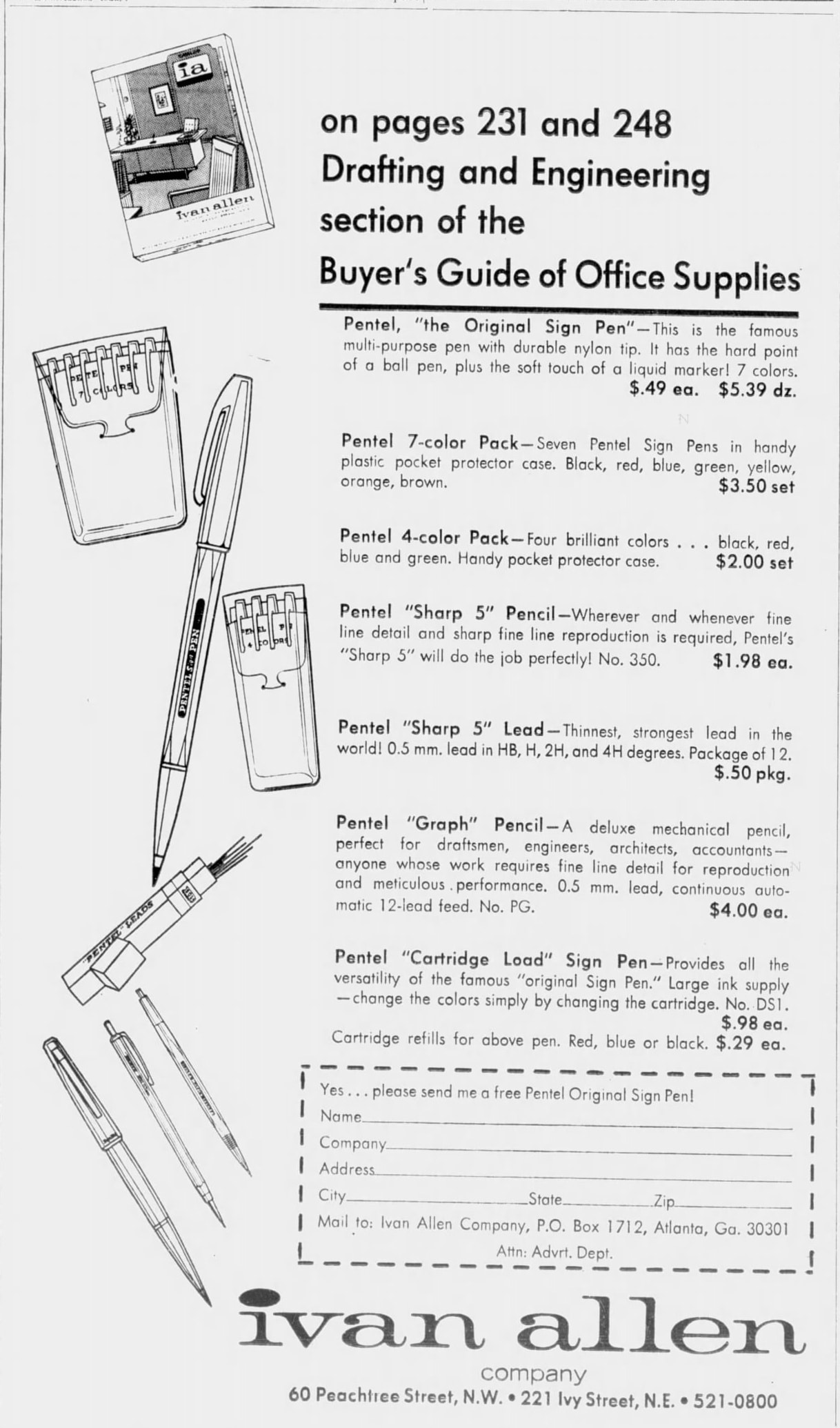
Ivan Allen Company, The Atlanta Journal, Atlanta, Georgia, May 9, 1967, printed p30. Retailer advertisement; references pages 231 and 248 of its Buyer’s Guide of Office Supplies.
This advertisement is a small treasure for our kind of reader. Ivan Allen places Pentel in the Drafting and Engineering section of its office-supply buyer’s guide, then reproduces an illustrated assortment on the newspaper’s business page. The catalog and newspaper are working together.
There is the Sharp 5, No. 350, at $1.98. Beside it is the more expensive Graph, No. PG, at $4, pitched to draftsmen, engineers, architects, and accountants. The Graph’s description emphasizes fine detail and a continuous supply of twelve 0.5 mm leads. Replacement Sharp 5 leads come in HB, H, 2H, and 4H, twelve for 50 cents.
No. 350 and No. PG: two small details that make a dated advertisement much more than decoration. They connect the names in our collections to an actual American offer. Even the lead grades tell us something about the expected buyer, who might care as much about the refill as the barrel.
The rest of the range provides a price ladder: the Original Sign Pen at 49 cents or $5.39 a dozen; four-color and seven-color packs at $2 and $3.50; a No. DS1 Cartridge Load Sign Pen at 98 cents, with 29-cent replacements. One brand could serve sketching, lettering, colored notes, and precise pencil work, at several price points.
Then comes the clever part: a coupon for a free Original Sign Pen. It asks for the reader’s name, company, and address and directs the reply to Ivan Allen’s advertising department. The retailer is offering a way to try the product and inviting a business contact in the process. We do not have coupon returns, but the mechanism of the offer is right there on the page.
The ad offers a whole route from curiosity to purchase. Look up the catalog pages. Compare the range. Send for the sample. Contact the store. Pentel supplies the products; Ivan Allen supplies a local way to turn interest into an order.
October 1967: the Sharp 5 knows exactly whom it wants
Five months later, the Boston advertisement at the opening speaks in Pentel of America’s own voice. Architects, draftsmen, and accountants are its named prospects. The giant headline gets their attention; the fine print tells them why they should recognize themselves in it.
The $1.98 Sharp 5, in brown or green, is sold on a fine line and a point that stays sharp. The copy claims exceptionally thin, strong lead. Those superlatives belong to the advertisement, but the choice of selling points is clear: Pentel wants the pencil judged by the work it can do.
The ad carries Pentel of America, Ltd., 333 North Michigan Avenue, Chicago, Illinois 60601. This time the advertiser is the American company, not Ivan Allen or Yasutomo. A second verified insertion of the same execution appears in The Boston Globe on October 31, 1967, p16. The same pitch reached Boston readers on at least two dates.
Source Note
The two verified insertions establish repetition. The total number of insertions and the campaign budget remain unknown.
At a drawing board, the appeal is easy to appreciate. Sharpening interrupts the job. A widening point changes the line. Keeping the right lead ready matters. To a collector, the brown and green barrels may be the irresistible detail; to the buyer Pentel pictured, the attraction was getting on with the work.
98 cents now, 29 cents when the ink runs out
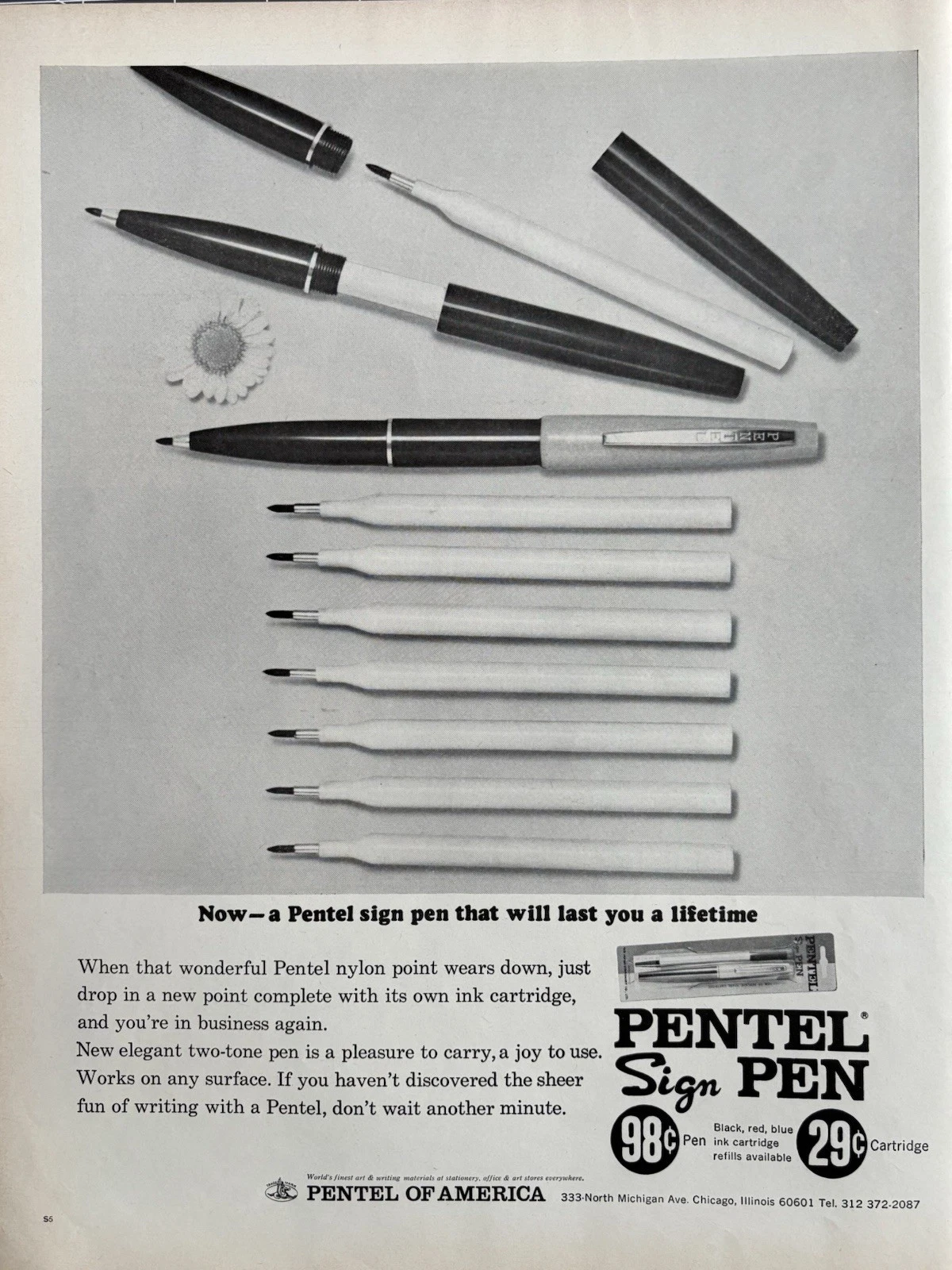
Pentel of America advertisement, seller-attributed to 1967. The original publication and issue have not yet been identified. Treat 1967 as provisional, not a verified insertion date.
View the surviving advertisement image
This ad shows the pen taken apart, surrounded by replacement cartridges. It offers the pen at 98 cents, with a replacement point-and-ink cartridge at 29 cents, in black, red, or blue. The company address is 333 North Michigan Avenue, Chicago.
The promise of long ownership is explained in the picture: keep the body and replace the point-and-ink cartridge. The disposable part is visible, and so is the part worth keeping. The illustration turns maintenance into a reason to buy.
That is a recurring idea in these pages. Pentel often makes a modestly priced object interesting by explaining what is inside it. A cartridge, a sleeve, a supply of leads: something small becomes a reason to choose the brand and keep using it.
October 1968: the professional magazine makes room for specifications

Pentel of America pencil advertisement, P/A News Report, October 1968, printed page 106.
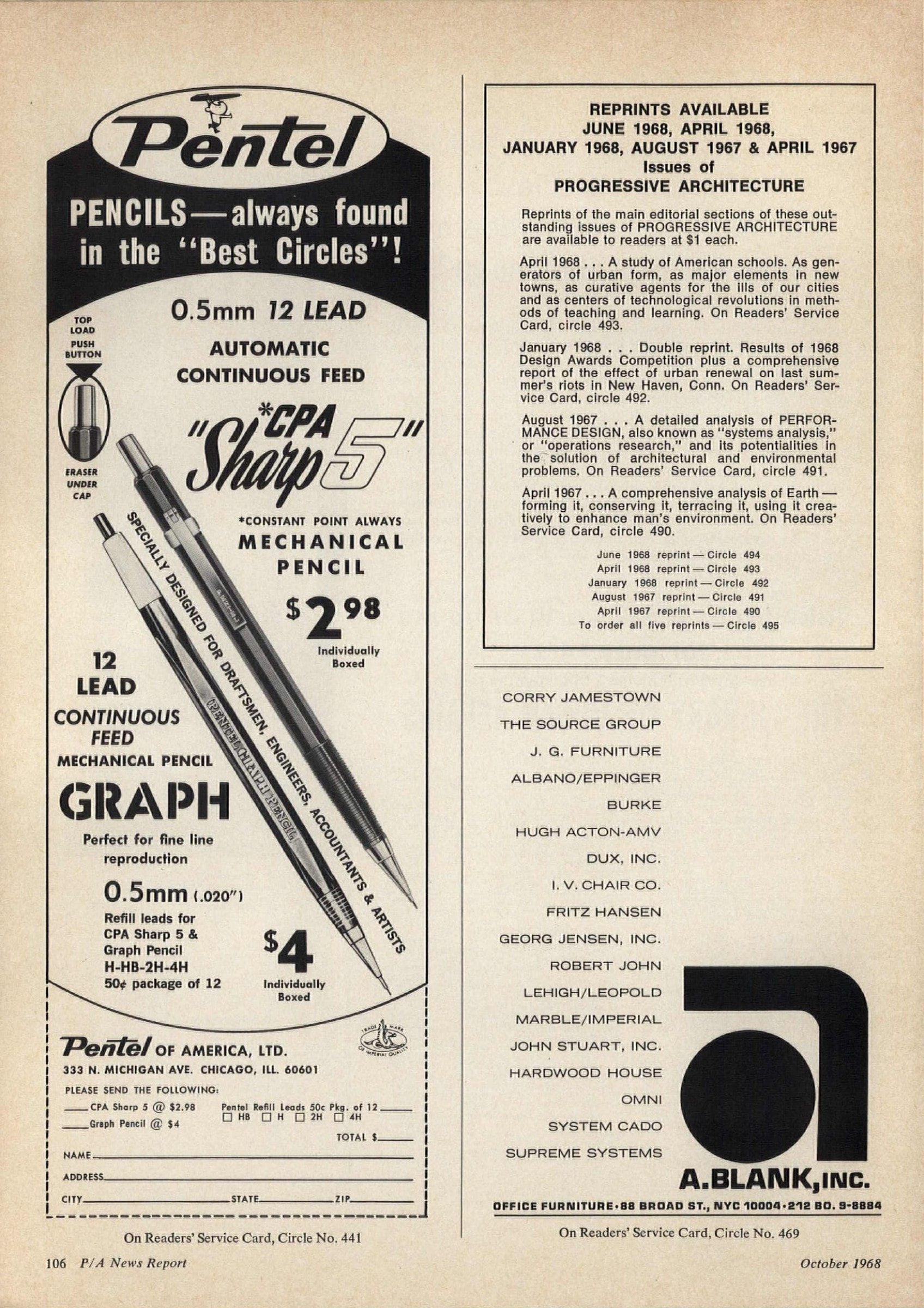
Complete page; PDF page 34. The advertisement occupies the left side.
Open the October 1968 PDF (complete document in 2 parts: part 1, PDF pp1–24; part 2, PDF pp25–42)
Here the pitch turns toward technical work. The advertisement names draftsmen, engineers, accountants, and artists. It presents the CPA Sharp 5 at $2.98, the Graph at $4.00, and 12 leads for 50 cents, with an order coupon directed to the Chicago address.
The copy emphasizes a 0.5 mm line and continuous feeding from a supply of 12 leads. In an architectural publication, those are arguments about work: line consistency, less interruption, and the convenience of having replacement lead ready inside the pencil.
The circular headline and illustration borrow the geometry of the reader’s work. A small patch of page can carry a pencil, a visual joke, specifications, prices, and a way to order. There is very little room here for atmosphere. Almost everything has a job.
The $2.98 CPA Sharp 5 and $4 Graph also make the range visible. Pentel is asking the reader to choose between described tools, not simply to remember a logo. For us, that is a glimpse of where the models sat in the company’s contemporary offer.
October 1968: “everything for your office,” including the pencil
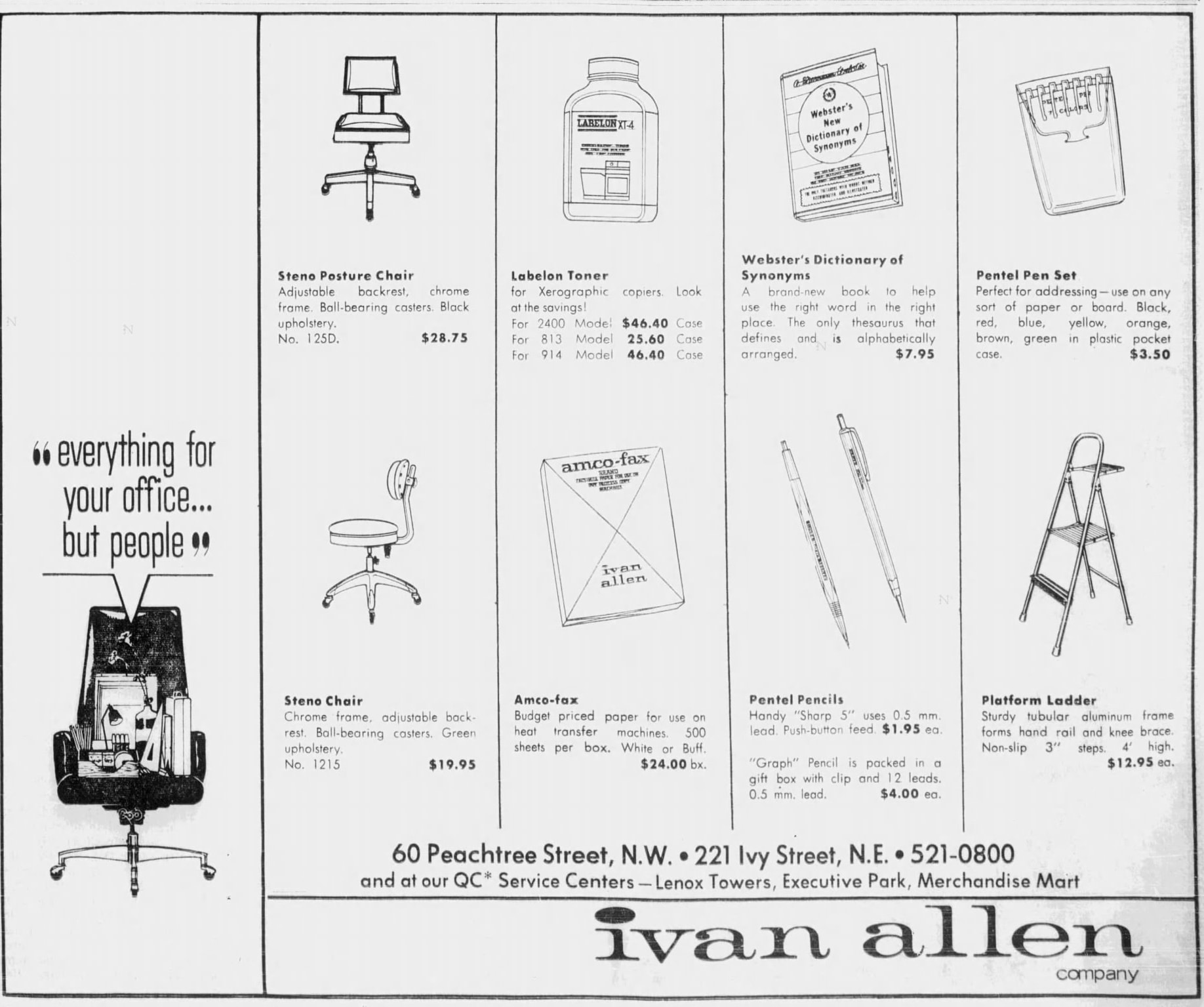
Ivan Allen Company, The Atlanta Journal, October 21, 1968, printed p13-B. Retailer advertisement.
The same Atlanta dealer puts the Sharp 5 at $1.95 and the Graph at $4 among a steno chair, copier toner, office reference material, fax paper, and a platform ladder. The Graph offer specifies a gift box, clip, and twelve leads. The seven-color Pentel pen set is $3.50.
That surrounding merchandise is part of the evidence. Pentel is being sold as something an office needs to function. The store names its Peachtree and Ivy Street locations and service centers at Lenox Towers, Executive Park, and the Merchandise Mart. A local purchasing route sits directly below the product.
Keep the descriptions beside the prices. The architectural ad’s $2.98 CPA Sharp 5 and this dealer’s $1.95 Sharp 5 are differently described offers from different sellers. Together they show the choices reaching customers; they cannot be flattened into a national price trend.
February 1970: meanwhile, yours for 22 cents
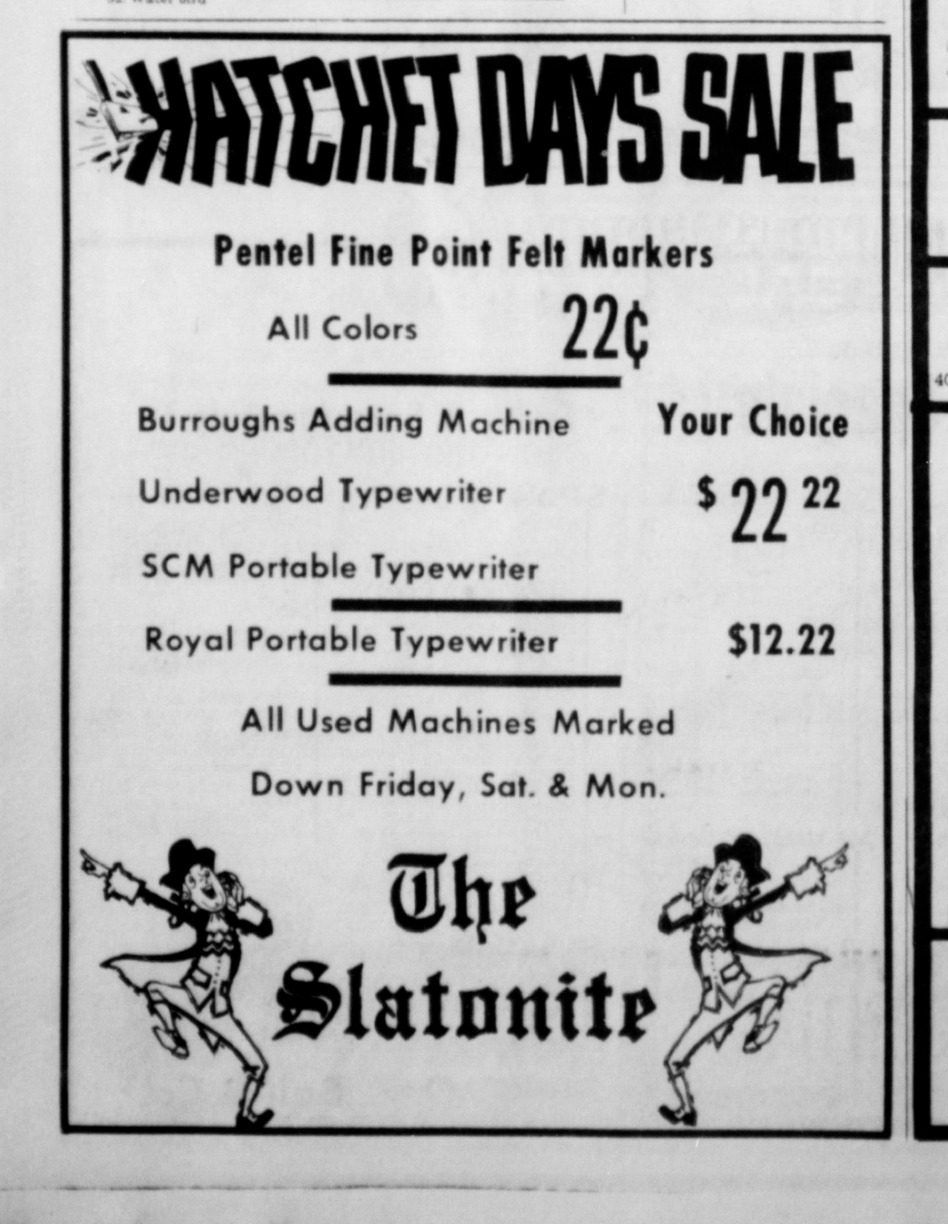
Pentel marker offer in the Slaton Slatonite, Slaton, Texas, February 19, 1970, printed page 10. Retailer advertisement.
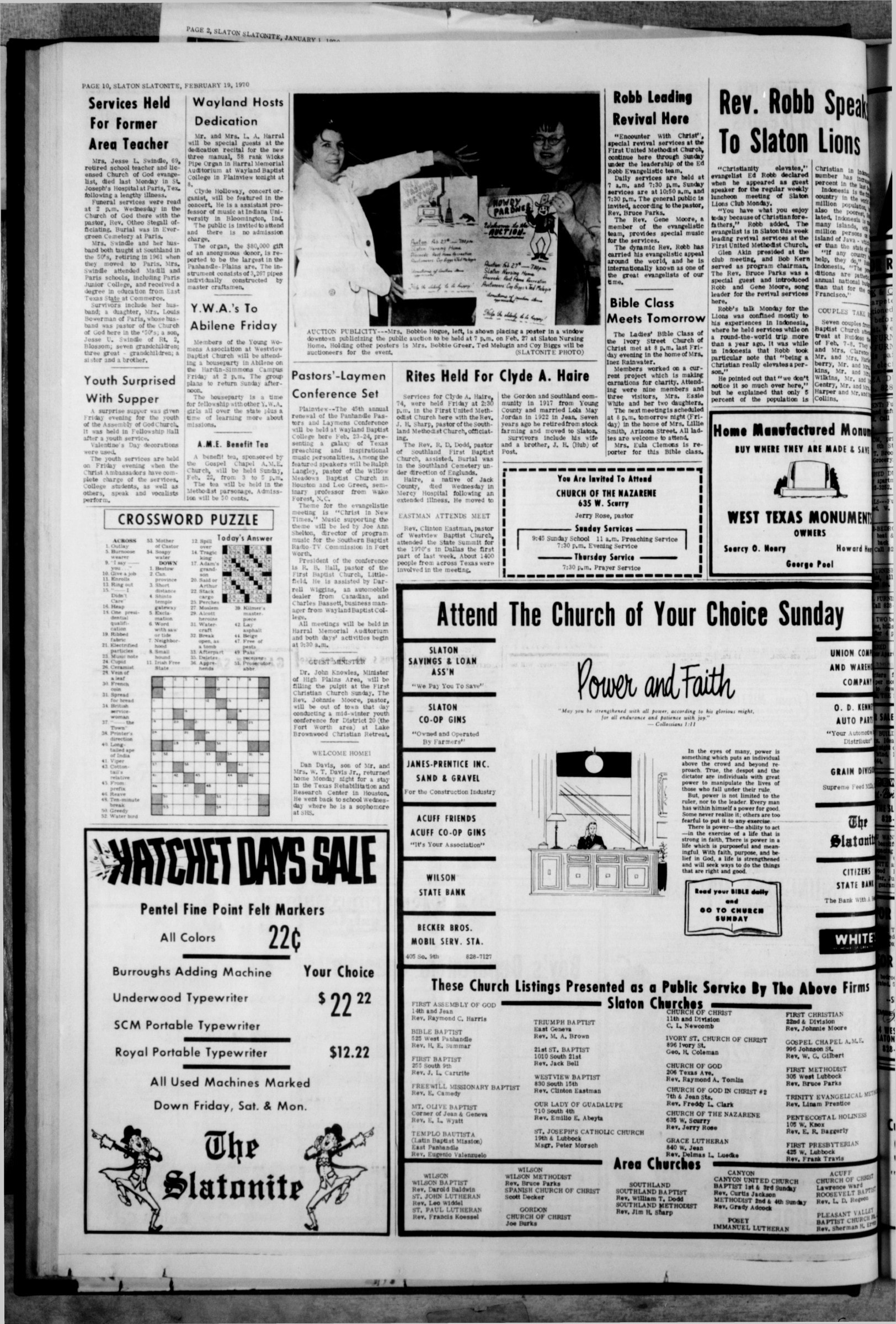
Complete source page; PDF page 10.
Open the complete Slaton Slatonite PDF
The sale advertisement offers Pentel fine-point felt markers in all colors for 22 cents. The surrounding merchandise includes used typewriters and other office goods, with The Slatonite identified as the seller.
Twenty-two cents does not make the most glamorous chapter in a design history. It does make a very clear invitation to buy. There is room in this story for an ad whose chief argument is that the price is hard to resist.
The price belongs to this seller and this sale. What matters to the larger story is the role the item plays: an inexpensive, colorful reason to look at the advertisement and perhaps visit the shop.
By now the brand can appear in a technical explanation, a business-status pitch, or a blunt bargain. That variety will grow in the 1970s, when the people making Pentel’s advertising begin to come into sharper view.
3. People, personality, and a very crowded pen rack
April 1970: television enters the documentary record
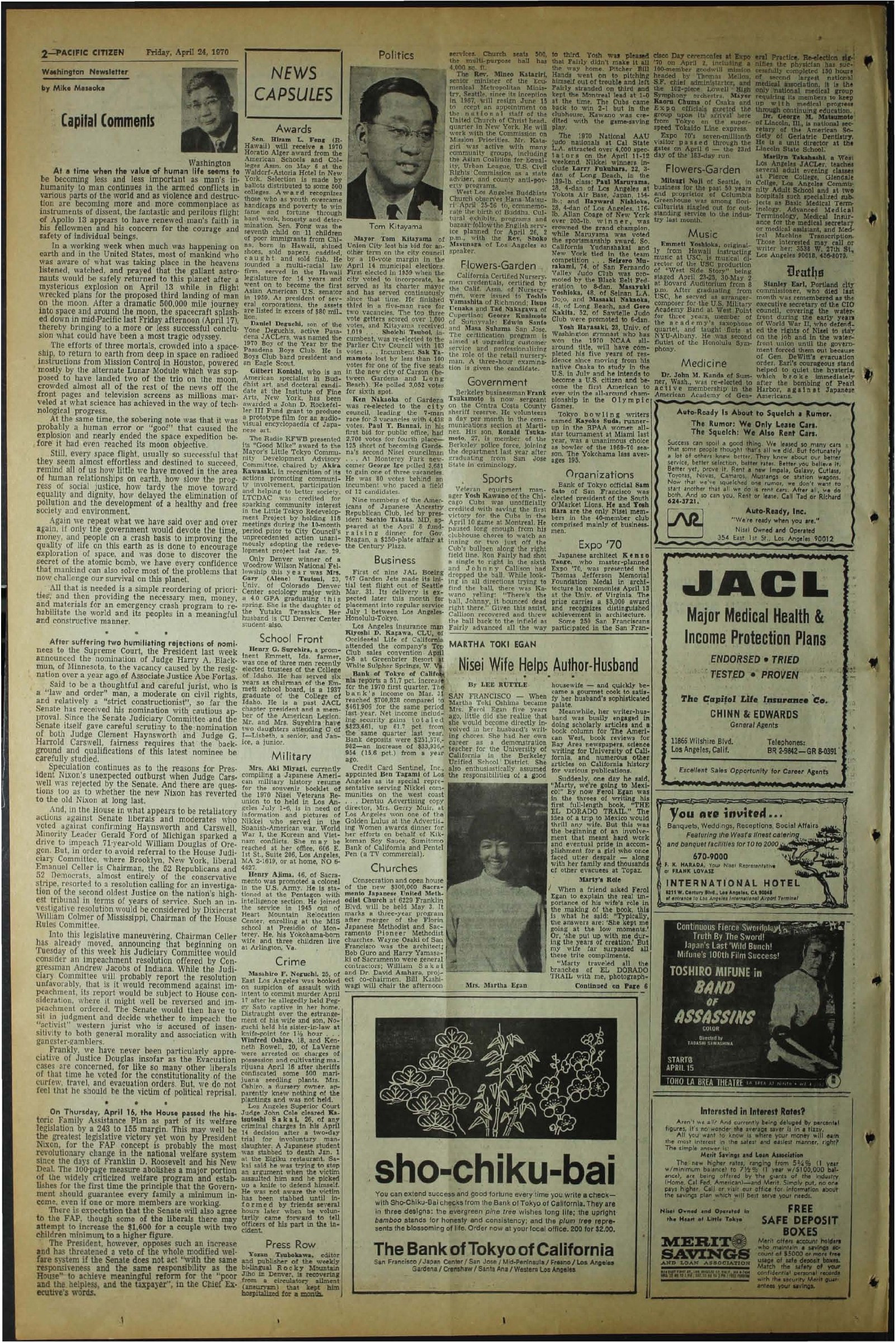
Pacific Citizen, April 24, 1970, page 2. Contemporary report mentioning a Pentel Pen television commercial in connection with Dentsu advertising work and Golden Lulu recognition.
Open the complete Pacific Citizen PDF
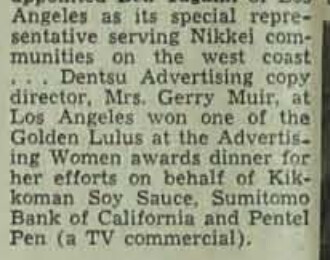
Close-up of the Dentsu item in the Business column; the name and credit are visible in the original scan.
Here we can recover another creator’s name. The newspaper identifies Gerry Muir, Dentsu Advertising’s copy director in Los Angeles, as receiving a Golden Lulu at an Advertising Women awards dinner for work involving Kikkoman Soy Sauce, Sumitomo Bank of California, and Pentel Pen, the last specifically identified as a television commercial.
A copywriter’s name is a welcome find in a history usually told through products. Muir’s credit puts a person and an agency behind Pentel’s television work by 1970.
Source Note
The short report groups several clients. It does not establish the Pentel film’s title, script, schedule, or exact award category. Those remain leads for a surviving reel or production file.
1971: Archie Boston tells Pentel what to do
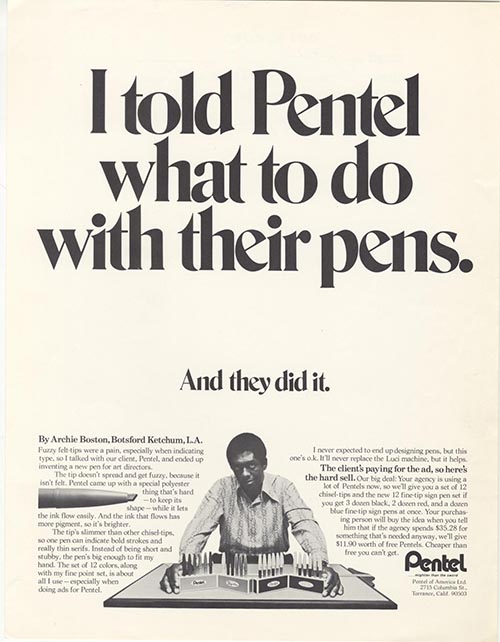
Archie Boston’s Pentel advertisement, preserved by Duke University. The archive dates the object July 28, 1971; that date is not independently established here as a magazine insertion date. Agency: Botsford & Ketchum, Los Angeles. The available web image is relatively small.
View Duke’s archival record · Open Duke’s image
The headline is wonderfully direct: “I told Pentel what to do with their pens. And they did it.”
The point of the ad is a working artist’s judgment. Boston is presented as somebody with a specific need, and Pentel as a maker willing to listen. The copy connects the point to rendering type. For a commercial artist, that is a recognizable task and a practical reason to pay attention.
The first-person approach gives the ad a personality that a list of specifications cannot. Yet it remains a selling document, with a multiple-dozen purchase offer and premium sets. Creative credibility and an order incentive occupy the same page.
Look at the difference from the executive ad. There, a pen helps you imagine being a certain sort of person. Here, a professional tells you what he needs the pen to do. Boston’s authority comes from the work, and the maker’s credibility comes from responding to it.
August 1971: a pencil for the computer programmer
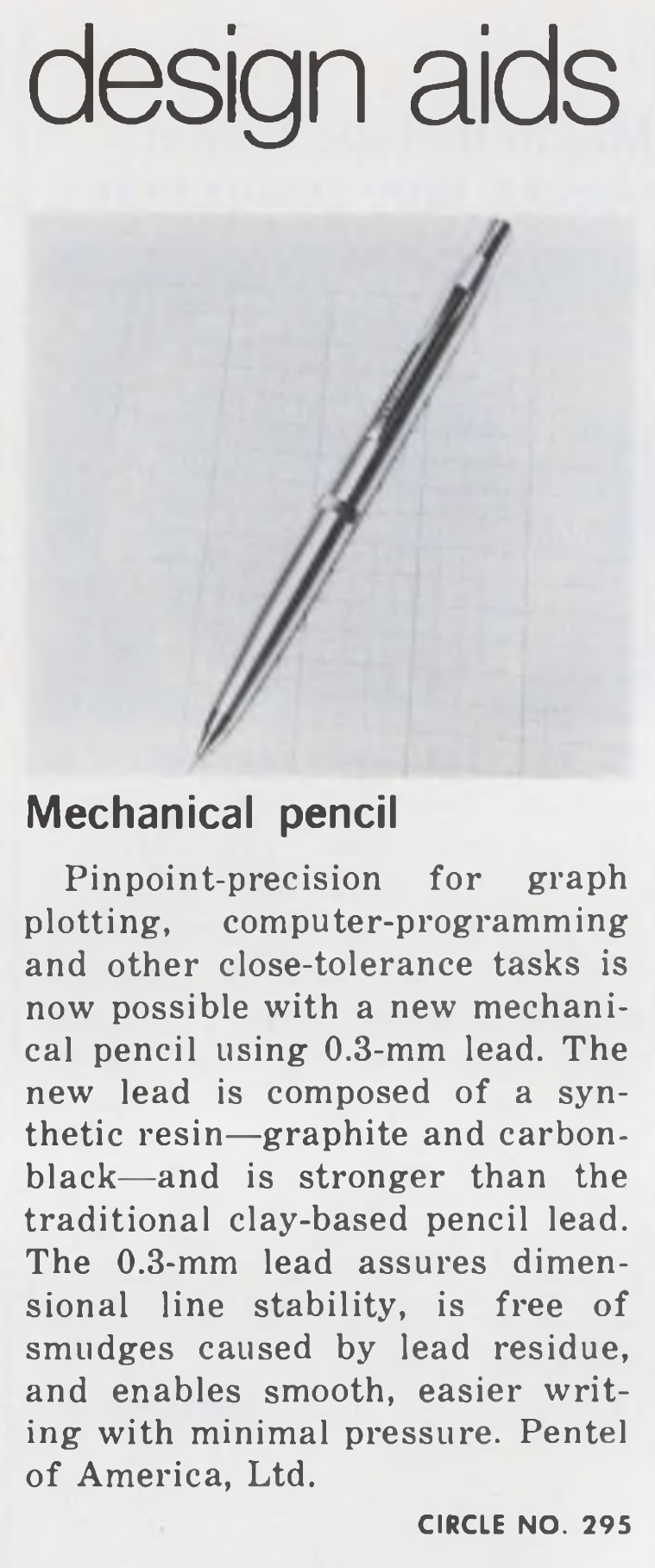
Electronic Design, August 5, 1971, printed p74, PDF p76. Product notice in “design aids,” rather than a verified paid advertisement. Complete issue PDF.
An electronics engineer turns the page past switches and keytops and finds a mechanical pencil. That placement makes perfect sense once you read the jobs assigned to it: graph plotting, computer programming, and other close-tolerance tasks.
The notice identifies Pentel of America and 0.3 mm lead. It explains the lead through its materials, a synthetic resin with graphite and carbon black, and presents strength, a consistent line, and writing with little pressure as advantages. These are the notice’s claims. The pencil is pictured, but its model number and price are not supplied.
There is something especially pleasing about finding a pencil in the computer story this early. In 1971, “computer programming” could still help sell a physical point that made a very fine mark. Pentel was finding uses for precision wherever people worked with information, including on the pages surrounding electronic components.
The little reader-service number 295 is part of the selling machinery too. A reader interested in that pencil had a route to ask for more information. Even this small product notice connects a technical promise with a possible next step.
October 1971: meet us at booth 57
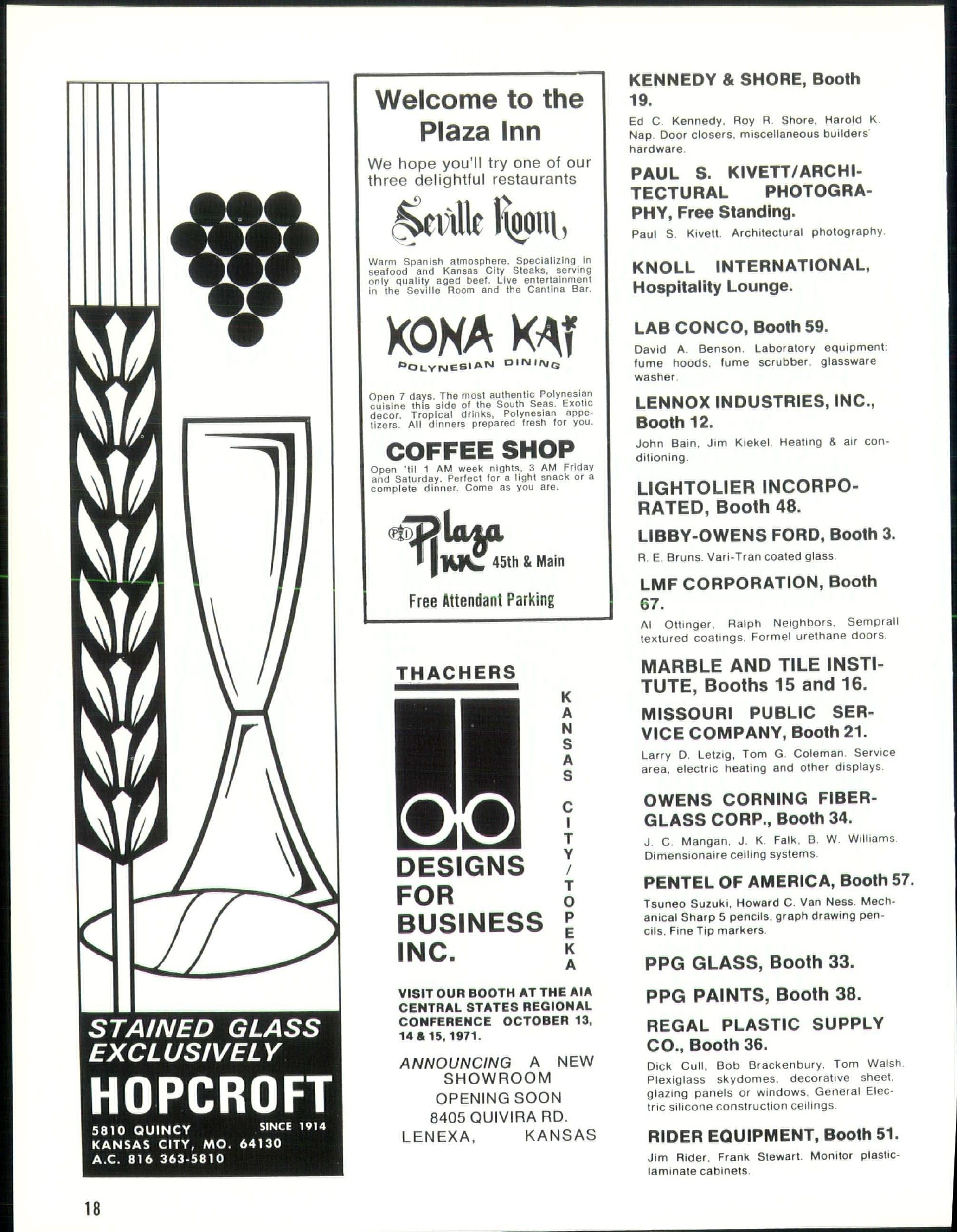
Exhibitor listing in the 1971 AIA Central States regional-conference material. Pentel of America is listed at booth 57. PDF page 18.
Open the conference-publication PDF (complete document in 2 parts: part 1, PDF pp1–34; part 2, PDF pp35–46)
Advertising eventually has to leave the page and talk to somebody. At booth 57, the professional market gets names and a place to meet. The October 13–15 conference material identifies Pentel of America, lists Tsuneo Suzuki and Howard C. Van Ness, and mentions mechanical Sharp 5 and graph pencils and fine-tip markers.
A magazine gives Pentel room to explain a tool; a conference gives it a place to meet the people who might use it. Suzuki and Van Ness make that selling effort human. The listing records the booth and products, although it leaves the conversations, demonstrations, and resulting orders to our imagination.
A skull, a bull, and a bobby walk into a stationery shop
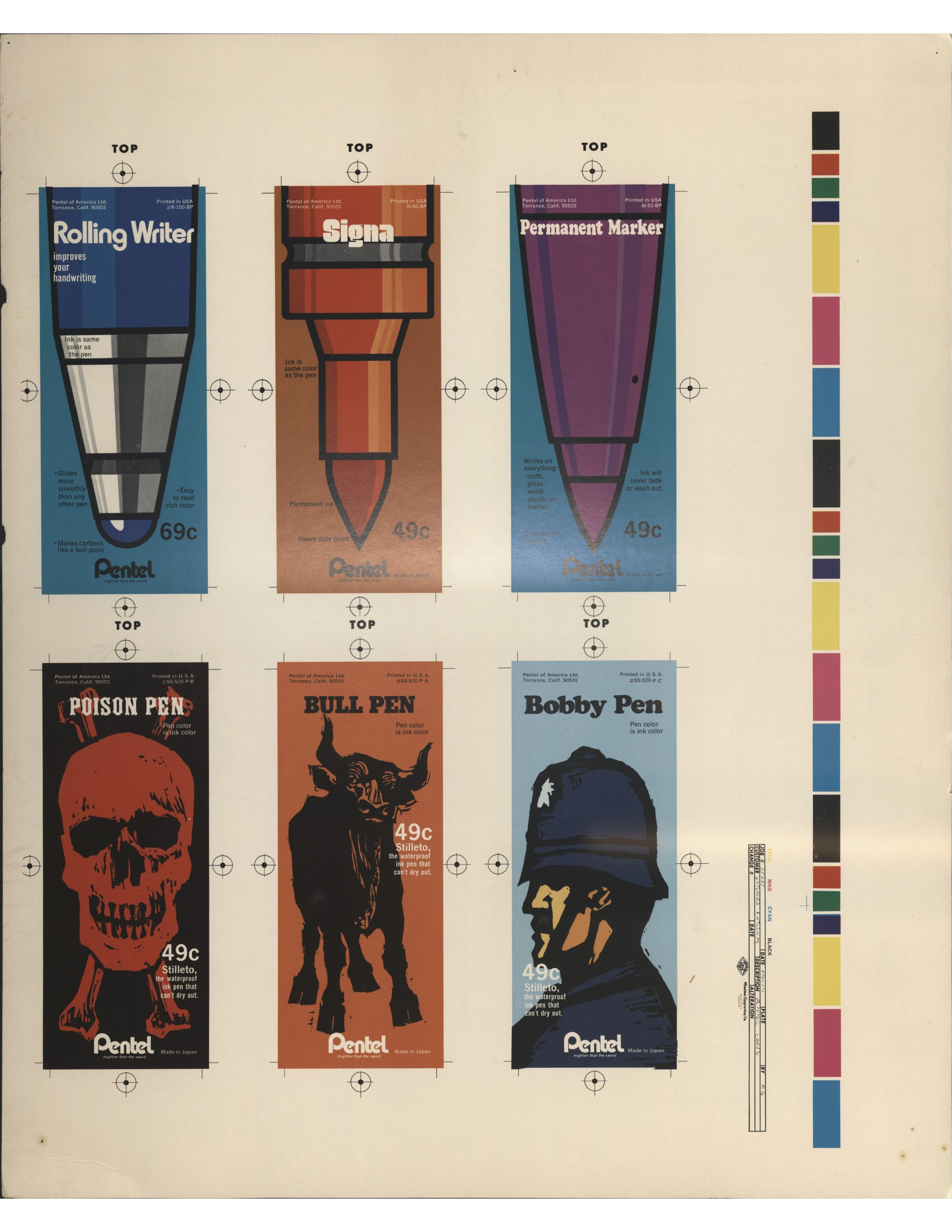
Pentel packaging proofs from the Archie Boston Papers at Duke University, attributed to Botsford & Ketchum. Undated. First sheet of the PDF; proof artwork, not proof of retail release.
Open the complete packaging-proof PDF · Duke archival description
Then the pens develop a sense of mischief. This proof sheet pairs three oversized pen-point designs with a skull, a bull, and a British policeman. Six packages, six chances to make somebody stop at the rack.
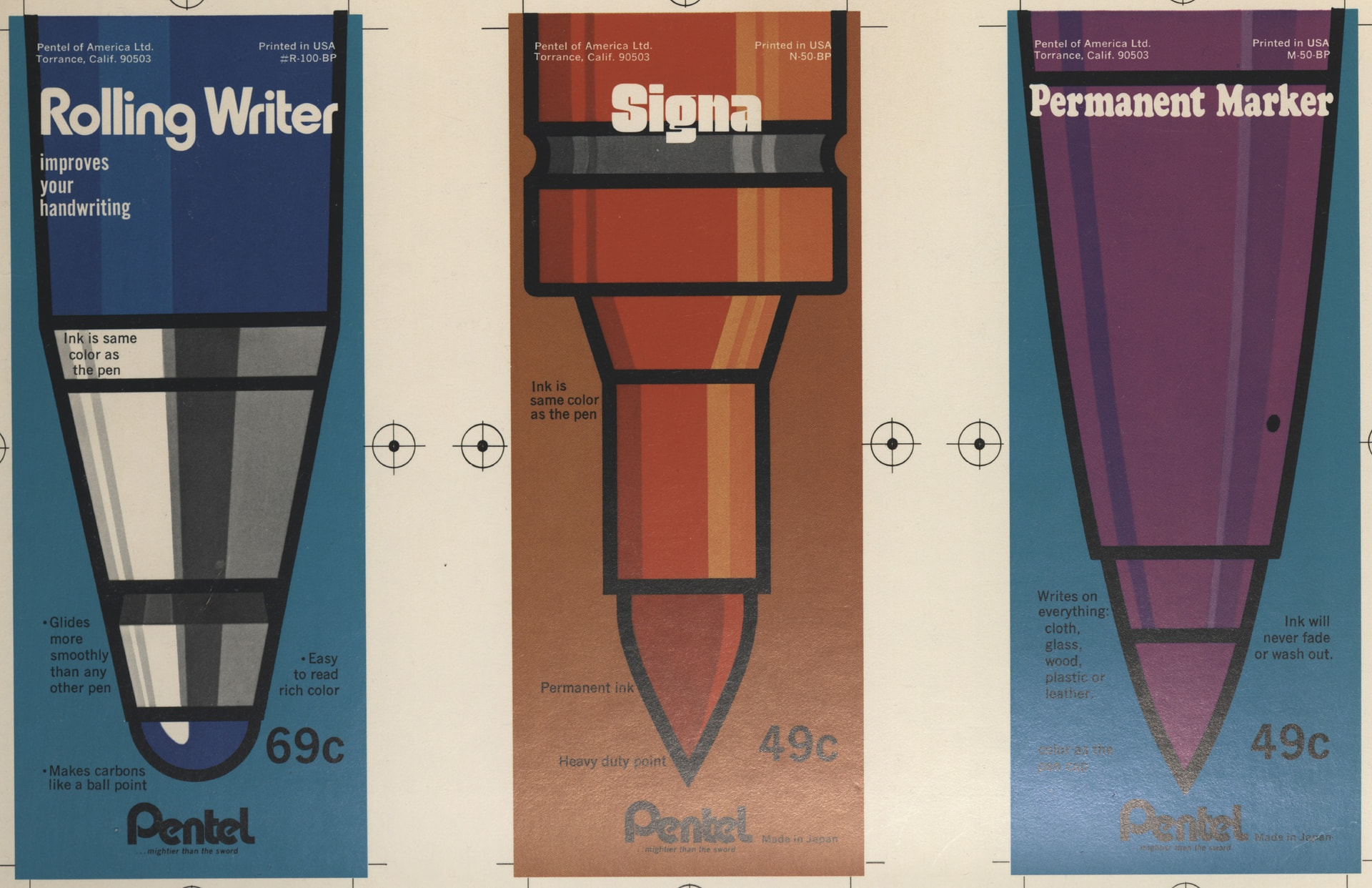
Close-up: Rolling Writer at 69 cents; Signa and Permanent Marker at 49 cents. Undated Duke proof sheet, not a dated shop display.
The top row makes the package a giant version of the thing inside. From a distance, you can read the shape before you read the copy. Blue, orange, and purple give each product its own territory. The Rolling Writer gets an extra little assignment: improve the customer’s handwriting. An ambitious job for 69 cents.

Poison Pen: skull-and-crossbones artwork, 49 cents. Detail from the same undated proof. The name and artwork are advertising wordplay, not a statement about the ink’s chemistry.
Then there is the Poison Pen. Other stationery promises efficiency; this one appears ready to write a strongly worded letter from a haunted house. The joke is immediate, and the skull does a remarkable amount of work before the shopper reads anything smaller than the name.
Look closer and the practical product description is still there. The theater gets your attention; the copy has to bring you back to the pen. That combination is what makes the design worth more than a passing chuckle.
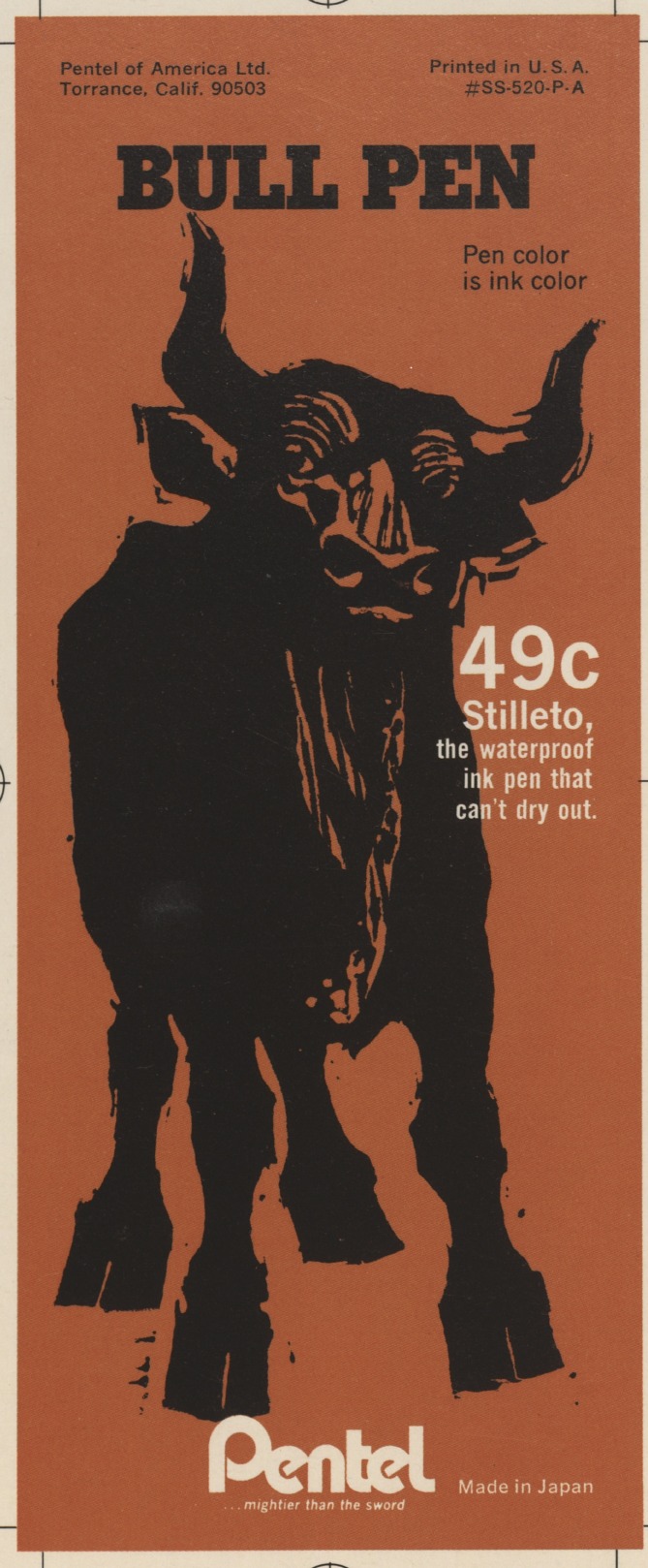
Bull Pen: another 49-cent design from the proof sheet. Same source, a very different personality.
The Bull Pen makes its pun with a black animal against an orange background. It is hard to imagine the brief calling for a package that would disappear politely on the shelf. The product is small; its personality is not.
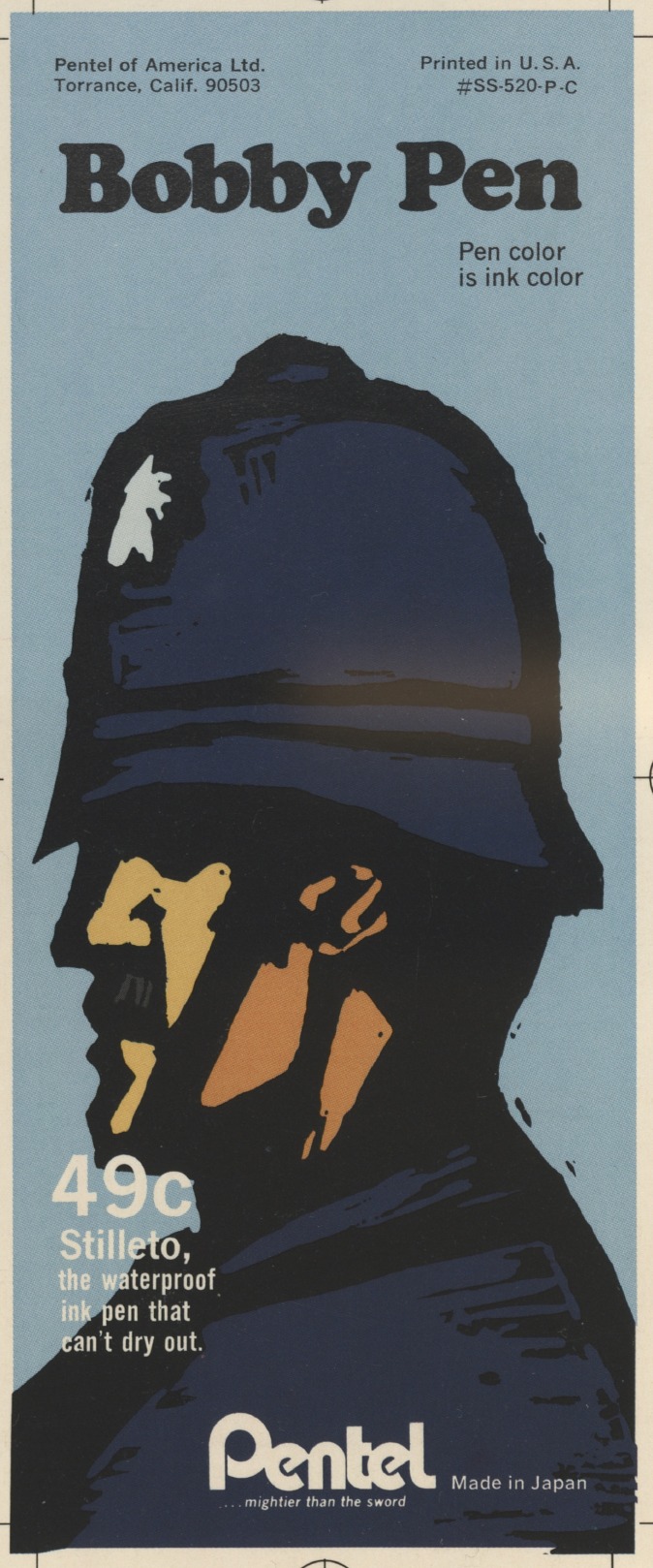
Bobby Pen: policeman artwork and another 49-cent price. Proof artwork; retail release remains unverified.
The Bobby Pen brings a British policeman to an American pen package. It is a visual joke you can get while walking past. Put the three together and the package becomes a tiny poster: a name, an image, a price, and enough personality to stick in the mind.
For a collector, this is dangerous territory. You arrive looking for a model number and leave wanting the cardboard.
The production details are part of the fun. Registration marks, crop marks, and the color strip survive on the full sheet. They let us see the work before it becomes a tidy retail object. Duke preserves it in the Archie Boston Papers and attributes it to Botsford & Ketchum; that supports the agency context, without proving who drew every element.
Source Note
These undated proofs show proposed packaging, with retail release unverified. The close-ups come from the one complete sheet linked above. A dated catalog or a surviving package with provenance could help carry these characters from the proof room to the checkout counter.
4. From drawing boards to the airwaves
March 1973: a 69-cent Rolling Writer in an office-supply ad
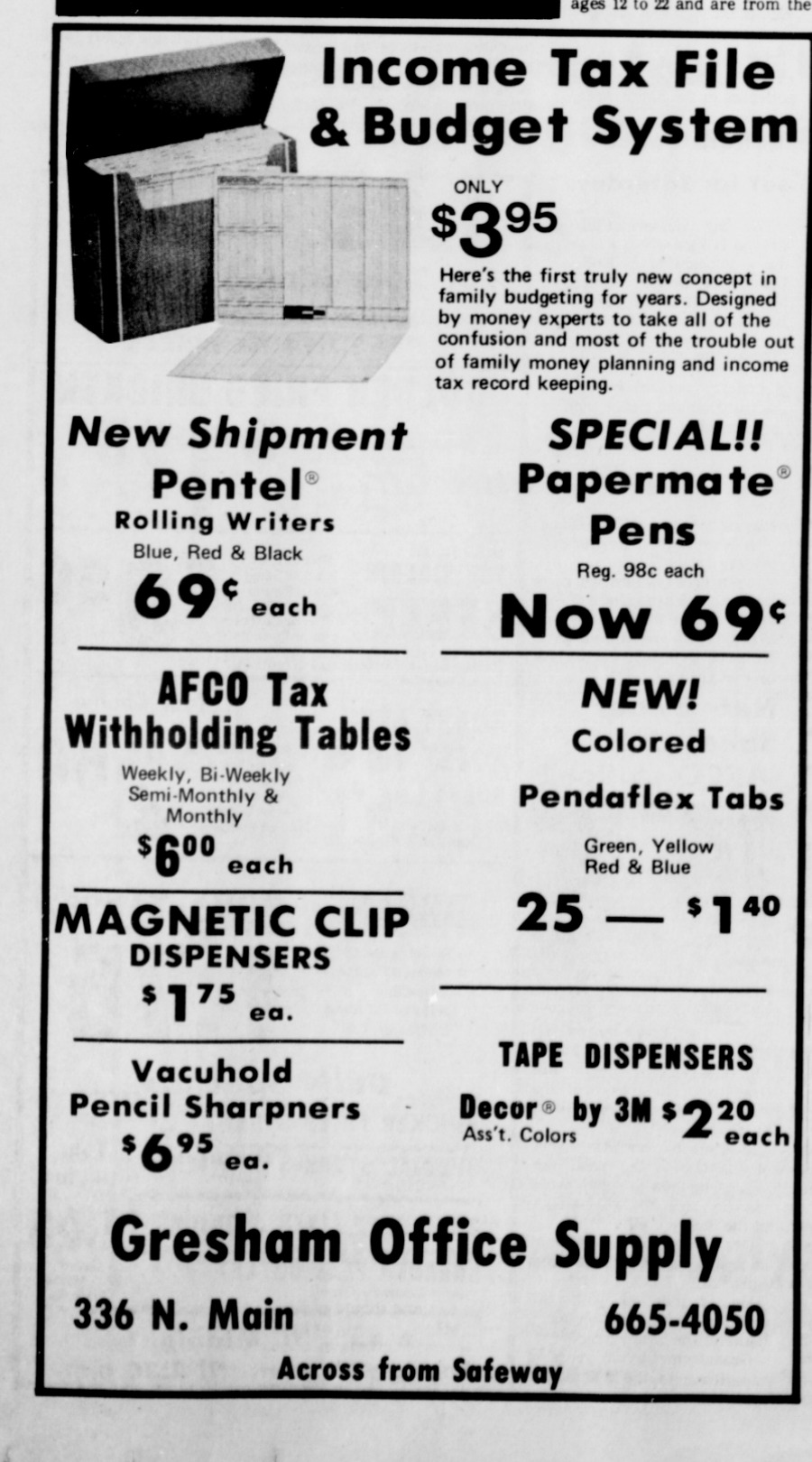
Gresham Office Supply advertisement, Sandy Post, March 15, 1973, section 2, page 2. Retailer advertisement.
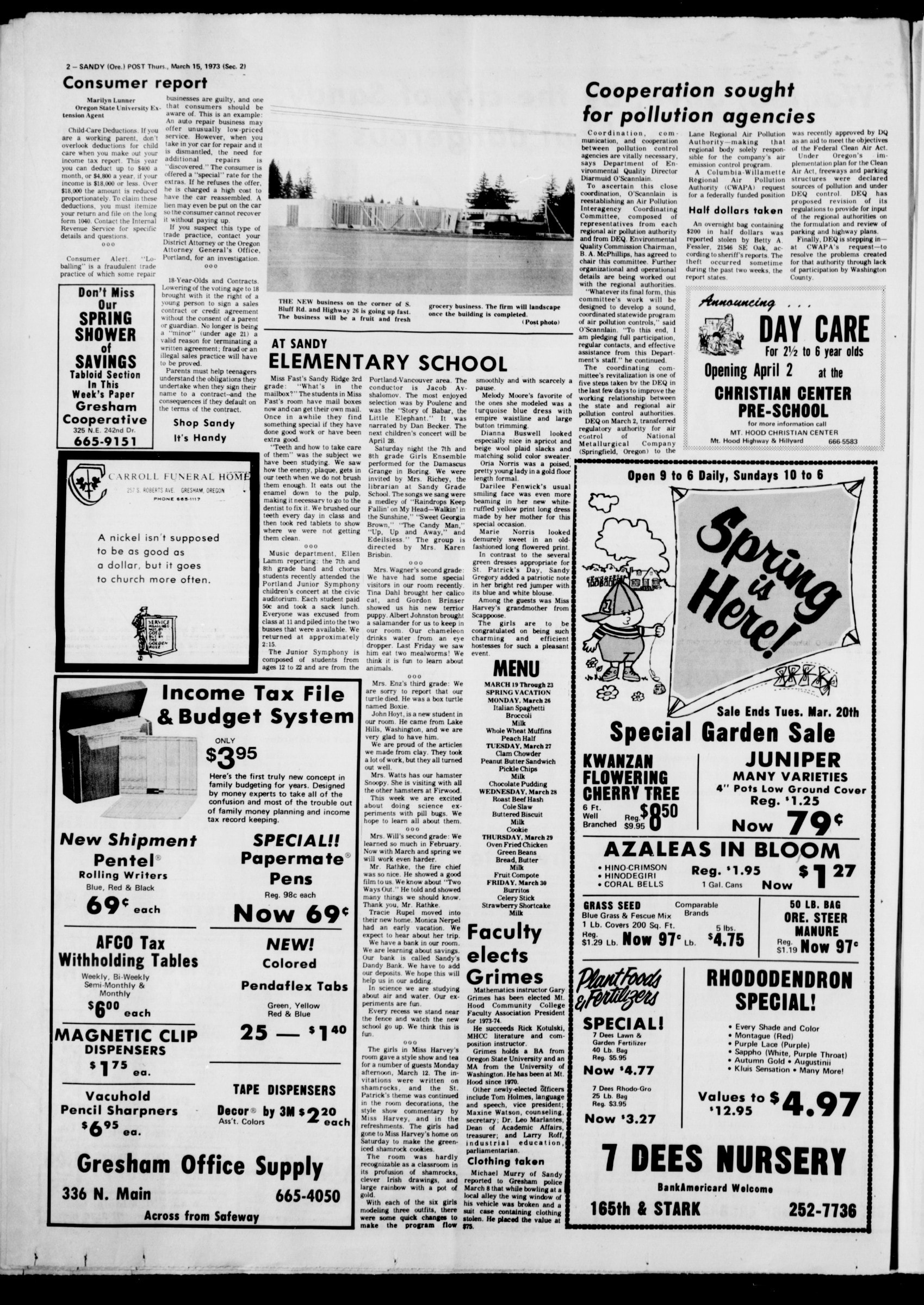
Complete archived newspaper page. This repository’s PDF contains this individual page, not the entire issue.
Open the complete archived-page PDF
Here is the reassuringly ordinary middle of the story: the pens have arrived, and a shop would like to sell you one. The retailer announces a new shipment of Rolling Writers in blue, red, and black at 69 cents. The same advertisement includes other office merchandise and a separate Papermate offer.
In the store’s language, the important news is availability: new stock, three colors, 69 cents. The price matches the Rolling Writer on the undated proof sheet, although that coincidence cannot date the artwork. Here we can attach the offer to a real seller and a day on the calendar.
June 1974: film stars, but hold the popcorn
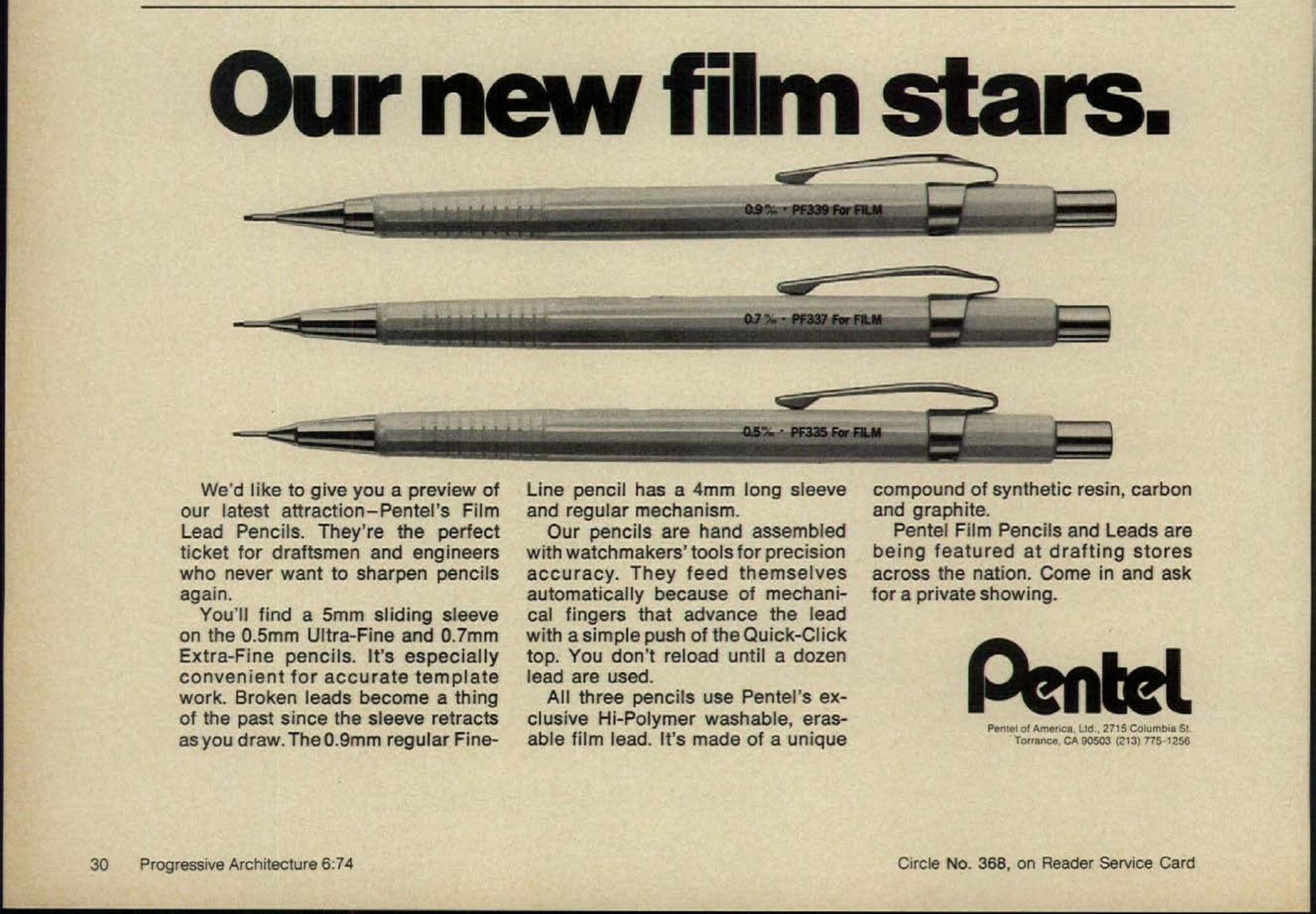
Pentel of America advertisement, Progressive Architecture, June 1974, printed page 30.
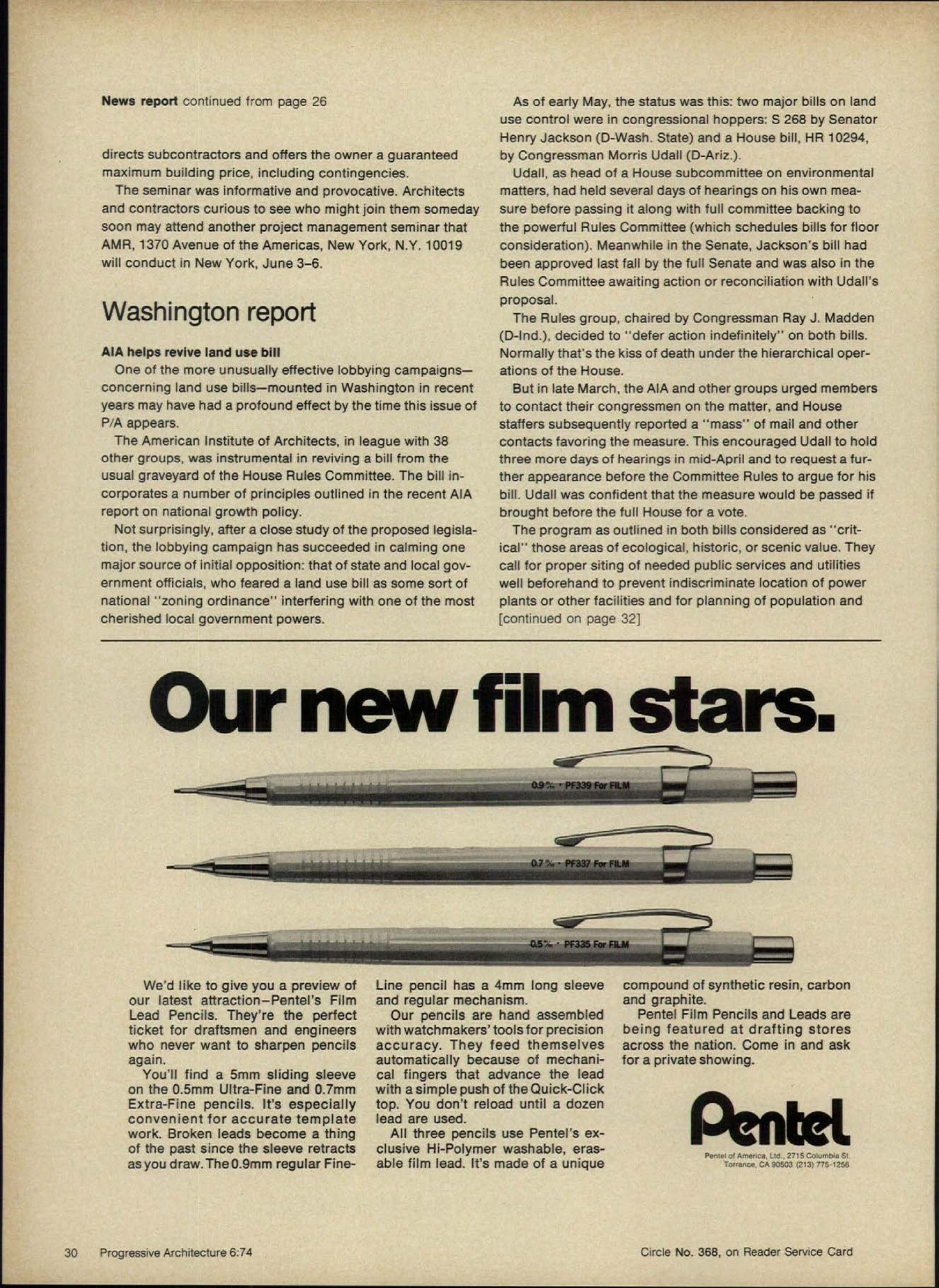
Complete source page; PDF page 26.
Open the June 1974 issue PDF (complete document in 5 parts: part 1, PDF pp1–33; part 2, PDF pp34–66; part 3, PDF pp67–99; part 4, PDF pp100–132; part 5, PDF pp133–144)
No red carpet is required. The “film” here is a drawing surface, and the stars have lead diameters. The wordplay introduces PF339, PF337, and PF335, in 0.9, 0.7, and 0.5 mm. The advertised lead and pencil features are presented as answers to technical drafting requirements.
The copy distinguishes the sleeve arrangements: a 5 mm sliding sleeve for the 0.5 and 0.7 mm versions, and a 4 mm sleeve and regular mechanism for the 0.9 mm version. It discusses erasability and washability on film and describes the lead’s materials. These are contemporary advertising claims, not results from a new test of surviving pencils.
The headline gets the smile; the sleeve dimensions earn the next minute of attention. That combination is well suited to a reader who may enjoy a joke and still need to know exactly how the pencil will behave on a drawing surface.
For collectors, this is where an old advertisement repays a slow reading. PF339, PF337, and PF335 become choices within an advertised working system, with different diameters and sleeve arrangements. The features we inspect today were once answers to a buyer’s immediate question: will this do the job?
1976: sixty seconds to sell a rolling ball
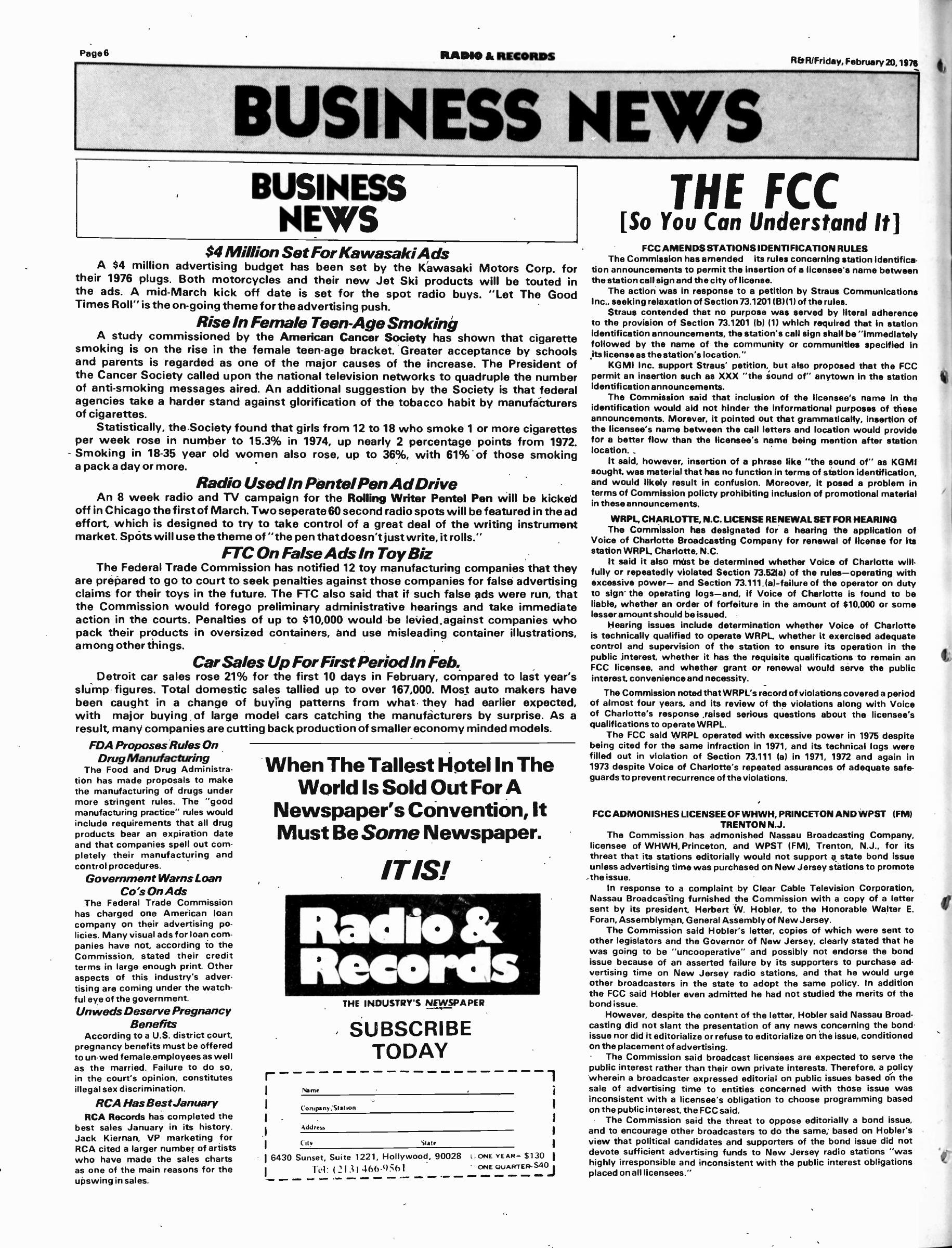
Radio & Records, February 20, 1976, printed and PDF page 6. The Pentel report is in the left column, below the smoking item.
Open the Radio & Records PDF (complete document in 2 parts: part 1, PDF pp1–30; part 2, PDF pp31–48)
A contemporary report announces an eight-week radio and television campaign for the Rolling Writer, beginning in Chicago on March 1. It specifies two separate 60-second radio spots and a message built around the distinction between merely writing and rolling.
On radio, Pentel has to make the benefit travel without a picture. A listener cannot study a sleeve diagram or admire a line sample. “Rolling” supplies both an action and a word to remember at the counter. The product’s name can carry part of its explanation.
The report describes an ambition to win more of the writing-instrument market.
Source Note
The report supplies a campaign plan, but no results or Pentel budget. The $4 million figure elsewhere on the page belongs to Kawasaki.
The autumn plan gives us another part of the campaign: the intended viewer.
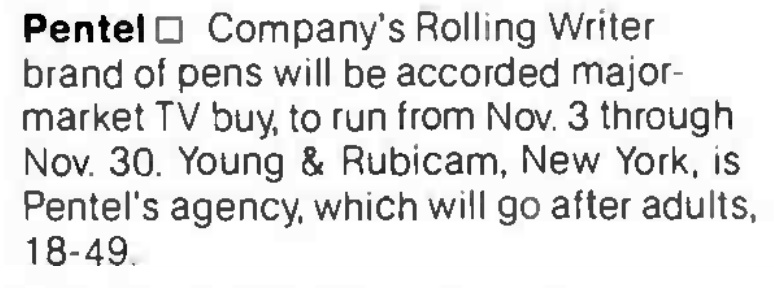
Broadcasting, September 6, 1976, p9. Pentel’s own paragraph, separated here from unrelated advertisers on the page. Complete issue PDF.
For November 3–30, Broadcasting reports a major-market television buy for the Rolling Writer, through Young & Rubicam, New York, aimed at adults aged 18–49. That is a targeting statement we can actually quote from a contemporary source. The earlier Chicago radio/TV report and this November plan describe separate campaign details; neither provides a complete annual schedule.
Together they show a product being given more than one push during the year. Pentel had a memorable name and a benefit to explain. The agency had to put them in front of people likely to buy a pen.
August 1977: the school-supply list gets a television special

Radio & Records, August 19, 1977, p4. The report explicitly includes automatic pencils alongside pens. Complete issue PDF (complete document in 2 parts: part 1, PDF pp1–39; part 2, PDF pp40–56).
Buy your notebooks. Find your class schedule. Turn on David Soul & Friends.
In the summer of 1977, Pentel’s back-to-school plans reached ABC television. A July 1 Radio & Records report announced Pentel of America’s sponsorship of an hour-long David Soul special, produced by Dick Clark, as the opening of what the report called the company’s largest back-to-school campaign to date. It named August 18 as the broadcast date and listed Donna Summer and England Dan & John Ford Coley as planned guests. Those are the announcement’s bookings, rather than a reconstruction of the finished program. July announcement, p4 (complete document in 2 parts: part 1, PDF pp1–39; part 2, PDF pp40–52)
The August item makes the product connection wonderfully plain: pens and automatic pencils, with radio supporting television and print. This was a coordinated school-season campaign that used a named entertainment event to help launch it. The pencil had acquired an appointment with the television audience.
Record World adds another useful detail: Dr Pepper and Pentel were the special’s sponsors. Pentel therefore shared the sponsorship; the surviving reports do not establish sole sponsorship or a personal product endorsement by Soul. The record label’s separate promotional plans also belong to the label, not to Pentel’s advertising budget. Record World, August 20, 1977, PDF p18 (complete document in 2 parts: part 1, PDF pp1–53; part 2, PDF pp54–66)
From an architect’s trade magazine to a network variety special is quite a journey for a pencil. The two approaches could coexist: explain the mechanism where detail matters, and make the brand familiar before the school-shopping trip begins.
December 1978: the pen goes on a very narrow stage
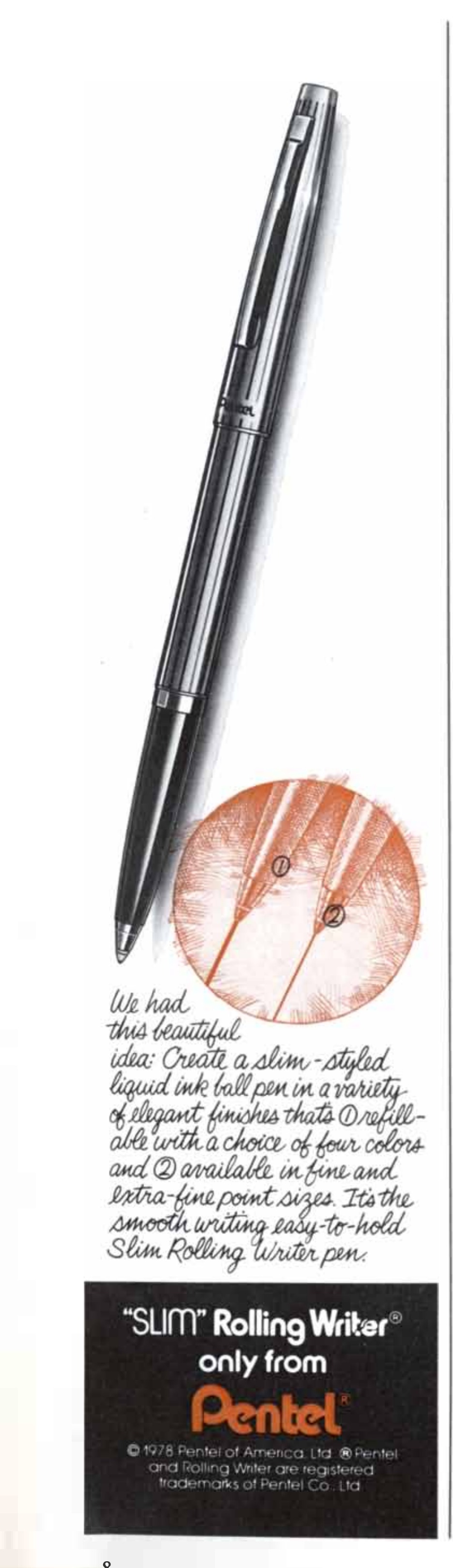
Pentel of America Slim Rolling Writer advertisement, Scientific American, December 1978, volume 239, number 6, printed page 8.
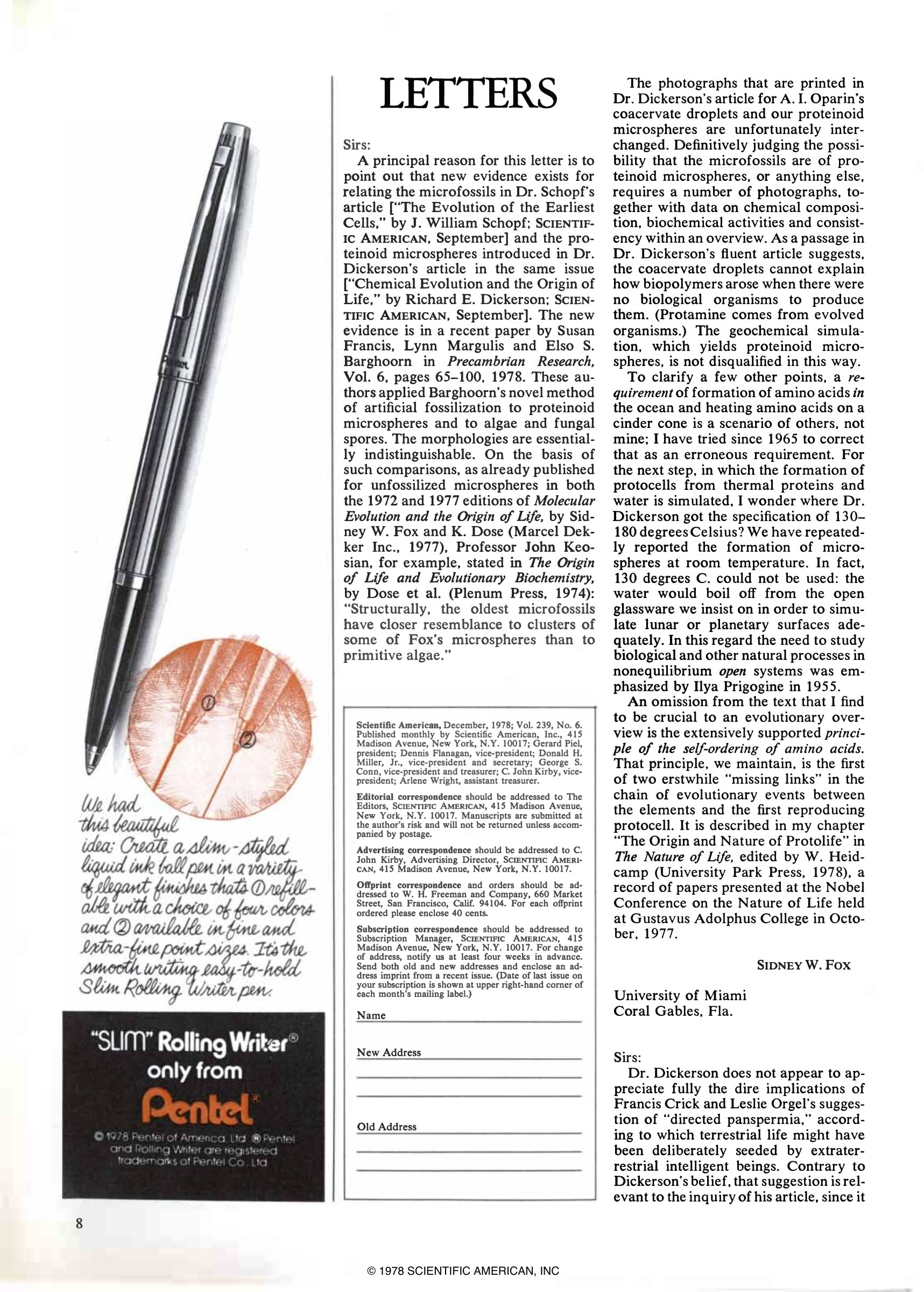
Complete page; PDF page 10. The adjacent masthead identifies the issue. The PDF is hosted by a third-party issue mirror.
Open the December 1978 issue PDF (complete document in 3 parts: part 1, PDF pp1–81; part 2, PDF pp82–162; part 3, PDF pp163–208)
The Slim Rolling Writer gets a column almost as skinny as its sales proposition. The narrow advertisement presents the Slim Rolling Writer as a slender, refillable pen, with choices of finish, four ink colors, and fine or extra-fine points.
Placed next to the magazine’s masthead, the advertisement has a compact space in which to communicate the product’s form and range. The long pen image and narrow column reinforce one another: the layout itself helps sell slimness.
1979: the credits roll
Young & Rubicam and Duck Soup Producktions

The useful three-line close-up: client, commercial title, agency, and animation company. A small credit can open a surprisingly large door.

Broadcasting, June 25, 1979, printed page 48. Pentel appears in the production listing toward the upper right; PDF page 48.
Open the complete Broadcasting issue PDF
The listing connects Pentel of America and a commercial titled “Evolution” with Young & Rubicam, Los Angeles, and Duck Soup Producktions in art/animation. Its context is the eighth annual U.S. Television Commercials Festival, introduced on printed page 46, with the Pentel entry under Production technique on page 48. This is an awards-related credit, not just an unlabelled studio directory.
For me, this is where the paper trail connects with one of the objects that made this subject so fascinating. A dated trade publication puts Pentel of America and Duck Soup Producktions together on a named commercial. That independently documents the client–studio relationship that makes my cel especially interesting.
Source Note
The dated credit establishes the Pentel–Duck Soup relationship, but does not identify my particular cel as part of “Evolution.” A matching scene in an identified print, a production number, or studio paperwork would settle that question.
The small credit gives us a remarkable amount to work with: festival, category, client, title, agency, and studio. It supplies neither an individual animator nor a gold or silver ranking. Festival heading and context, PDF page 46
This is also a reminder that the finished commercial was a collaboration. Pentel commissioned a piece of selling; an agency and a production company helped give it a performance. To match that performance to a surviving film, we still need a reel or production record with the same credits.
The music: Bob Thompson and the Rolling Writer
Animation also has a soundtrack, and one useful account comes from Spenser Thompson, writing about his father, composer and arranger Bob Thompson. He identifies a Rolling Writer commercial as a late-1970s assignment and specifically describes a 1979 example accompanied by a string quartet. This is a family recollection, not a contemporary production ledger. Spenser Thompson’s account
A string quartet is a lovely detail to recover in the life of a pen. Somebody had to decide how it should sound, and somebody had to fit that sound into the available seconds. Music could give the name a rhythm and the object a personality that a catalog illustration could never supply.
Thompson’s recollection and the “Evolution” listing remain separate pieces of evidence. An authenticated film or production file would be needed to connect them. For now, they give us two promising routes into the creative work behind Pentel’s screen presence.
There is also a surviving 30-second animated Rolling Writer commercial available to watch:

“Rolling Writer Commercial,” uploaded by layzer80 on June 14, 2014. The uploader dates it to 1979.
Source Note
The video page and animation have been inspected, but the original airdate and production credits have not been independently authenticated. The clip’s date remains provisional, and it has not been identified as “Evolution.”
5. Television ambitions, everyday purchases
1980: please leave the catalog where I can reach it
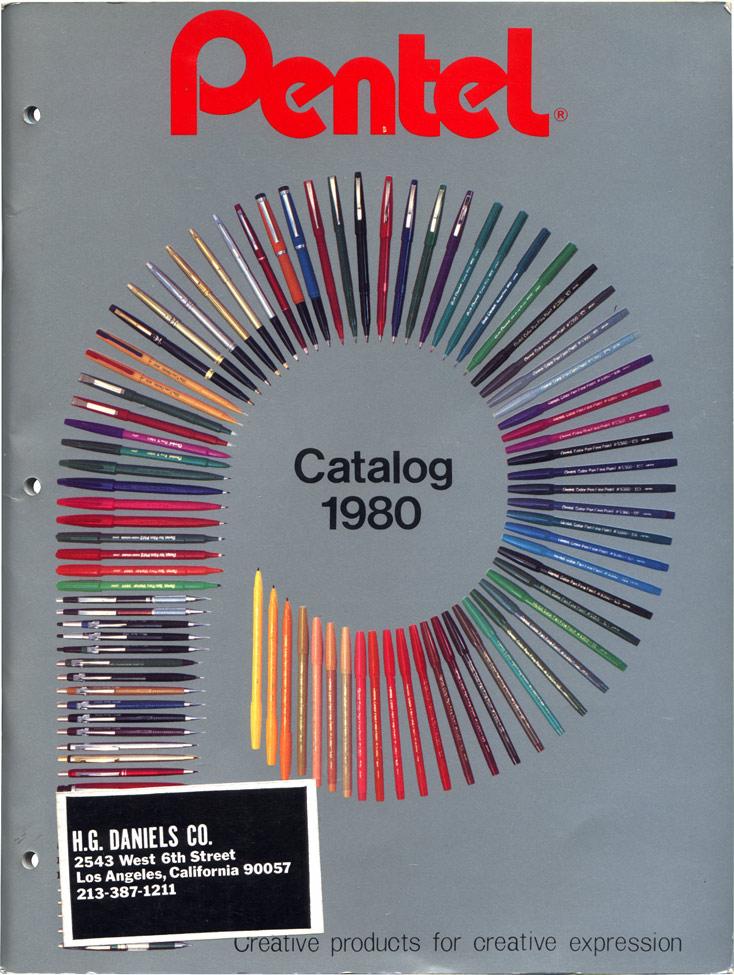
Pentel Catalog 1980, cover. The dealer label identifies H. G. Daniels Co., 2543 West 6th Street, Los Angeles, California. Cover and pages 20–27 survive in scans preserved by Dennis B. Smith’s Leadholder site and the Internet Archive. Archived catalog entry.
If the television commercial gets you into the shop, this is the document that can keep you there.
The cover arranges writing instruments in a colorful circle and promises “Creative products for creative expression.” A Los Angeles dealer’s label gives the copy a local destination. It is manufacturer literature with a shop attached, a particularly satisfying survivor of the journey from company range to something a customer could ask for at a counter.
Only the cover and eight interior pages have been recovered here. They form an unusually rich pencil section, although they are not the complete catalog.
Download the recovered catalog extract: cover and pages 20–27 (2.3 MB; not the complete catalog).
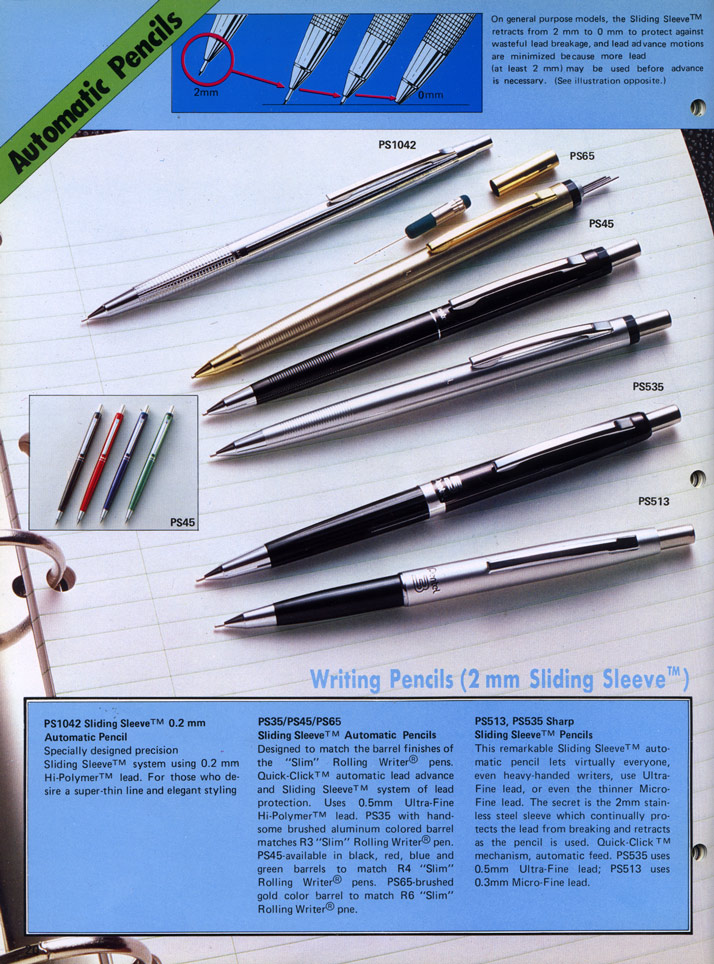
Catalog p20: automatic pencils, sliding sleeves, and finishes coordinated with Slim Rolling Writers.
Start with the PS35, PS45, and PS65. The copy ties their finishes to the Slim Rolling Writer range. Pentel is giving a pen buyer a reason to want a companion pencil, and a pencil buyer a reason to consider a matching pen. The photograph does some of the persuading before the specifications begin.
Then come PS513 and PS535, with 0.3 and 0.5 mm lead respectively. The sleeve and lead sizes let the customer shop for a particular writing experience. The colors and finishes give the practical choice room to become a personal one.
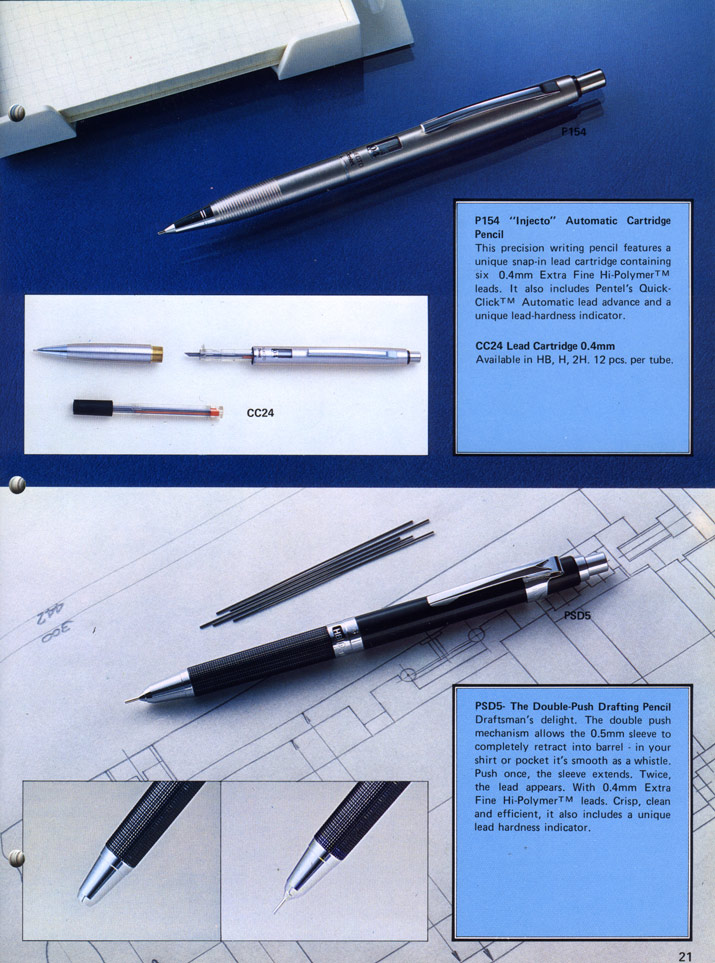
Catalog p21: P154 Injecto and PSD5 Double-Push. The PSD5 description contains conflicting diameter wording; the scan is retained without silently correcting it.
The P154 Injecto turns refilling into a feature in its own right: a snap-in cartridge holding six 0.4 mm leads. Beside it, the PSD5 Double-Push gets an explanation of its retracting mechanism. Pentel could sell the line the pencil made, but it could also sell the satisfying little piece of engineering that got the point ready to work.
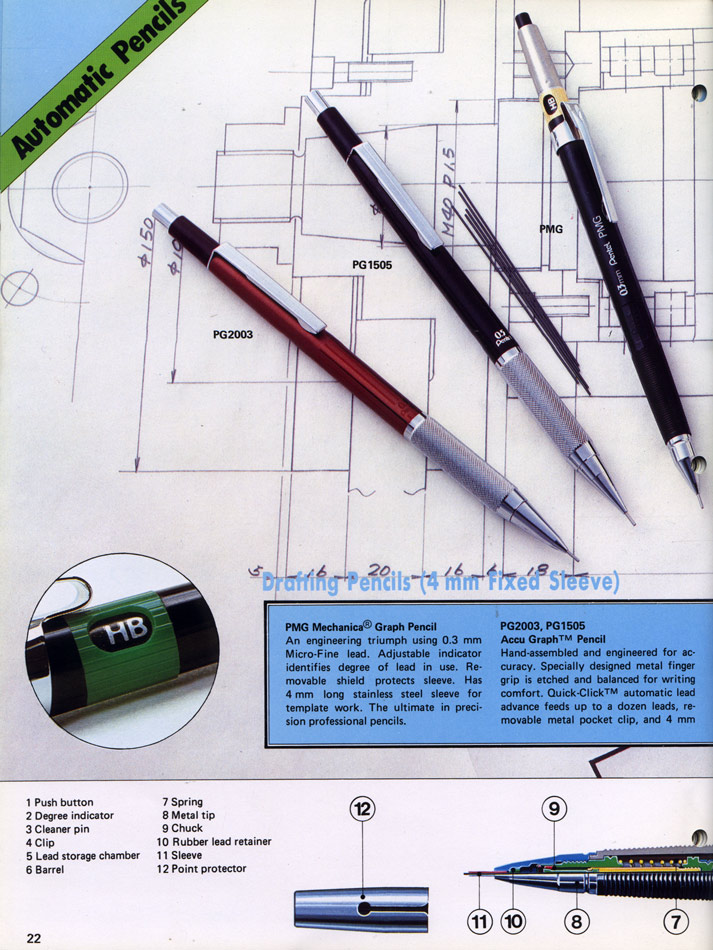
Catalog p22: PMG Mechanica Graph Pencil, PG2003, and PG1505, with a mechanism illustration.
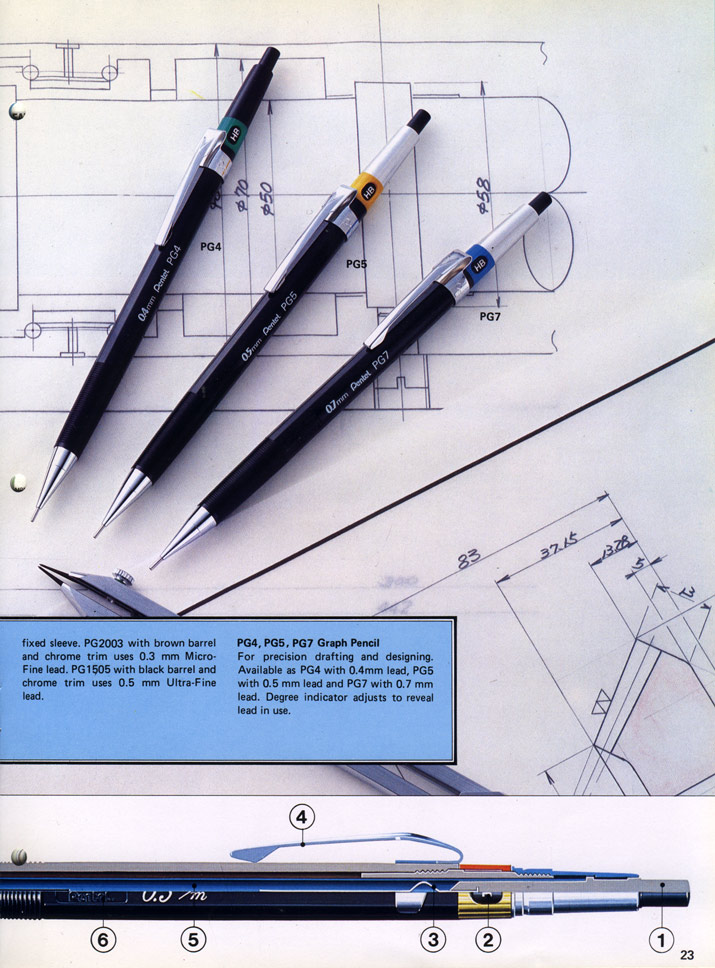
Catalog p23: PG4, PG5, and PG7, continuing the drafting-pencil explanation.
Here is the part where a collector stops turning pages. PMG, PG2003, PG1505, PG4, PG5, PG7: current tools in a sales catalog, with their features still needing to earn their keep. The drawings open up the mechanism and point toward the working end. Precision becomes something the customer can inspect.
There is a difference between telling a buyer that a pencil is good and showing where the claimed advantage lives. These pages repeatedly invite the second kind of attention. It is very much the same conversation Pentel was having with architects in the 1960s, with a larger range spread out on the counter.
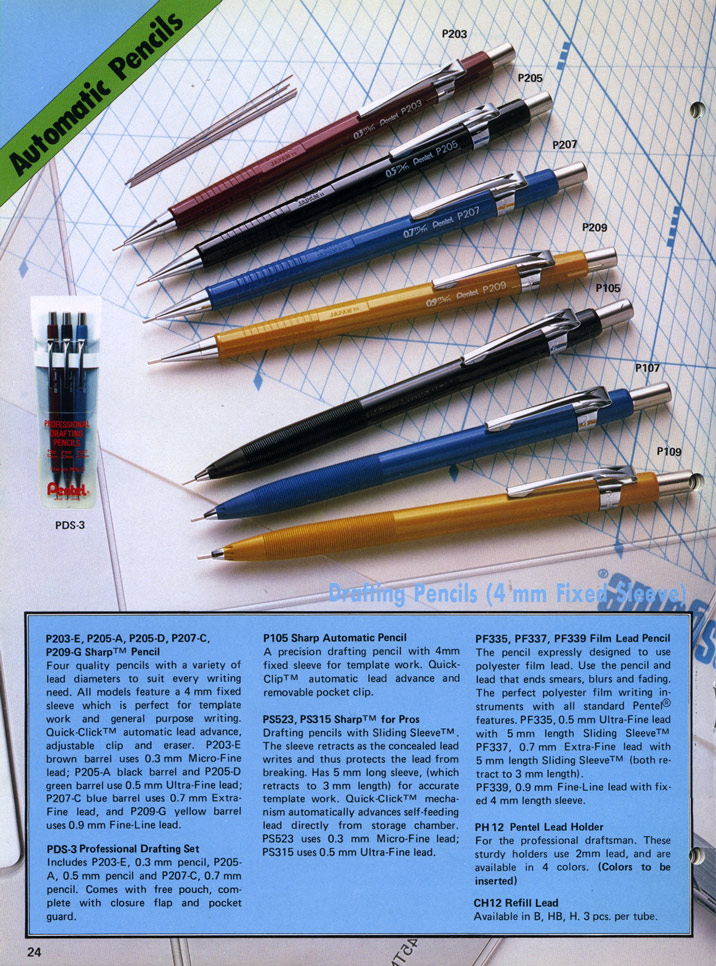
Catalog p24: P200 and P100 ranges, plus the PDS3 drafting set.
This page alone could make a Knockology member miss an appointment. P203 in brown, P205 in black, P207 in blue, and P209 in yellow form a familiar-looking lineup. The text also offers a green P205D. The PDS3 set brings together P203, P205, and P207 with a pouch, making a group of working sizes into one purchase.
The catalog lets us stop guessing about whether this particular range was being presented together in the United States in 1980.
Source Note
A dated catalog establishes the offering shown in that edition, not when each model or color first appeared.
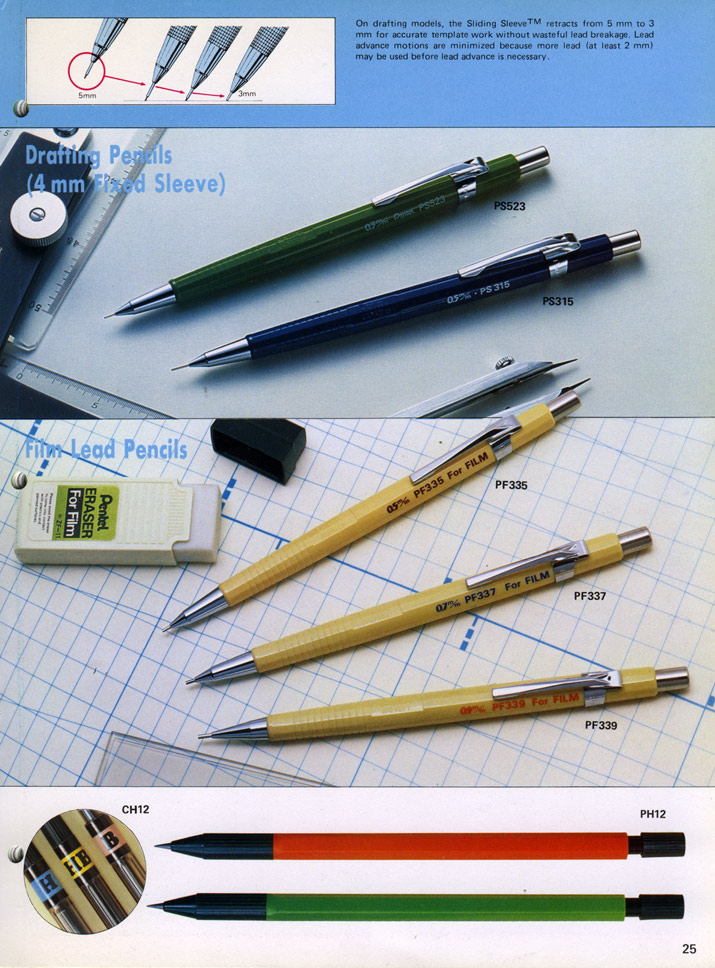
Catalog p25: sliding-sleeve pencils, yellow film pencils, and PH12 2 mm leadholders.
The PF335, PF337, and PF339 return in bright yellow, six years after the film-pencil advertisement above. Alongside them are PS523 and PS315 sliding-sleeve pencils and the PH12 leadholder. The catalog lets Pentel keep several sorts of user in the same family: someone writing, someone drafting, someone working on film, someone who wants a substantial 2 mm lead.
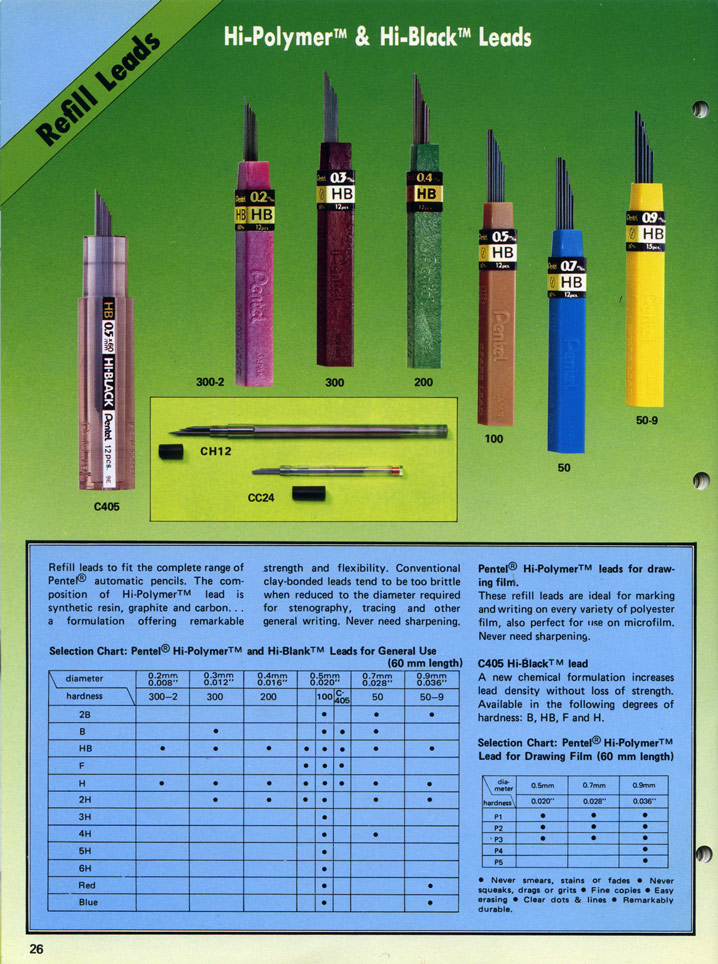
Catalog p26: Hi-Polymer and Hi-Black leads, with diameter and grade choices.
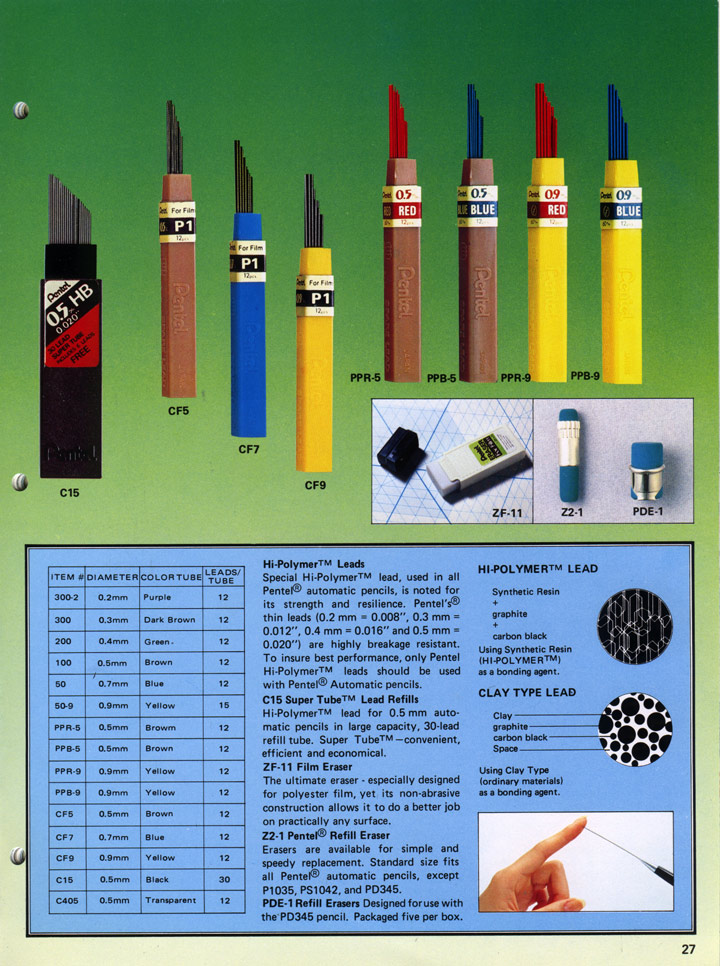
Catalog p27: more refills, erasers, and a diagram explaining the lead. The PDE-1 eraser is associated with PD345 in the text.
Finally, the refills. Colored tubes, grades, diameters, erasers, and a cutaway explanation occupy serious catalog space. The first sale did not finish the relationship. A pencil needed supplies, and the catalog gave the customer reasons to keep asking for Pentel at the same counter.
For us, these pages restore something that loose vintage pencils often lose: their neighbors. A model was part of a range, a range had consumables, and the whole display offered several perfectly reasonable excuses to buy one more thing.
July 1980: the audience is written down

Pentel campaign listing, Broadcasting, July 14, 1980, printed and PDF p9. The complete page places it under “TV ONLY.”
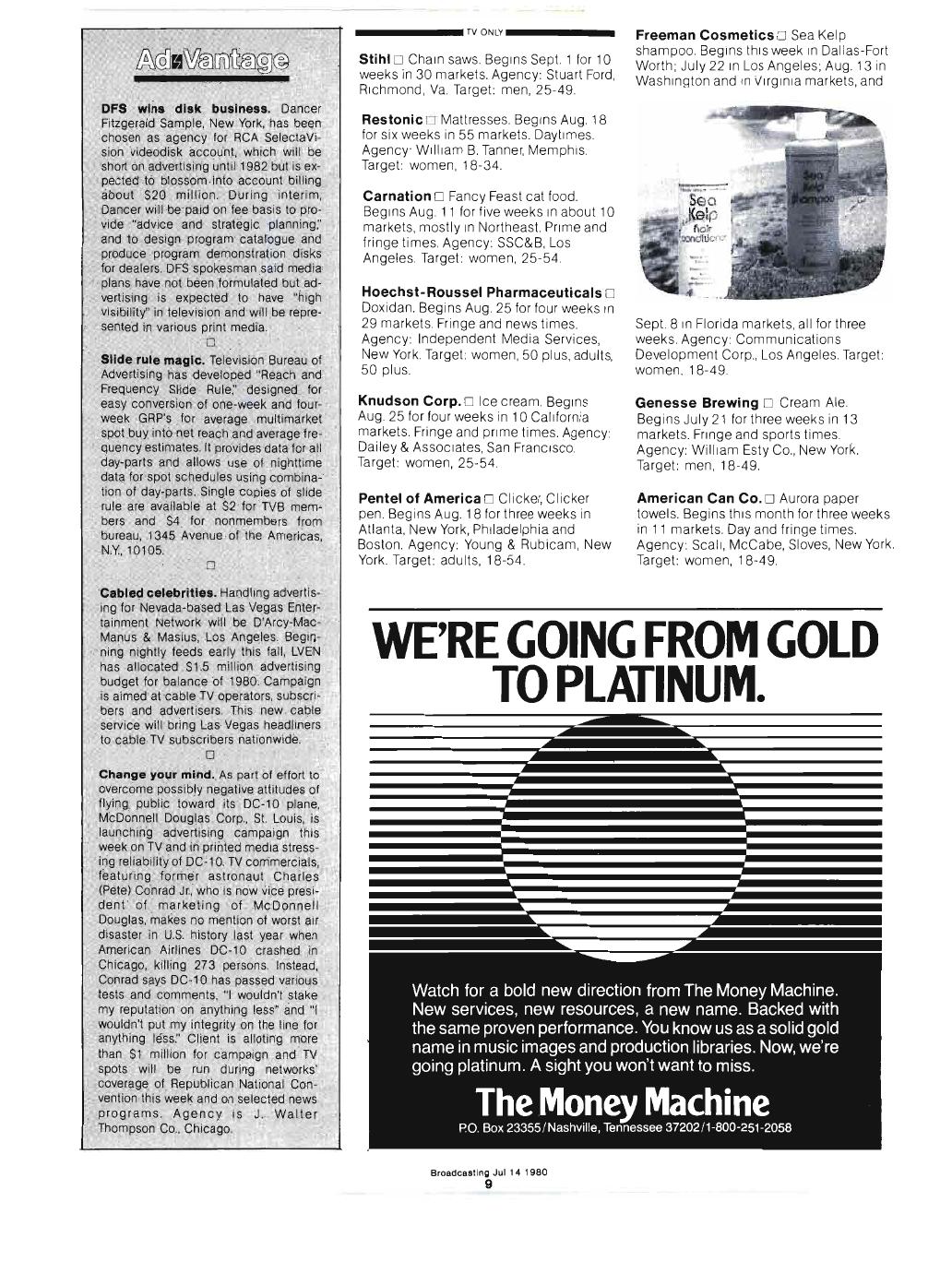
Open the complete July 14, 1980 Broadcasting PDF
This is the sort of short trade-paper entry that can answer questions a beautiful advertisement leaves open. It names Pentel of America, gives the product wording “Clicker, Clicker pen,” and announces a three-week campaign beginning August 18 in Atlanta, New York, Philadelphia, and Boston. The agency is Young & Rubicam, New York. The explicit target is adults aged 18–54.
The audience is explicit, and it is broad. Adults 18–54 takes us well beyond a narrowly defined professional group.
Source Note
The printed product wording is “Clicker, Clicker pen.” It does not identify PD345, so this entry should not be retitled a Quicker Clicker campaign.
The agency credit has shifted cities too. “Evolution” names Y&R’s Los Angeles office; this listing names New York. We can identify the offices credited for the two assignments without assuming that the whole account changed hands.
This is a plan for a specific burst of exposure in four markets. The entry gives no spending, audience actually reached, or sales outcome. Its value is unusually direct evidence of whom Pentel intended to reach, where, and for how long.
September 1981: put the pencil on the school list
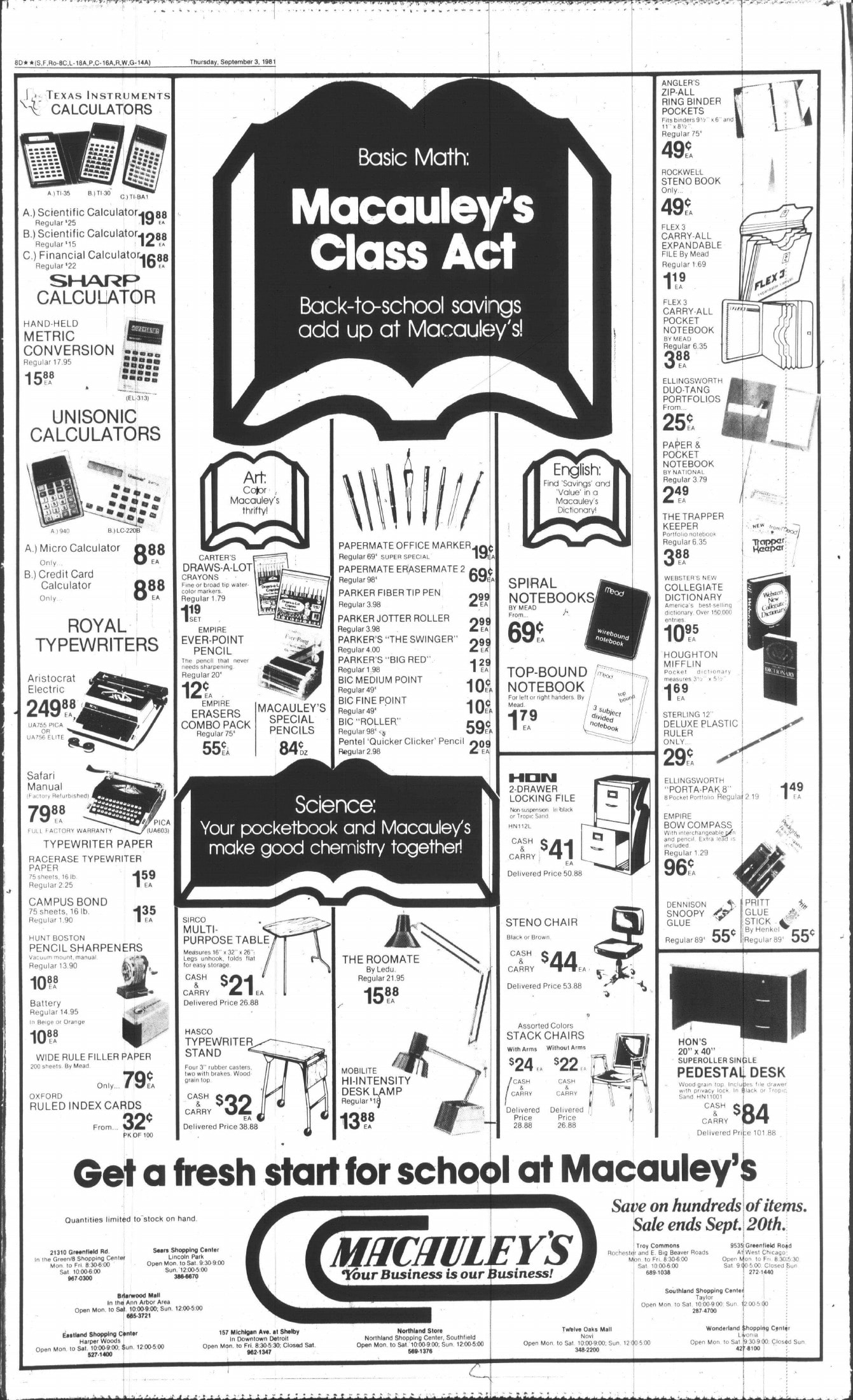
Macauley’s “Class Act” school-supply advertisement, Observer newspaper scan dated September 3, 1981, printed p8D, PDF p16, preserved by Canton Public Library. Complete scanned PDF (complete document in 5 parts: part 1, PDF pp1–12; part 2, PDF pp13–24; part 3, PDF pp25–36; part 4, PDF pp37–48; part 5, PDF pp49–52).
Macauley’s gives its school-sale page the shape of a book. Among calculators, typewriters, notebooks, and other supplies sits the Quicker Clicker at $2.09, against a printed regular price of $2.98. The sale runs through September 20, and the page lists Michigan stores including Detroit, Ann Arbor, Southfield, and Novi.
This is the retail end of the back-to-school idea: a named pencil, a saving, a deadline, and a choice of places to buy it.
Source Note
The newspaper records Macauley’s offer. It does not establish whether Pentel contributed money to the placement.
January 1982: a Quicker Clicker, with change left over

The part a pencil collector’s eye goes straight to: model, colors, price, eraser, and lead. Ridgway’s has helpfully put the whole shopping list in one strip.
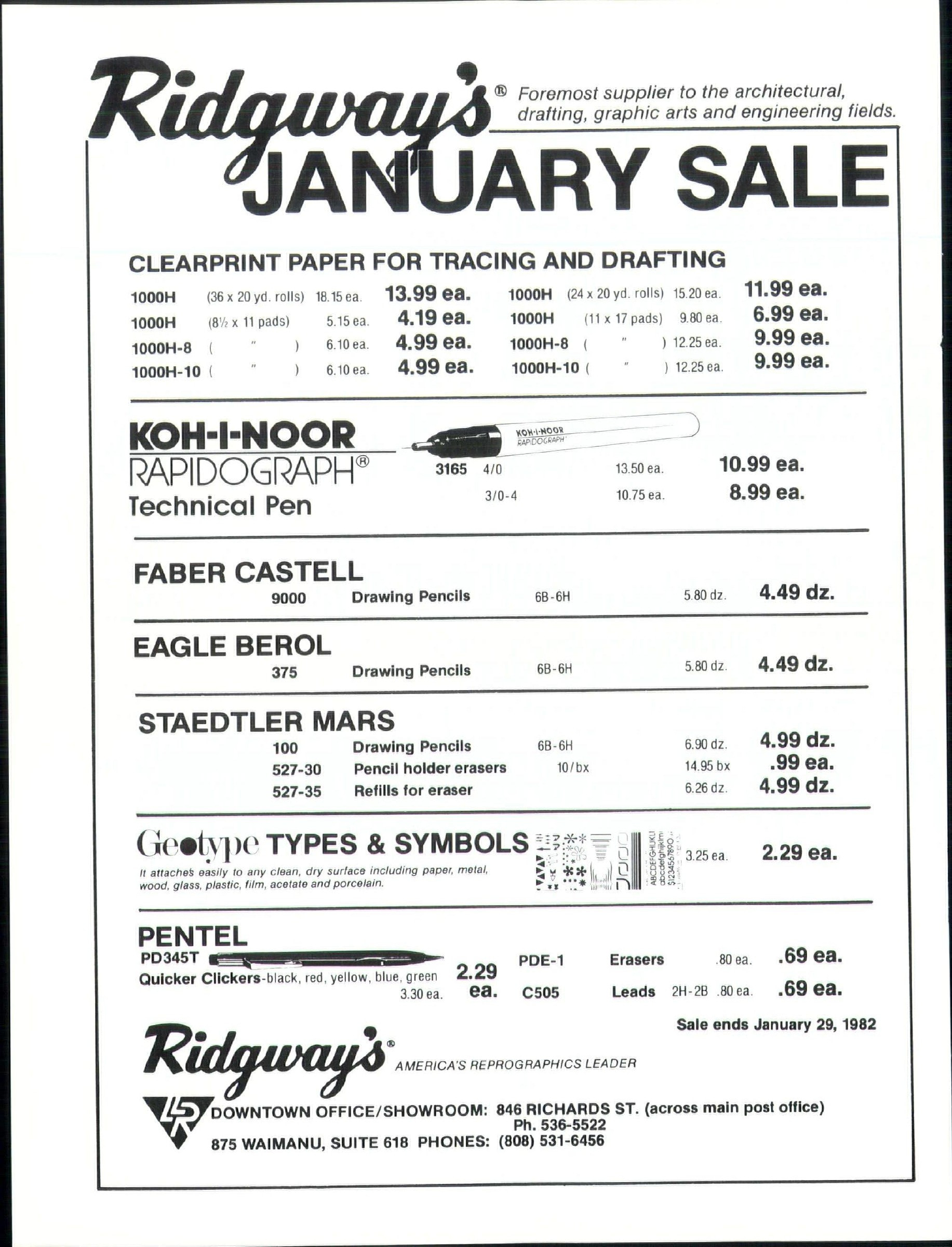
Ridgway’s retailer advertisement, Hawaii Architect, January 1982, PDF page 20. The sale runs through January 29, 1982.
Open the complete Hawaii Architect issue PDF
Ridgway’s advertises the PD345T Quicker Clicker in black, red, yellow, blue, and green at $2.29, against a printed regular price of $3.30. The PDE1 eraser and C505 lead are each offered at 69 cents, against 80 cents regular.
Around that offer is the equipment of a drafting-supply shop. Ridgway’s assumes the reader may need more than a pencil, and puts the eraser and lead beside it. The architectural audience has not gone away while Pentel has been developing its television presence.
There is a useful progression from the 1967 Boston ad: a fine-line pencil sold to professionals, then a later retailer offering a named model in five colors with its consumables. That does not establish a straight model lineage. It does show a durable way of selling, built around choosing a working tool and keeping it supplied.
For a Quicker Clicker enthusiast, the strip is also a small time machine. PD345T, five listed colors, a local sale price, and a deadline of January 29. The pencil has not yet become a hunt for an elusive example. It is current merchandise, and the problem is choosing which color to take home.
August 1982: the pencil has entered the computer
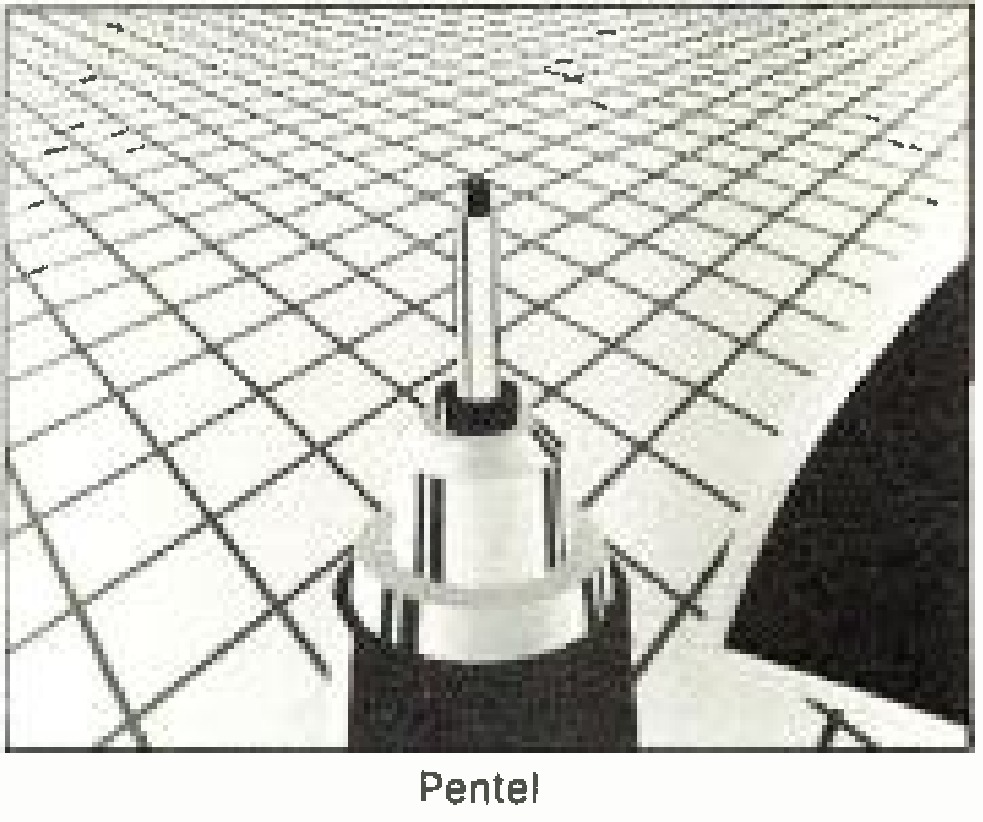
The image printed beside the 1982 production report. This is a contemporary magazine reproduction, not a recovered video file.

Broadcasting, August 16, 1982, printed page 11, in the AdVantage section at upper right. The Pentel item includes a small computer-generated image; PDF page 11.
Open the complete Broadcasting issue PDF
The report describes a 30-second computer-generated Pentel commercial introducing an advanced writing-instrument line, demonstrated in New York and Los Angeles on August 12. It names Triton Advertising and Cineflex, and says a network campaign was planned for late August.

Close-up of the contemporary production report, naming Triton and Cineflex. The full page and issue are linked above.
Look at the still above. A writing point rises over a receding grid like a small piece of futuristic architecture. The pencil has become the leading actor, with a set large enough to admire it in. That is an extravagant treatment for an object whose ordinary workplace is a sheet of paper.
The visual joke has a serious selling purpose. If the instrument is meant to feel advanced, the commercial’s appearance can do some of that work before a specification is spoken. That is my reading of the surviving still, not a reconstruction of the missing commercial.
The method earns its own publicity. Broadcasting gives trade readers a story about the making of the commercial, complete with an image. Pentel therefore appears twice in the selling process: as the subject of the planned spot and as a client associated with a novel way of making one.
Source Note
The report presents the commercial as a technological first. That is its contemporary claim, not an independently established world-first finding. The announced schedule is not a broadcast log. No Pentel budget or financial return appears in this item; neighboring advertisers’ figures belong to their own campaigns.
September 1983: the bookstore knows what you came for

UO Bookstore advertisement, Oregon Daily Emerald, Eugene, Oregon, September 27, 1983, p11. Full newspaper-page PDF. This PDF contains the complete individual page, not the entire issue.
Here is a college bookstore doing its best to derail a quick errand. Duck shirts, a calculator watch, personal necessities, and a 0.5 mm Quicker Clicker share the page. The pencil is $2.29, reduced from $3.29, with the sale ending October 8. The address is 13th and Kincaid, at the University of Oregon.
A student could encounter Pentel while buying something else entirely. That is the appeal of this page as a historical object: it puts the pencil back into an ordinary shopping trip, complete with all the distractions surrounding it.
The black-and-white ad does not establish a rack full of unusual colors. It gives us a more basic, securely dated fact: a campus bookstore was advertising the Quicker Clicker by name and using its price as a reason to visit.
1985: the three-piece school survival kit
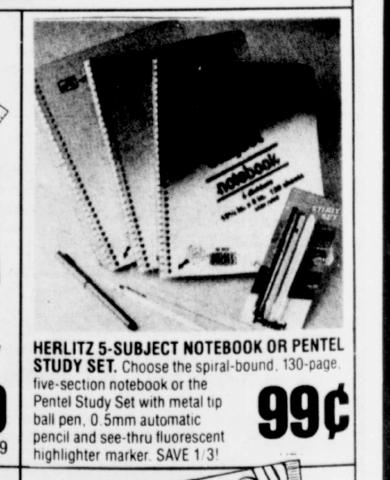
Enlarged detail of the retailer’s Pentel offer.

Winn’s advertisement in the Winters Enterprise, Texas, August 29, 1985, printed and PDF page 8. Retailer advertising; the offer runs through September 4.
Open the complete newspaper PDF
The Pentel Study Set sits among lunch kits, folders, binders, crayons, and pencils in a back-to-school sale. It combines a metal-tip ball pen, a 0.5 mm automatic pencil, and a fluorescent highlighter, advertised at 99 cents as one of two alternative items in the offer.
August does some of the advertiser’s work. The page gathers the things a family needs before school starts, and Pentel bundles three writing tasks into one small purchase. Nobody has to read a paragraph about sleeve construction to understand the offer.
Professional and school-supply appeals can sit side by side in the same company’s history. The drafting ads explain why a particular instrument suits a job. Winn’s makes a bundle easy to choose during a seasonal shopping trip. Pentel now has several ways into the basket.
January 1986: the refill gets its own invitation
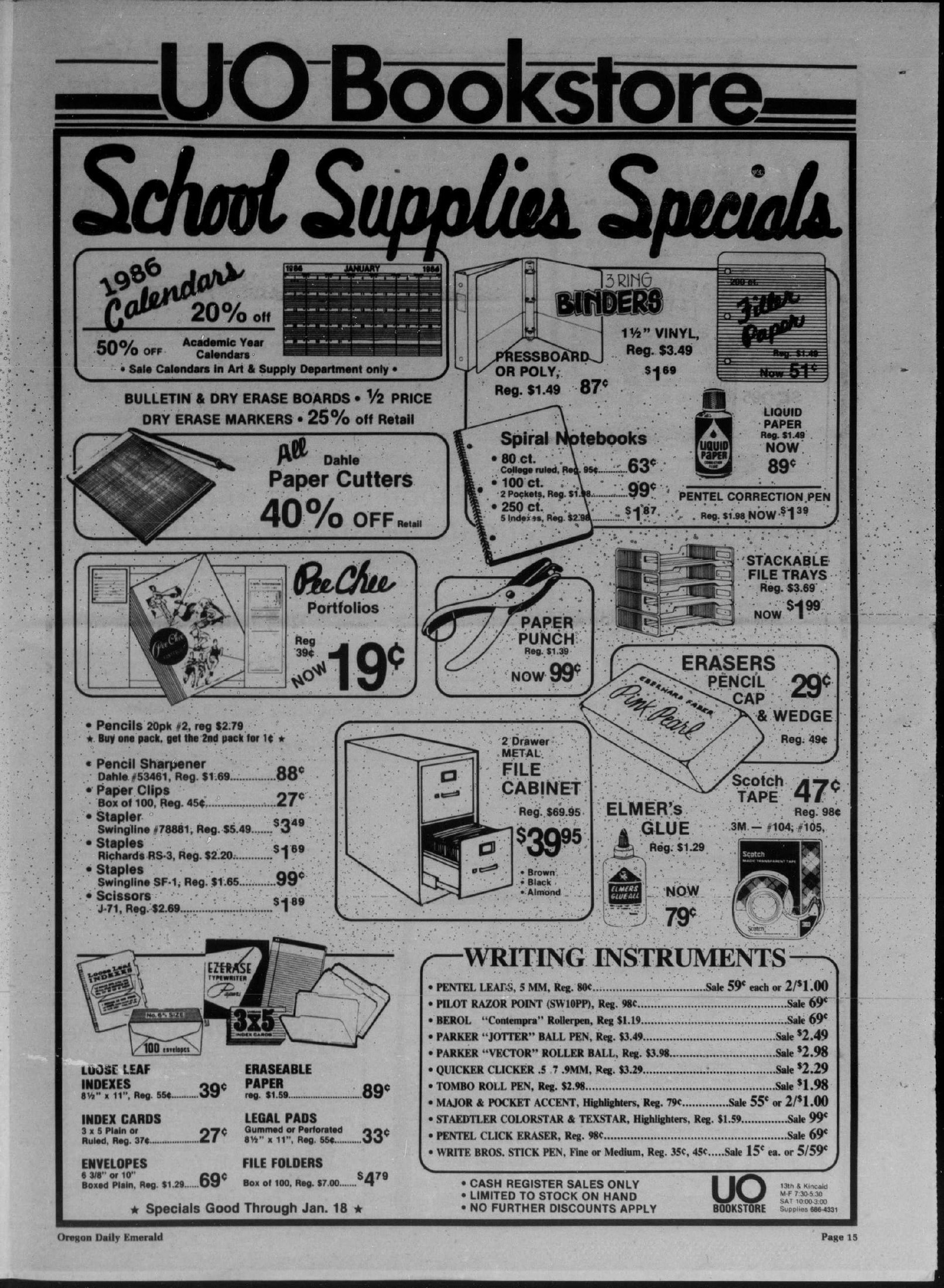
UO Bookstore, Oregon Daily Emerald, Eugene, Oregon, January 6, 1986, p15. Sale through January 18. Full newspaper-page PDF.
The bookstore returns with 0.5, 0.7, and 0.9 mm Quicker Clickers, again $2.29 against $3.29 regular. Pentel 0.5 mm leads are 59 cents, or two for $1, against 80 cents regular. A Click Eraser and a Correction Pen have their own discounts.
For the student who already owned the pencil, the refill could be enough to bring the brand back into the basket. For a collector reading the page now, the three lead sizes offer a different temptation. A trip for paper can become an argument for a second pencil with a perfectly sensible justification: this one makes a different line.
These two Eugene advertisements give the college-bookstore memories a dated paper trail. They also explain why the refill belongs in a marketing history. A product that can be replenished gives the customer another occasion to notice the name.
1987–89: the Quicker Clicker does the household shopping
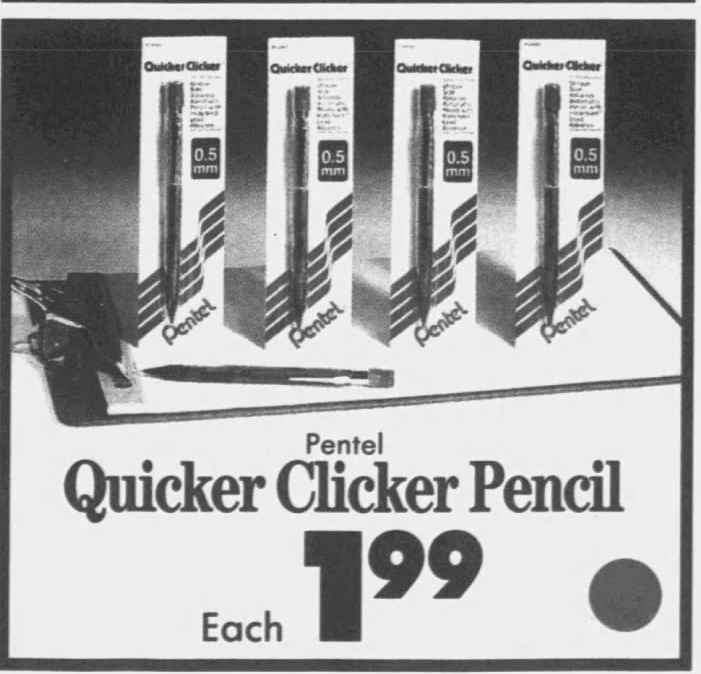
Grand Union circular in The Record, Hackensack, New Jersey, August 30, 1987. Printed circular p7. Quicker Clicker, $1.99 each.
The Quicker Clicker has made it into the supermarket circular. In Grand Union’s back-to-school block, the packages stand above a $1.99 price, beside notebooks, filler paper, tape, and crayons. Above them are detergent, paper towels, pet food, and photo-processing offers.
The route to the pencil is an ordinary household shopping trip. A specialist supplier can explain why a particular instrument matters; a supermarket can put one in reach while the customer is buying everything else. Grand Union supplies the occasion, the display, and the price.
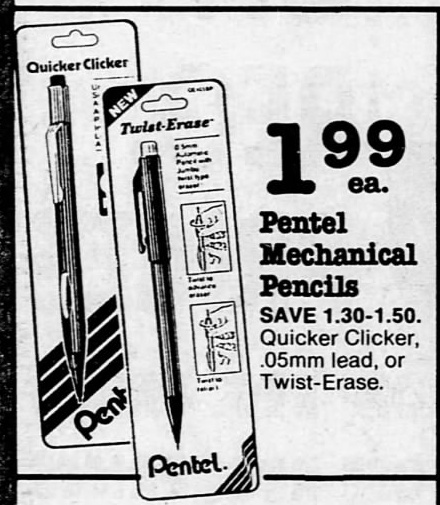
Hook’s Dependable Drug Stores, Lansing State Journal, Lansing, Michigan, January 18, 1989, p8A. Quicker Clicker or Twist-Erase, $1.99 each; offer through January 22.
In Lansing, Hook’s offers Quicker Clicker or Twist-Erase at $1.99, with an advertised saving of $1.30–$1.50. This time the neighboring purchases are everyday drugstore goods. The store locations at Frandor Center and Logan Center are printed at the bottom of the page.
A precision instrument can become a routine drugstore purchase without losing its appeal to the person who cares about it. These two circulars are part of that story of access.
Source Note
In the Hook’s scan, “.05mm” appears to be a typo. The word “new” on the pictured package is not enough to establish a launch date.
6. Please put a Pentel in the shopping basket
1993: come for lunch, stay for the Fax Pencil
There is a more sociable side to this story, too. On September 24, 1993, Radar Business Systems and Pentel appeared together in The Daily News-Journal, inviting Rutherford County business people to the American Office Products Distributors’ New Products Tabletop Show. The advertised date was September 29, at the Loews Vanderbilt Plaza Ballroom, from 11 a.m. to 6:30 p.m.
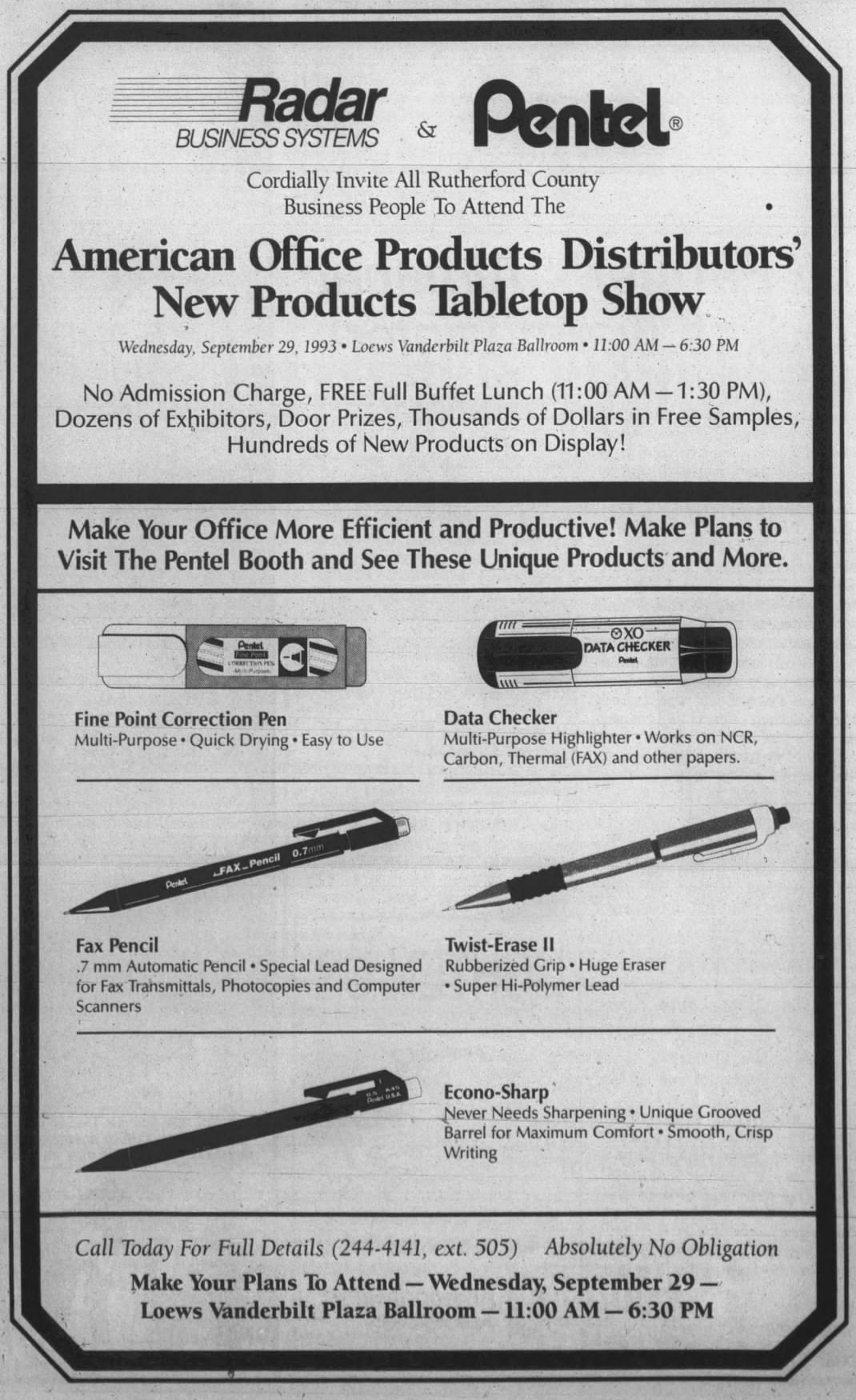
Radar Business Systems and Pentel, The Daily News-Journal, Murfreesboro, Tennessee, September 24, 1993, printed page 7A. The invitation advertises a September 29 event. Clean crop from the complete newspaper page. Download the full page PDF.
The invitation offered free admission, a buffet lunch, door prizes, and free samples. For the show as a whole, it advertised dozens of exhibitors and hundreds of new products. Pentel’s own invitation was to visit its booth and make the office more efficient and productive. You can see the practical appeal: take a break, see what is new, and put an unfamiliar tool in your hand.
For pencil people, the star of this particular time capsule may be the 0.7 mm Fax Pencil. Its lead was promoted for fax transmissions, photocopies, and computer scanners. A mechanical pencil was being sold as a useful companion to the machines that moved office paperwork around. That is a wonderfully specific reason to buy a pencil.
Beside it, the Twist-Erase II offered a rubberized grip, a large eraser, and Super Hi-Polymer lead. The Econo-Sharp stressed comfort and freedom from sharpening. A correction pen and the Data Checker highlighter rounded out the display, with the latter promoted for carbon, NCR, and thermal fax papers. This was a small toolkit for the paper-filled office of 1993.
The Sharp 5 had met architects in their professional magazine and at booth 57 in 1971. Here, more than twenty years later, Pentel and a local dealer invited business customers to another booth, with office problems as the conversation starter.
Source Note
The invitation documents the advertised sales approach and products, but not attendance, resulting orders, or how Radar and Pentel divided the advertising bill.
1995: a calculator, a pencil, and a trip to Rite Aid
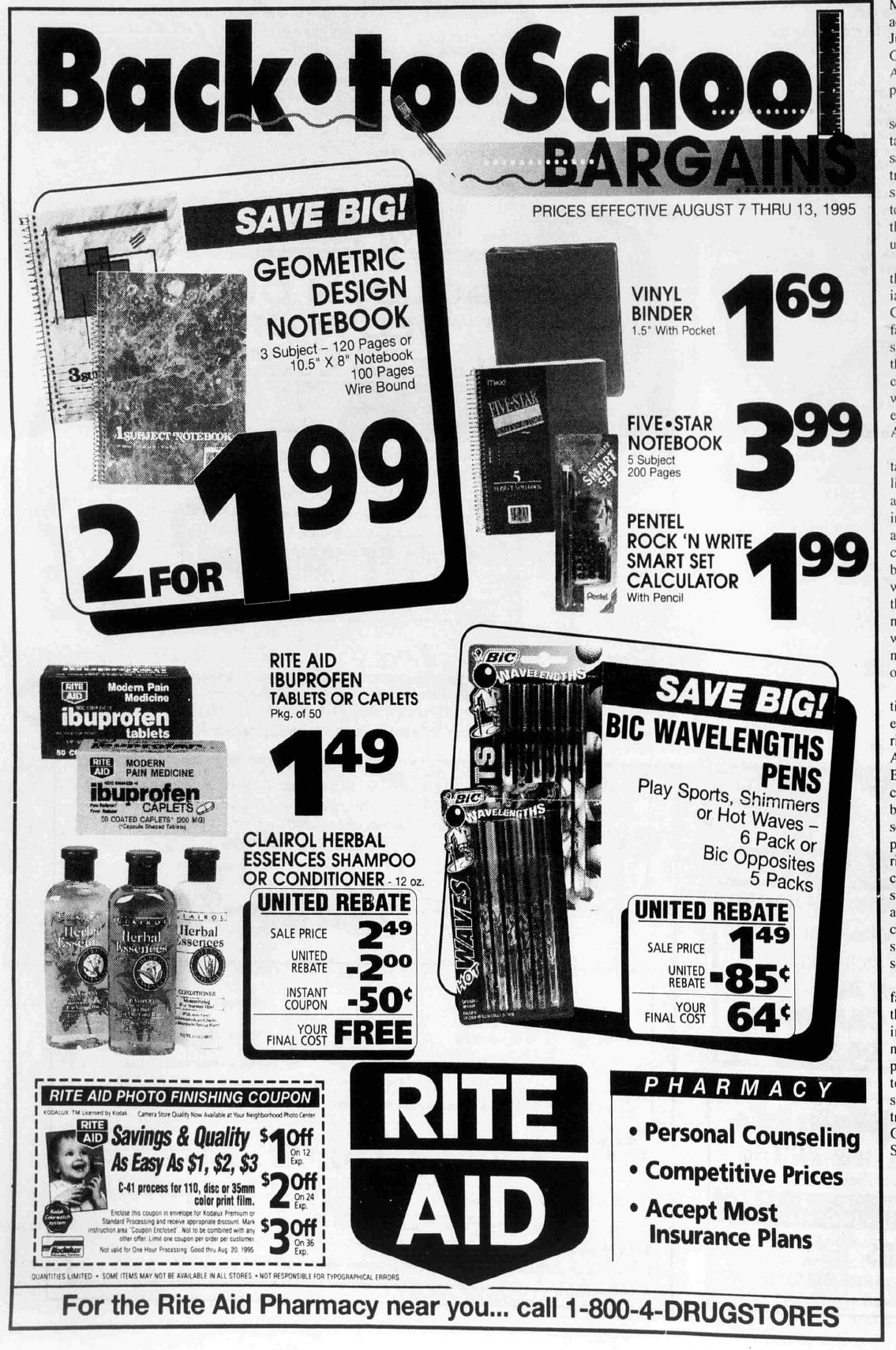
Enlarged detail of the retailer’s Pentel offer.
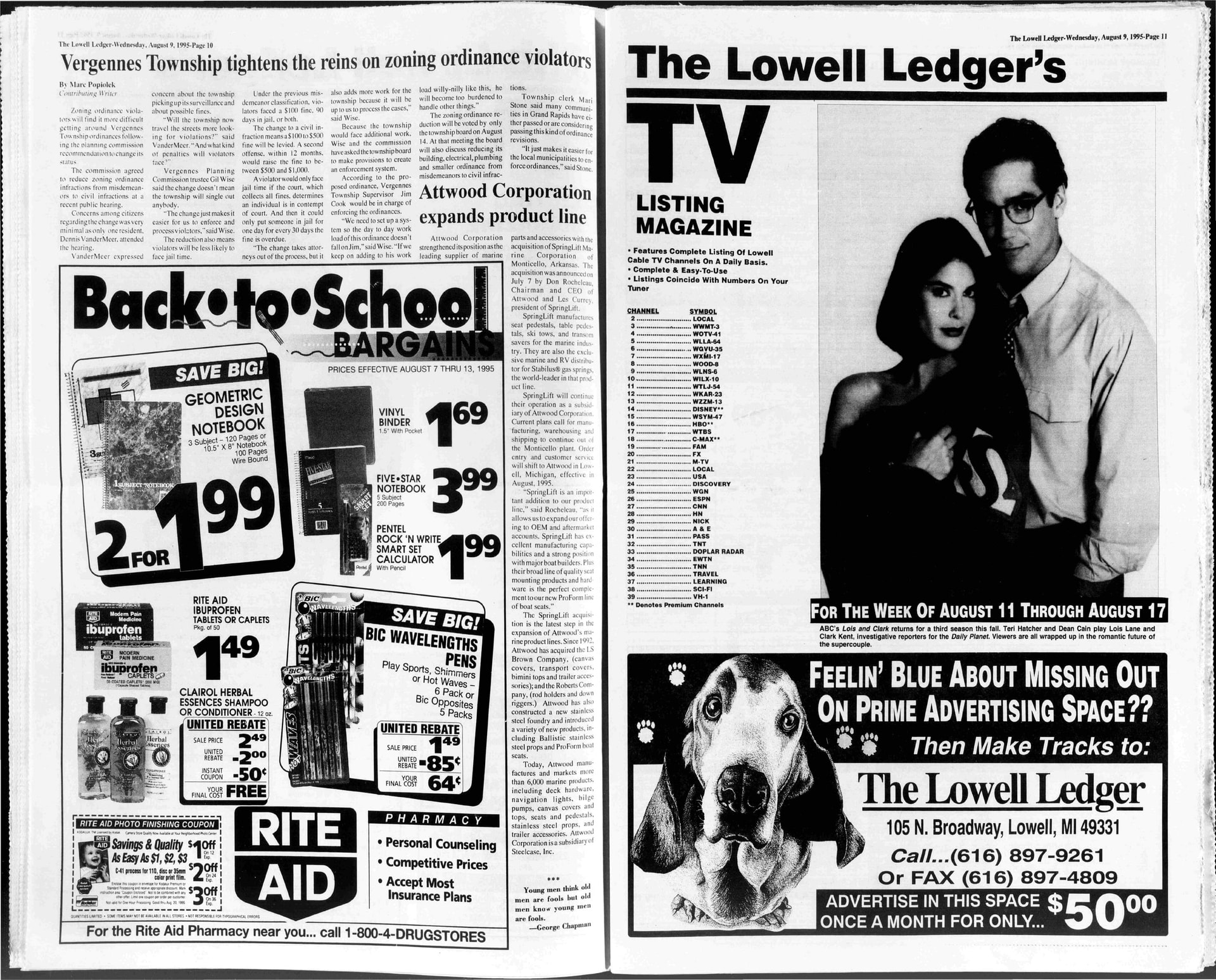
Rite Aid advertisement in the Lowell Ledger, Michigan, August 9, 1995, printed page 10, on the left of this scanned spread. PDF page 6 contains printed pages 10–11. Prices apply August 7–13.
Open the Lowell Ledger PDF (complete document in 2 parts: part 1, PDF pp1–9; part 2, PDF pp10–15)
Rite Aid offers the Pentel Rock 'N Write Smart Set calculator with pencil for $1.99. The item shares a back-to-school layout with notebooks and a binder; other parts of the retailer’s advertisement offer toiletries and medicine.
Rock 'N Write has a different ring from CPA Sharp 5. It brings a little playfulness to a practical purchase, while the calculator-and-pencil combination gives the shopper a quick reason to choose the set.
The competition is visible a few inches away. A BIC pen offer uses rebates to advertise an eye-catching final price. Pentel offers a calculator-and-pencil combination. Inside one retailer’s layout, we can see two different attempts to win the same shopper’s attention.
The college bookstore, where one more color was reason enough
Here the story reaches one of my favorite places to shop. In the 1990s, I loved going into college bookstores and finding PD345 colors I had never seen before. I could know the pencil and still get surprised by the rack.
That is a personal memory, not a dated color chart. But it explains why the route to market matters to a collector. What you think exists depends partly on what your local stores carry. Another bookstore can make a familiar pencil feel like a discovery.
By the end of our period, Pentel itself helps document the channel. Its 1998 U.S. website explicitly lists college bookstores, alongside art-supply stores, office superstores, discount stores, drug and convenience stores, grocery stores, wholesale clubs, computer stores, dollar stores, and variety/craft stores. That is a company’s own contemporary description of where it sold its products, rather than a channel list reconstructed entirely from memories.
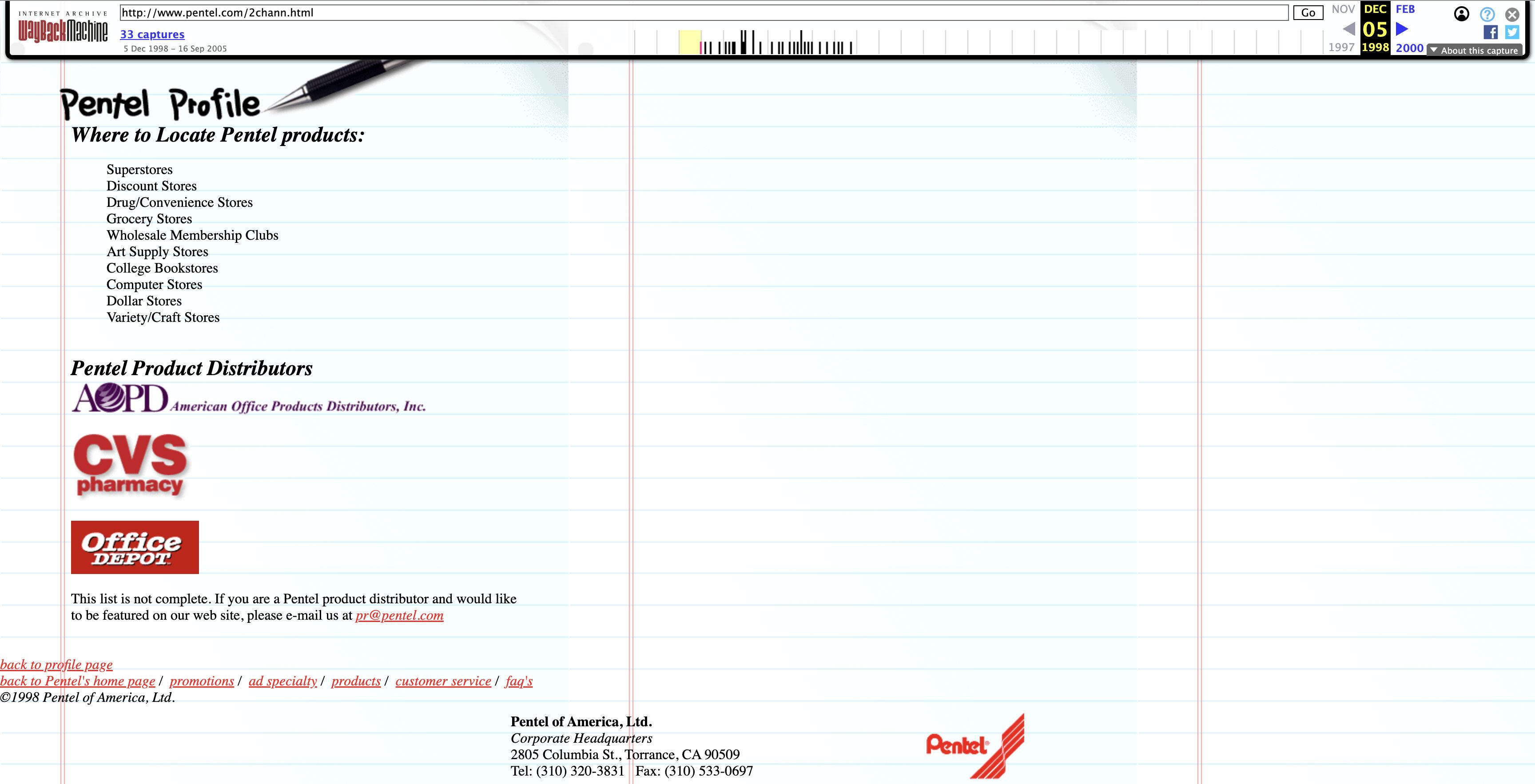
Pentel of America’s distribution page, Wayback capture December 5, 1998. View the archived page. The archive’s reconstructed appearance can include assets captured separately from the page HTML.
1998: Pentel has a home page, and the pencil gets a help desk
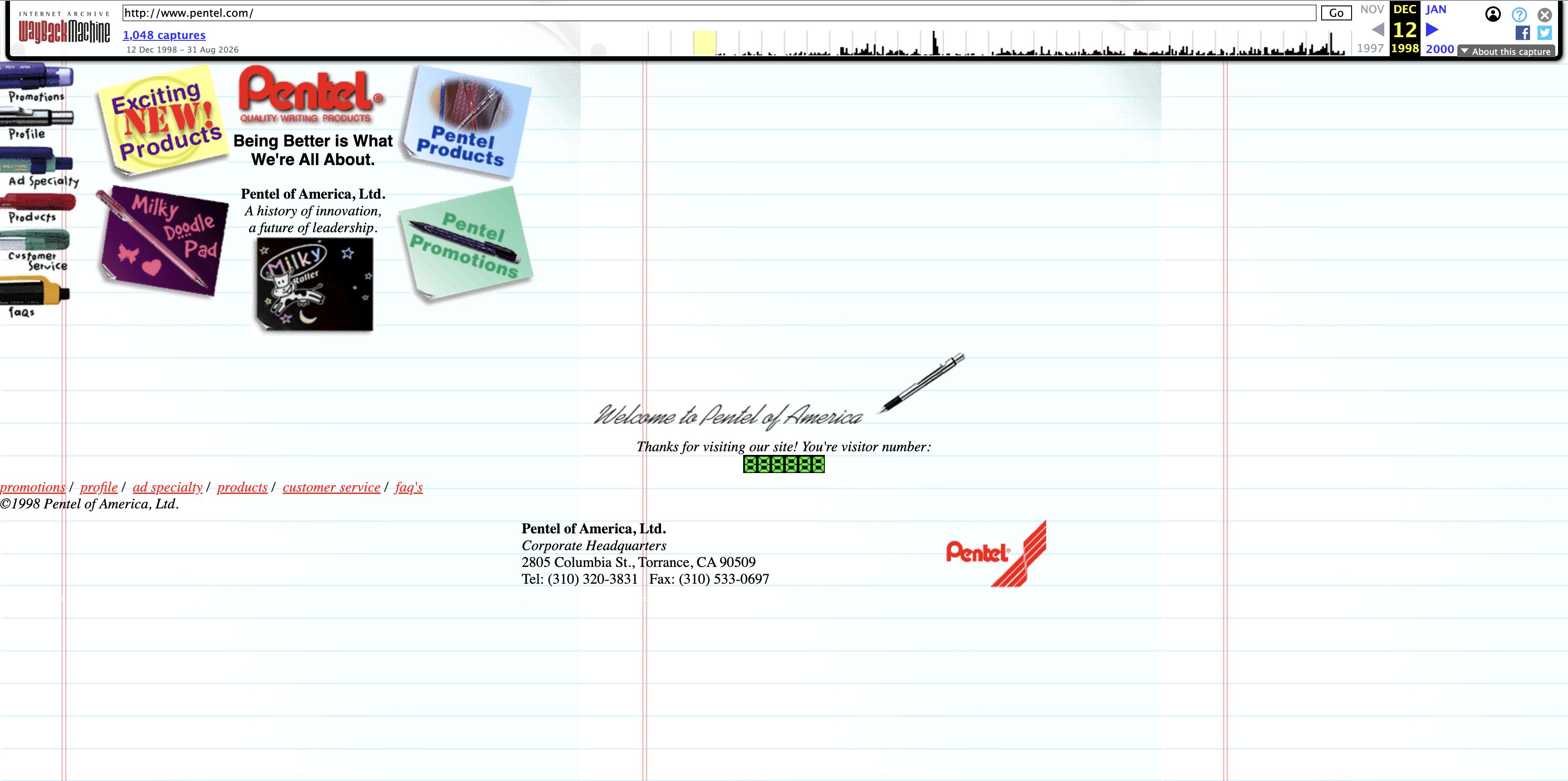
Pentel of America homepage, Wayback capture December 12, 1998. Archived homepage.
The homepage brings the familiar product range into a new medium: promotions, product information, customer service, and an advertising-specialty section. There is a Milky Gel Roller promotion, a doodle-pad invitation, and that wonderfully period detail, the visitor counter. The footer identifies Pentel of America and its corporate headquarters on Columbia Street in Torrance, California.
When did the American website first appear? The defensible answer from this research is online by December 1998. The domain registry gives May 31, 1997 as the registration date for pentel.com, and the earliest captures located in this search are from December 1998. Registry record
Source Note
Domain registration does not establish a public launch date, and an archive’s earliest surviving capture is not necessarily a site’s first day. “Online by December 1998” is the boundary supported by the captures located here.

Automatic Pencil and Automatic Drafting Pencil Information, Wayback capture December 3, 1998. Archived customer-service page.
The pencil-help page rewards a collector’s visit. There are explanations of refilling, erasers, lead advance and retraction, the Quicker Clicker’s side button, and the P205’s 0.5 mm designation. Precision, consistent advance, refillability, and a warranty are still part of Pentel’s case for ownership.
Think back to the 98-cent cartridge pen and the drafting ads with their lead supplies. The website extends that practical conversation beyond the sale. A customer can return for instructions when the first lead or eraser runs out. The counter has acquired a help desk that fits on a screen.
1999: pencils, groceries, and the end of our century
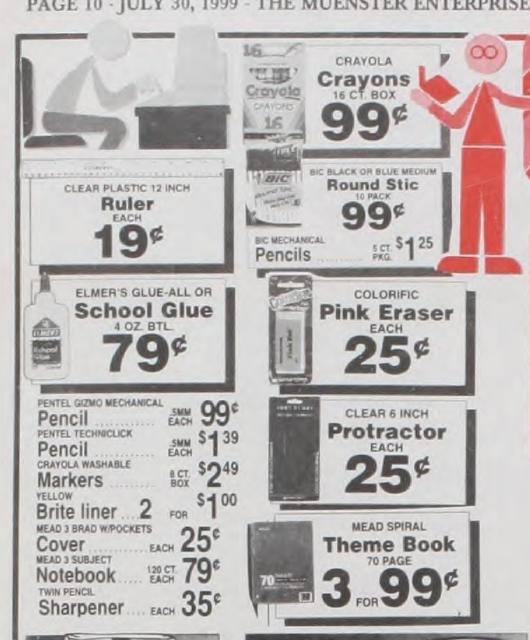
Enlarged detail of the retailer’s Pentel offer.
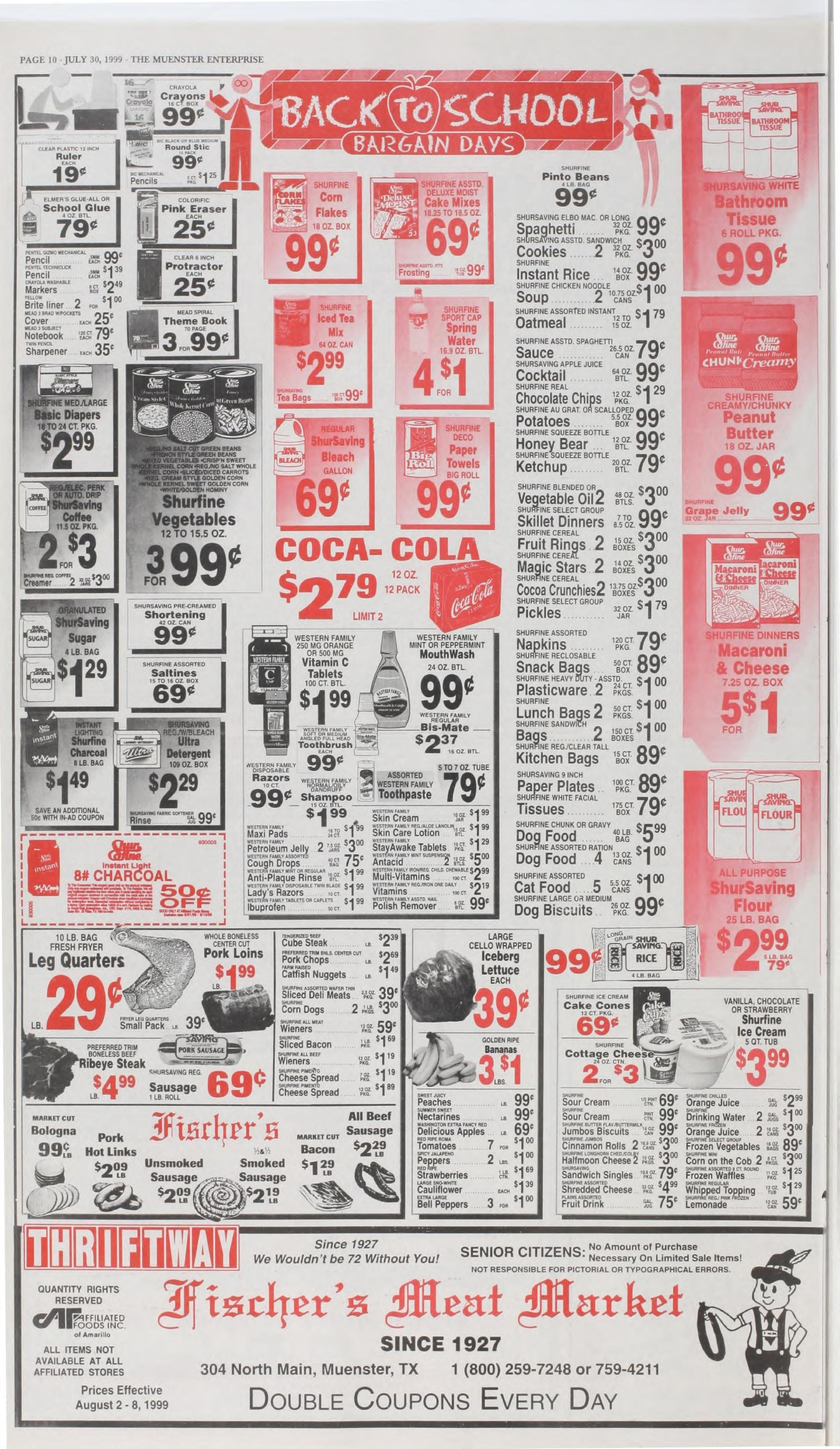
Fischer’s Meat Market/Thriftway advertisement, Muenster Enterprise, Texas, July 30, 1999, printed and PDF page 10. The advertised prices apply August 2–8, 1999. Pentel appears in the school-supply block near the upper left.
Open the complete Muenster Enterprise PDF
The 0.5 mm Gizmo mechanical pencil is 99 cents, and the 0.5 mm Techniclick is $1.39. The surrounding page sells groceries, household supplies, and other school merchandise.
There is something satisfying about ending the retail trail on a grocery page. The early sources spend time introducing an unfamiliar tool and explaining its possibilities. Here the model, diameter, and price are enough to make an offer. The pencil has a place among the things to buy before school.
The office market: an account with consequences
The office-supply channel leaves a different kind of paper trail. A later court memorandum recounting 1998–99 events describes Pentel as an important, profitable account for Triton Advertising. It names Barry Epstein, vice president of creative services and senior art director, as principally handling the account in his final years there.
The memorandum describes advertisements prepared for the 1999 Office Depot catalog appearing in the Corporate Express catalog with the wrong retailer direction, and records the end of Pentel’s Triton relationship in May 1999. These details come from the memorandum’s account of the events, rather than an independent reconstruction here. Court memorandum recounting the 1998–99 account history
The incident illustrates how specific the selling work could be. A product ad had to send the reader to the right retailer, in the right catalog. By the end of our period, Pentel’s American story included managing those individual buying routes as well as building recognition of the name. The source was written later; the events discussed here end in 1999.
Same brand. Several very different desks.
Pentel’s American market comes into focus when we put the pages beside one another. An importer reaches artists through specialist advertising. The American subsidiary explains pencils to people who earn their living with fine lines. Dealers turn products into locally available purchases. Agencies and studios make the name perform on air. School-season retailers give it a place in a much larger shopping trip.
The publication helps shape each pitch. American Artist supplies an art-material setting; P/A News Report and Progressive Architecture make room for the details of professional equipment. The narrow Scientific American ad makes the Slim Rolling Writer look as slender as its name. These are readings of the placements themselves. The explicit adults 18–49 target in 1976 and adults 18–54 target in 1980 tell us more directly whom the television planners intended to reach.
The back-to-school reader has another task: buy what is needed, at a price that makes sense, and get on with the rest of the list. A set, a sale price, and a recognizable package can do more work there than a long explanation. This is part of what makes the newspaper pages so valuable. They preserve the buying situation around the object.
| Customer or occasion | Evidence shown here | Selling approach |
|---|---|---|
| Artists and art-material buyers | Reported American Artist placements, 1963–64; Daily Toreador, 1965 | Introduce a useful new drawing and writing tool through specialist channels |
| Teachers | Devil’s River News, 1964 | Red ink and concrete classroom tasks |
| Draftsmen, engineers, architects | P/A News Report, 1968; AIA conference, 1971; Progressive Architecture, 1974 | Explain precision, convenience, lead, and sleeve construction |
| Broader writing-instrument buyers | Chicago radio/TV plan, 1976; Scientific American, 1978 | A memorable product idea and a slim, refillable pen |
| Technical-supply customers | Hawaii Architect, 1982 | Model choice, colors, consumables, and a timed retail discount |
| Students and family shoppers | UO Bookstore, 1983 and 1986; Winters Enterprise, 1985; Lowell Ledger, 1995; Muenster Enterprise, 1999 | Back-to-school sets, accessible prices, and one-stop shopping |
| Office-supply buyers | Documented 1999 retailer-catalog work | Reach buyers within the ordering channel |
The audiences overlap rather than form a neat succession. The architect, the student, the office buyer, and the enthusiast can all care about the same pencil for different reasons. Pentel’s advertisements give us those reasons in the language of their time.
The cash register: what the numbers actually tell us
The financial question finally has some substantial contemporary numbers. Broadcasting published estimated U.S. television expenditures for Pentel, including four consecutive years of network-TV figures.
Source Note
These are trade estimates, not Pentel’s audited accounts. The figures cover the television categories specified in the table, not a complete advertising budget.
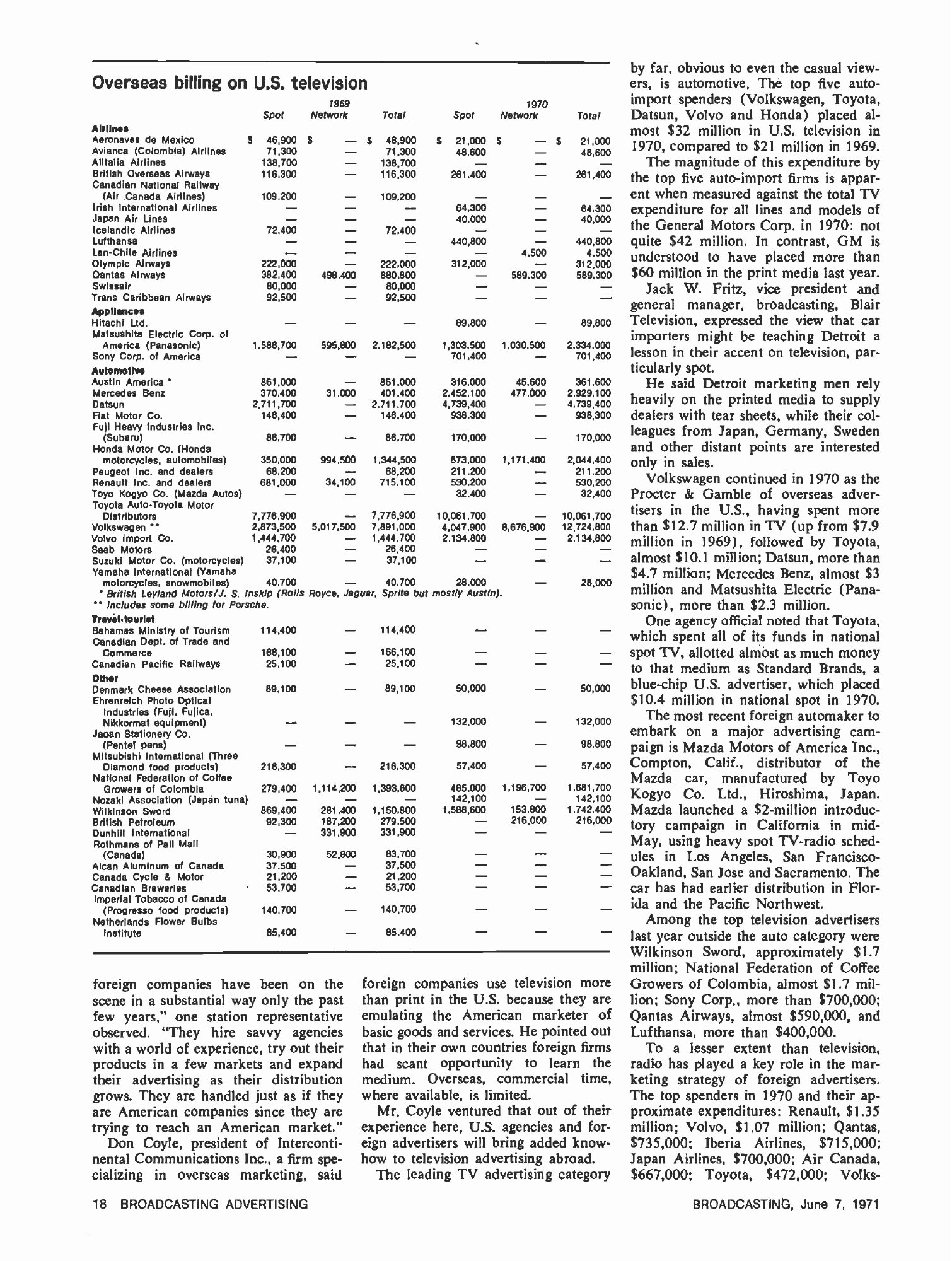
Broadcasting, June 7, 1971, p18. The row “Japan Stationery Co. (Pentel pens)” shows the 1970 spot-TV estimate in the right-hand group of columns. The adjacent 1969 group must not be confused with it.
| Spending year | Estimated expenditure | What the source measures | Contemporary source |
|---|---|---|---|
| 1970 | $98,800 | U.S. spot television, listed under Japan Stationery Co. (Pentel pens) | Broadcasting, June 7, 1971, pp17–18 |
| 1977 | $707,100 | Network television, Pentel Co., rank 357 | Broadcasting, April 24, 1978, printed pp50, 52; PDF pp77, 75 |
| 1978 | $656,000 | Network television, Pentel, rank 381 | Broadcasting, March 12, 1979, pp78–80 (complete document in 2 parts: part 1, PDF pp1–89; part 2, PDF pp90–172) |
| 1979 | $1,009,200 | Network television, Pentel, rank 347 | Broadcasting, March 17, 1980, pp64–68 |
| 1980 | $441,200 | Network television, Pentel, rank 434 | Broadcasting, April 13, 1981, pp152–154 (complete document in 2 parts: part 1, PDF pp1–127; part 2, PDF pp128–196) |
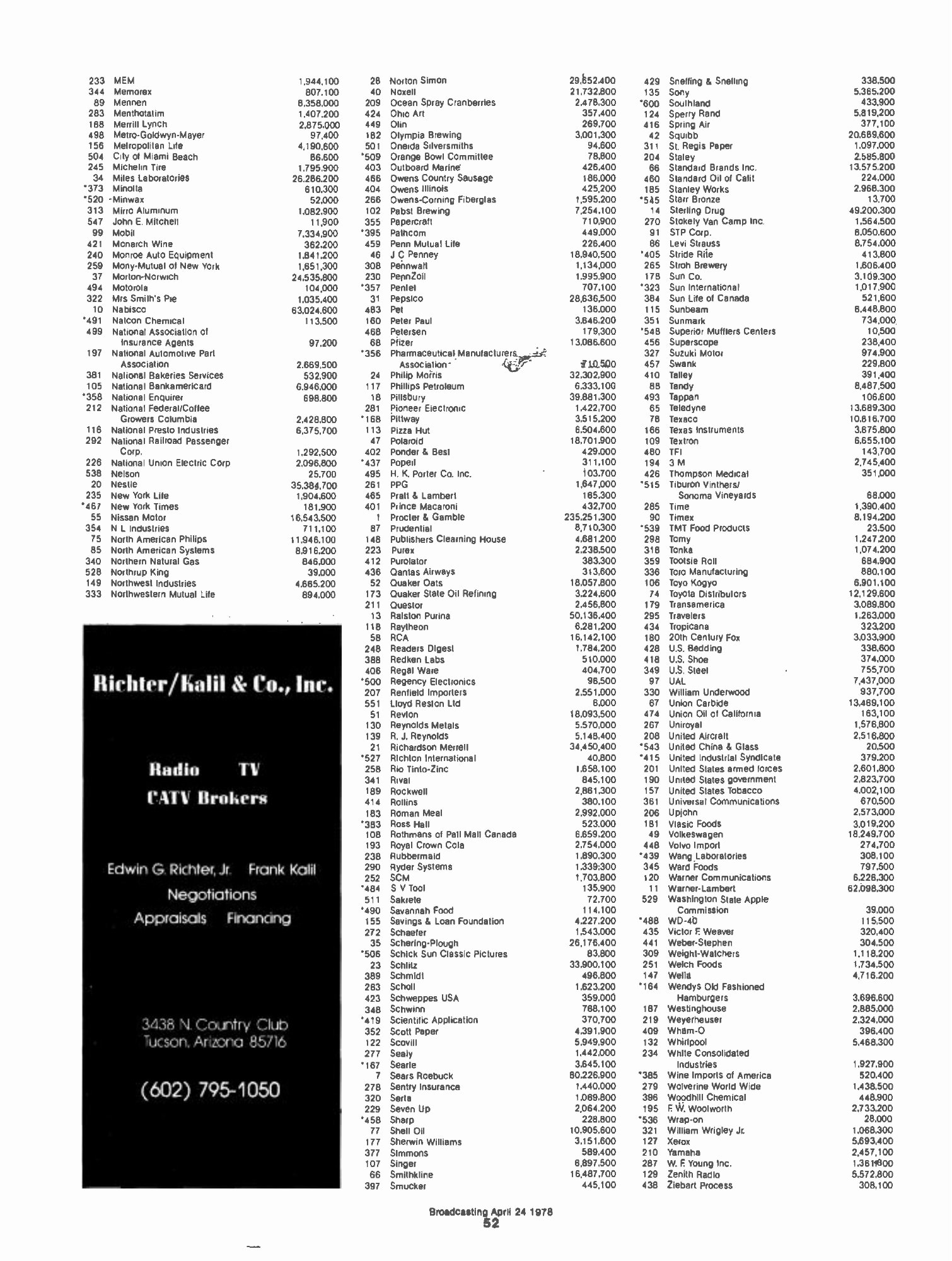
The 1977 network table. Pentel appears in the center column, rank 357. The accompanying article identifies Pentel among that year’s larger newcomers to network advertising. This scan’s PDF pages are out of printed order.
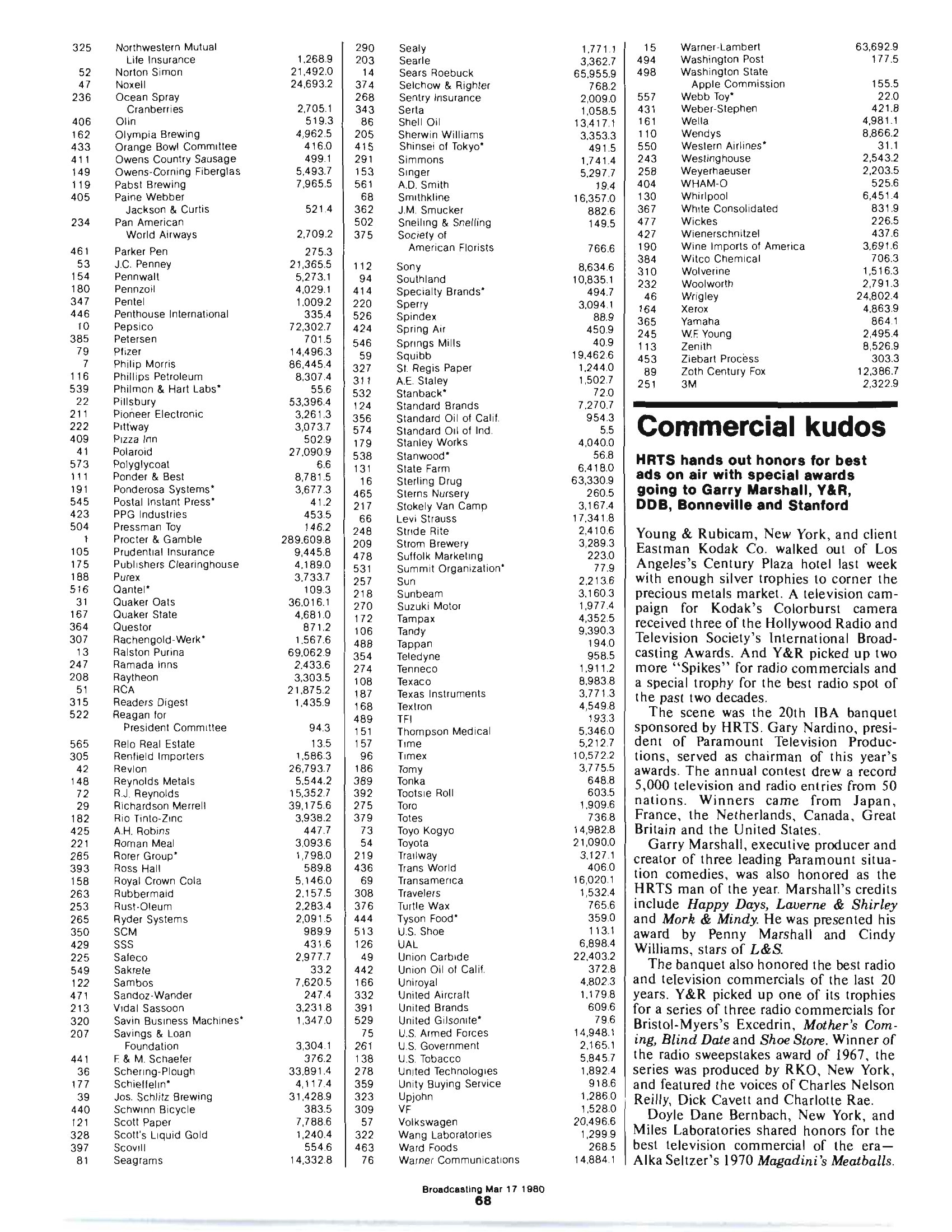
The 1979 network table, published March 17, 1980. Pentel’s entry is 1,009.2; the heading on p64 says to add three zeros. The amount is therefore $1,009,200, not $1,009.20.
The network estimates were compiled by Broadcast Advertisers Reports and presented through the Television Bureau of Advertising. The earlier imported-products survey includes a different measure, spot television, and expressly excludes local dealer advertising. That $98,800 belongs alongside the later figures as evidence of an earlier TV presence, but it is not the first point in a directly comparable network-spending series.
The 1977 “newcomer” description is especially easy to misread. It means a newcomer to that network-TV table. We already have both a 1970 television-commercial credit and a 1970 spot-TV estimate. Pentel had been on television before the network survey counted it in this group.
For 1979, the reported network figure passes one million dollars. That gives a sense of the scale behind the small objects. A pen or pencil might cost a few dollars at the counter, while the effort to put the brand on national television involved a much larger sum.
Source Note
Changes between annual figures cannot establish campaign success or shifts into other media. Print, radio, local TV, production, displays, dealer support, and other expenses are not rolled into the network numbers. A complete U.S. marketing budget and a measured market-share history remain open questions.
The retail and campaign numbers answer different questions: what customers were offered, and how particular promotions were supposed to work.
| Date | Documented number | What it measures |
|---|---|---|
| 1964 | More than 2 million U.S. Sign Pens sold; 15,000 dozen shipped monthly; two-month backlog | Contemporary reported commercial claims in the Yasutomo reprint |
| 1967 | $1.98 Sharp 5; $4 Graph; free Sign Pen sample | Dated Atlanta retailer offer; Boston manufacturer ad confirms $1.98 Sharp 5 |
| 1968 | $2.98 CPA Sharp 5; $4 Graph; 50 cents for 12 leads | Prices printed in a Pentel of America advertisement |
| 1971 | Booth 57; two named representatives | A documented professional selling presence, not sales volume |
| 1976 | Eight weeks; two 60-second radio spots; Chicago launch | Announced campaign duration and format |
| 1977 | David Soul & Friends on ABC; television, radio, and print | Named sponsorship and a coordinated back-to-school plan |
| 1980 | Nine surviving catalog scans, including the cover | Dated U.S. product range; not a sales-volume measure |
| 1980 | Four cities; three weeks; adults 18–54 | Announced TV-only schedule and stated demographic, not actual reach |
| 1982 | 30-second CGI spot; late-August network campaign planned | Production format and intended distribution |
| 1982 | $3.30 regular / $2.29 sale for PD345T | Ridgway’s advertised local offer |
| 1983 / 1986 | $3.29 regular / $2.29 sale for Quicker Clicker | UO Bookstore advertised offers in Eugene |
| 1985 | 99-cent Pentel Study Set | Winn’s back-to-school offer |
| 1995 | $1.99 Rock 'N Write Smart Set calculator with pencil | Rite Aid’s advertised offer |
| 1999 | 99-cent Gizmo; $1.39 Techniclick | Fischer’s/Thriftway advertised offer |
Keep the numbers in their proper columns. An offer price tells us what a seller invited someone to pay. Shipment counts tell us what a contemporary account reported moving through distribution. Neither supplies an advertising budget or a campaign’s return. The evidence here documents the selling effort much better than it measures the resulting market share.
The names need the same care. TKY appears with Yasutomo in 1964; Dentsu with the 1970 television report; Botsford & Ketchum with the Duke materials; Young & Rubicam and Duck Soup with “Evolution”; Triton and Cineflex with the 1982 computer-generated commercial. These are credits for documented pieces of work, not a complete list of exclusive agency appointments.
The pencil in the drawer used to have a sales pitch
Go back to that Boston Sharp 5. It is still a handsome pencil at $1.98, and brown versus green is still a perfectly respectable dilemma. But there is a larger story behind it now: the importer who found an audience, the ad man who chose the art magazines, the dealers who put products in catalogs, and the company learning to speak to American customers in several settings.
The pages cannot calculate how much recognition each campaign created. They can show the work of becoming familiar. A fine line explained. A free sample offered. A booth booked. A commercial produced. A refill stocked. A pencil placed where somebody doing the weekly shopping might notice it.
For mechanical-pencil people, the professional connection runs deep in the evidence. The Sharp 5 and Graph were pitched to architects and other fine-line users in 1967. Technical publications gave the mechanisms room to explain themselves. The PF339, PF337, and PF335 brought specialized drawing requirements into the copy. The PD345T arrived in Ridgway’s ad with a choice of colors, lead, and erasers. Long before these were things to hunt for, they were tools somebody had to choose.
And the selling had personality. An executive identity for 49 cents. Archie Boston telling the maker what he wanted. A skull that makes a cardboard package collectible. A string quartet for a Rolling Writer. A pencil big enough to star in a computer-generated landscape. Serious tools did not require solemn advertising.
An old advertisement gives a familiar object its original sales pitch back: what it promised, whom it was meant for, where to get it, and what it cost. That is why the surrounding paper deserves a place beside the pencil.
My cel caught one moment in that selling effort: a pencil turned into a performance. The newspapers and catalogs put the performance back into a larger world of shops, working desks, school lists, and people deciding what to buy. The artwork is one part of what makes this history so fascinating; the surrounding paper helps us understand the world in which it was made.
And somewhere near the end of this story, in a college bookstore in the 1990s, there is still one more PD345 color on the rack. I may have come in knowing exactly what I needed. That was before I saw it.
Your turn: what is hiding in your paper pile?
The strongest next additions would be the actual 1963 and early 1964 American Artist placements described in the contemporary press sheet; a securely identified original issue for the refillable Sign Pen ad; published insertion copies of the Archie Boston advertisement; dated retail examples matching the packaging proofs; and authenticated copies of the television commercials documented in 1970, 1979, and 1982.
The missing pages of the 1980 catalog, more complete commercial reels, and dated U.S. national campaigns from the later 1980s and the 1990s would deepen the picture beyond the retail examples shown here, while keeping the endpoint at 1999. I would particularly welcome complete magazine pages, newspaper dates, catalog covers and publication details, or commercial credits that let a clip be identified securely.
If you have something to add, please include the full page when you can. A date, a page number, a catalog cover, or a production credit can turn a great image into something the next collector can check and build on. I would love to see what is hiding in your paper pile.


