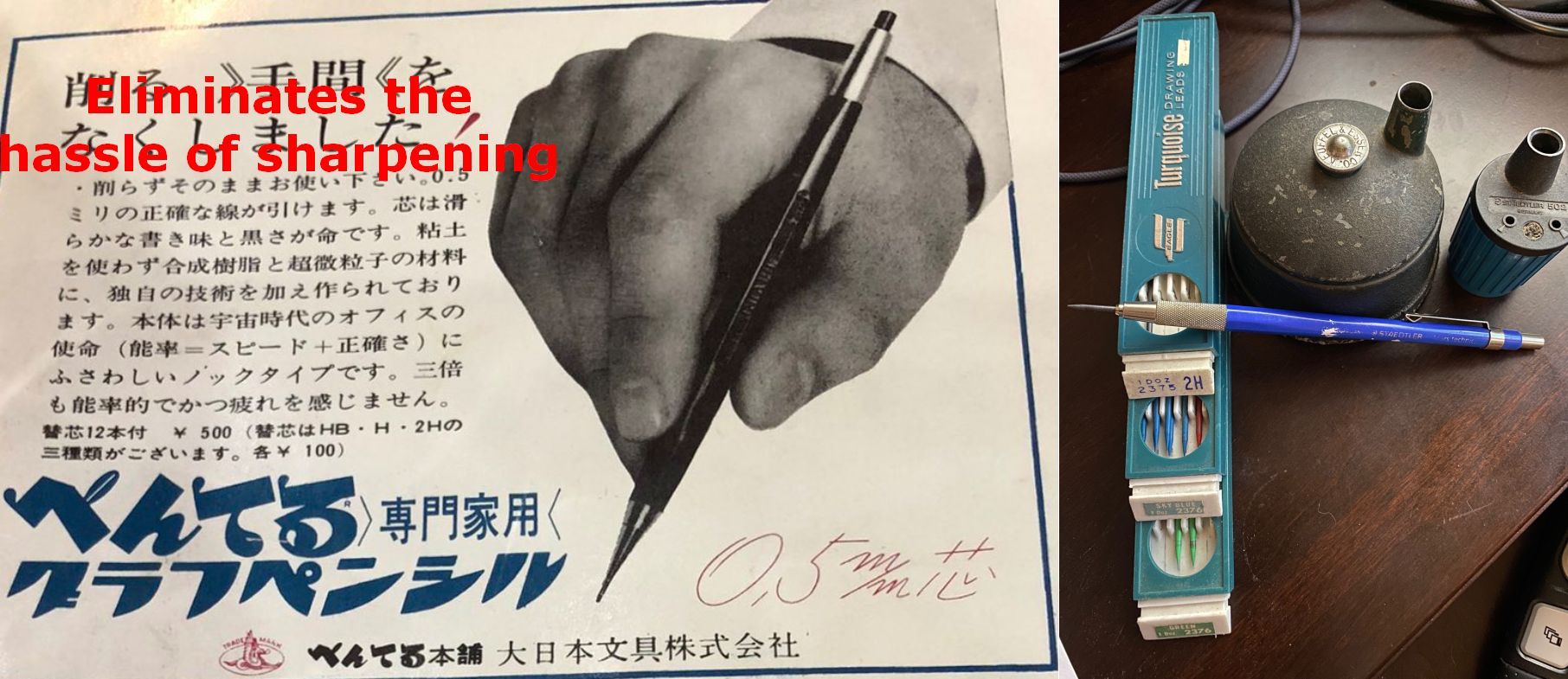
The official version is that Pentel invented the polymer-bound fine lead and launched it on the market in 1960. But is that the correct and complete picture? In the book “Drawing Instruments 1580–1980” by Maya Hambly (Sotheby’s Publications 1988) it reads:
The most recent development in special drawing pencils is a plastic ‘polymer’ combined with graphite to produce very fine leads, only 0.3, 0.5, 0.7 and 0.9 mm thick. Originally developed by Faber-Castell in the 1950s this process was soon taken over by a Japanese firm, now known as Pentel, who specialize in a range of fine leads supplied for small automatic-feed clutch pencils.
(I already asked Faber-Castell about this a few years ago, but never received a reply.)
From other research into details that are widely accepted, I know that reality is usually much more complex. And what is the situation here? Does anyone know more?
“Originally developed by Faber-Castell in the 1950s, this process…”
This kind of misleading sentence is frequent in boastful marketing, and consequently copy-pasted by authors.
She likely referred to early European experiments with polymer additives in lead formulations during the 1950s, possibly tied to colored pencil advancements, rather than inventing ultra-fine (0.2-0.9 mm) polymer-graphite leads specifically for thin mechanical pencils. German firms like Faber-Castell refined binders for durability in wood-cased and colored pencils, which could involve initial polymer trials amid post-war material innovations. However, no primary sources confirm Faber-Castell pioneering the resin-based Hi-Polymer process that enabled breakage-resistant fine leads. Pentel commercialized that breakthrough in 1960-1963 for knock mechanisms and prompted a race toward ever finer mechanical pencils.
A Timeline of the Introduction of 0.5mm Mechanical Pencils and Other Related Stuff!
1962
• Pentel release the world’s first 0.7mm and 0.5mm polymer leads, and pencils.
1967
• Faber-Castell release the worlds second 0.5mm polymer lead, and their first 0.5mm pencil “A.W. Faber Castell TK 9501”.
1968
• Pentel release the world’s first 0.3mm polymer lead, and pencils
1969
• Staedtler release their first 0.5mm polymer lead and pencil “Micrograph 770” [and Pilot release their first polymer lead, the NEO]
• Chitose Kagaku Kogyo Co. Ltd (OEM lead manufacturer) founded by Sekiya Takashi, former Pentel employee and developer of their polymer leads.
1973
• Pentel release the world’s first 0.2mm polymer lead and pencils.
Something else occurred to me: “polymer additives” do not necessarily have to be synthetic, as is common with thin leads, but can also be of natural origin like cellulose. To my knowledge, cellulose was used as a binding agent for the last Staedtler micro carbon leads, which were recently replaced by imported standard leads, rather than PVC (the old micro carbon leads were polymer-bound too). This technique began in the late 1950s and was also used for the wood-cased Dynagraph and Duralar pencils. I wouldn’t be surprised if Faber-Castell tried something similar and Maya Hambly didn’t distinguish between these processes.
I believe this entry is incorrect, because as far as I know, Newman introduced the 0.2 mm lead as early as 1971.
This entry is now known to be incorrect, STAEDTLER’s first pencil and first 0.5/0.7/0.9 mm polymer leads were released earlier, with the date being somewhere from March 1966 at earliest to October 1967 at latest.