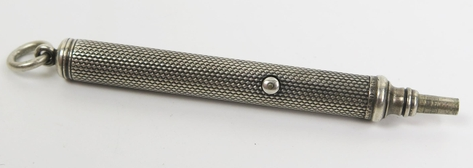
It’s understandable that the patent 18,435 has proved elusive, as it was not taken out in Mordan’s name, but that of its inventor, FC Danvers. A summary of the specification, dated 1889, can be found here:
Although the side button is used to extend/retract and lock the pencil mechanism within its outer case, the pencil itself still uses Mordan’s twist mechanism to advance the lead. In this sense, it is more like an early double-knock (or vanishing point) pencil, not a true side knock as such.
However, I have recently come across an interesting patent that could well represent one of the earliest side-knock mechanisms applied to a mechanical pencil. Dated 29 August 1844, its inventor, Mark Freeman, had already been granted patents for various desktop items such as an inkstands, candlesticks and card cases. I have not yet established if Freeman was also a manufacturer (there is a Thomas Freeman listed as a Birmingham pencil case maker in the 1840s), or indeed if his invention was ever produced.
Unfortunately I have not yet been able to locate the drawings that accompanied the specification, but from the text I think it is clear that these were all rack-based designs that worked by pressing a button on the side - “by the hand that is using the pencil” - to advance the lead in regular increments (which possibly makes it not only the first side-knock pencil, but also the first ever knock-type pencil).
Intriguingly, the fourth variant is described as being operated by two buttons “pressed alternately”, which sounds uncannily like the Knips/Belfor Clicker of a century later.
For ease of reference (and future searches), I have transcribed the patent summary text below. It would be good to hear any opinions on the various mechanisms, or news of any real-life examples that might be lurking out there in plain sight.
A.D. 1844, August 29.–No 10,297.
FREEMAN, MARK. – “Improvements in apparatus called ever-pointed pencils.” The invention consists in so arranging the apparatus that the forcing wire may be propelled a regulated or certain distance, and that this may be effected by the hand that is using the pencil, and that warning is given just before the lead in a pencil case is used up. Four of the five pencil cases described have each an external case, an inner tube fastened to it by a screw or stud, and the ordinary point or nozzle. In Nos. 1, 2, 3, the forcing wire has at the top a toothed rack, worked in 1, 2, by a lever which moves on an axis “fixed in the slide,” and is so formed as to take into the teeth of the rack. In 1, 2, when a shield (affixed to each lever) is pressed, the rack will be moved downwards. In 1, a bent spring is so placed that, when the pressure is removed, one end of it will raise the handle of the lever; this will cause the other part of the lever to take into the next tooth, while the other end of the spring having a small projection on it will act as a catch and prevent the rack from moving back. In 2, the spring is affixed to or forms part of the lever. In 3, the rack is moved downward and prevented from moving back by two bent springs acted upon by a stud which passes through both cases and both springs, but influences only the outer spring by pressure. When a fresh supply of lead is required, a slight lifting of lever and stud will allow the rack to pass back freely. In both lever and stud is a notch to prevent them “from being pressed inwards,” when the inner tube is drawn back. In 4, the upper part of the rack has two rows of teeth, one row “being intermediate” with the other. A coiled spring (the lower end pressing against a flange on the rack, the upper against a ring in the inner case) has “a tendency to press the forcing wire outward, but the same is controlled by means of an escapement,” namely, “a sliding instrument having an opening through it,” such that if the ends or buttons of it are pressed alternately, one of its surfaces will allow the rack to descend half the distance between two of the teeth. The forcing wire must be pressed back when a fresh lead is to be introduced. In 1, 2, 3, 4, the nozzle slides to and fro; but in 5, the machinery is in a separate case, and the external case forms a sheath when the pencil is not in use. The mechanism differs from that of ordinary pencil cases only in having “the screw, in what manufacturers call the ‘movement,’ cut in the reverse direction,” in order that the finger may cause the lead to be moved outwards by pressing round a “wheel which is fixed or formed” on the nozzle. When the nozzle is in the sheath, a wire passing between two projections on the ring at the lower end of the sheath, and two placed a little above the nozzle wheel, prevents any turning and consequent wasting of lead. A projection is “formed on the rack, or means of giving motion to the forcing wire, which projection coming out of a hole in the inner tube, shows itself beyond the end of that tube,” thus indicating that the lead is nearly used up.
[Printed, 1s. Drawings.]