I met this pencil at a FP collectors in-person meeting here in Trieste in May this year, and it quickly stood out in the crowd of surrounding writing implements; since the general audience was way more focussed on pens than on pencils, I was able to snag it for a more than reasonable price, and after some tests I am intrigued by its many quirks.
This is, of course, the Sailor N21 (or N.21) in 0.5mm. Already from its name, you can see that it is a sound candidate for an “adult” collection (and even if the name is not enough, I believe it has earned the right to drink a glass or two, after so many years of just being around).  Picture below.
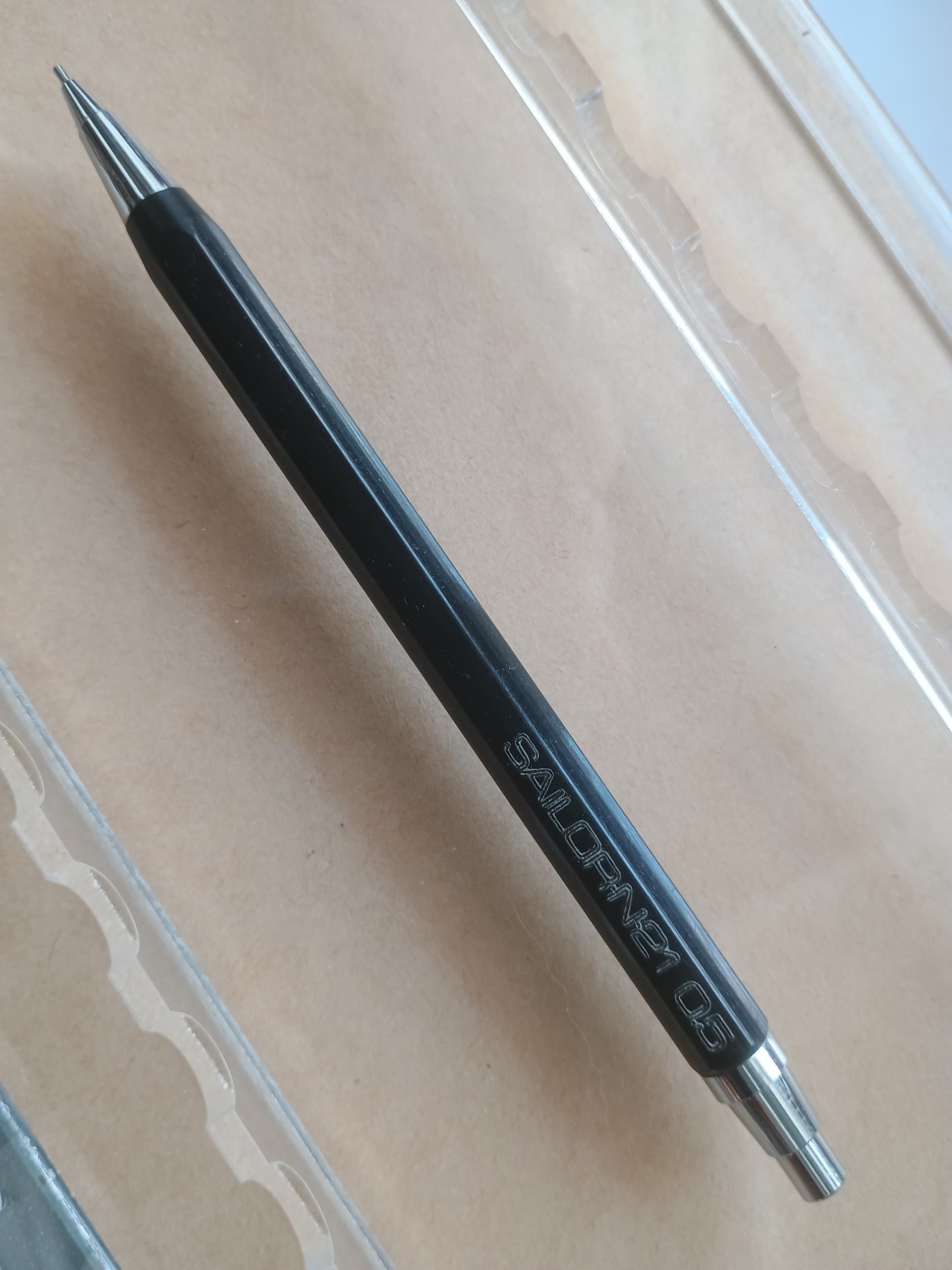
In many respects, I would say that this pencil is an “edgy” one: almost all general features of the specimen are just a bit off, but in a way which evokes personality, rather than design flaws.
Take for instance the barrel: thick black plastic with a hexagonal section, but the edges of the facets are gently chamfered and rounded, so that the overall tactile feeling is unusually pleasing — it reminds me of the black Golden Axe, also known as a clone of the Mitsu-Bishi M-30.
Then the endpoints: it has a strange two-step tip section (Sakura XMP, to name a relative, or Pilot H-1085, but with a more seamless-oriented angle), but the structure is purely aesthetic, instead of functional; also, this two-step form factor is mirrored in the tail end, where the pushbutton is gently introduced by a tapered metal band.
The imprint on the barrel is somber, almost austere, but there is clearly a missing space between “Sailor” and “N21”, as if the kerning had gone off the rails — but then again, the spacing seems perfectly correct and fully aware when it comes to separating the name of the object from the “0.5” notice of the lead size.
There is a lead sleeve for the thin-lead cores, as in a drafting pencil, but it is fixed, and it is especially short when compared e.g. to the one of a real drafting pencil (Accugraphs, Tikkys, Tomobow Monos, rOtrings…), which raised the question: what was the use case for this pencil?
There are way too many but’s in this pencil to look like a coincidence: it is like someone studied all these little features and put them together intentionally, and masterfully, to see how well they worked together, and how far from the mass it could set this piece. Needless to say, such a collection of weird points makes the pencil very interesting to me, and quite dear.
What do you think? Do you know about some other pieces which could compare to this? Was it a common item or an unusual name in the catalogues? I am all ears.