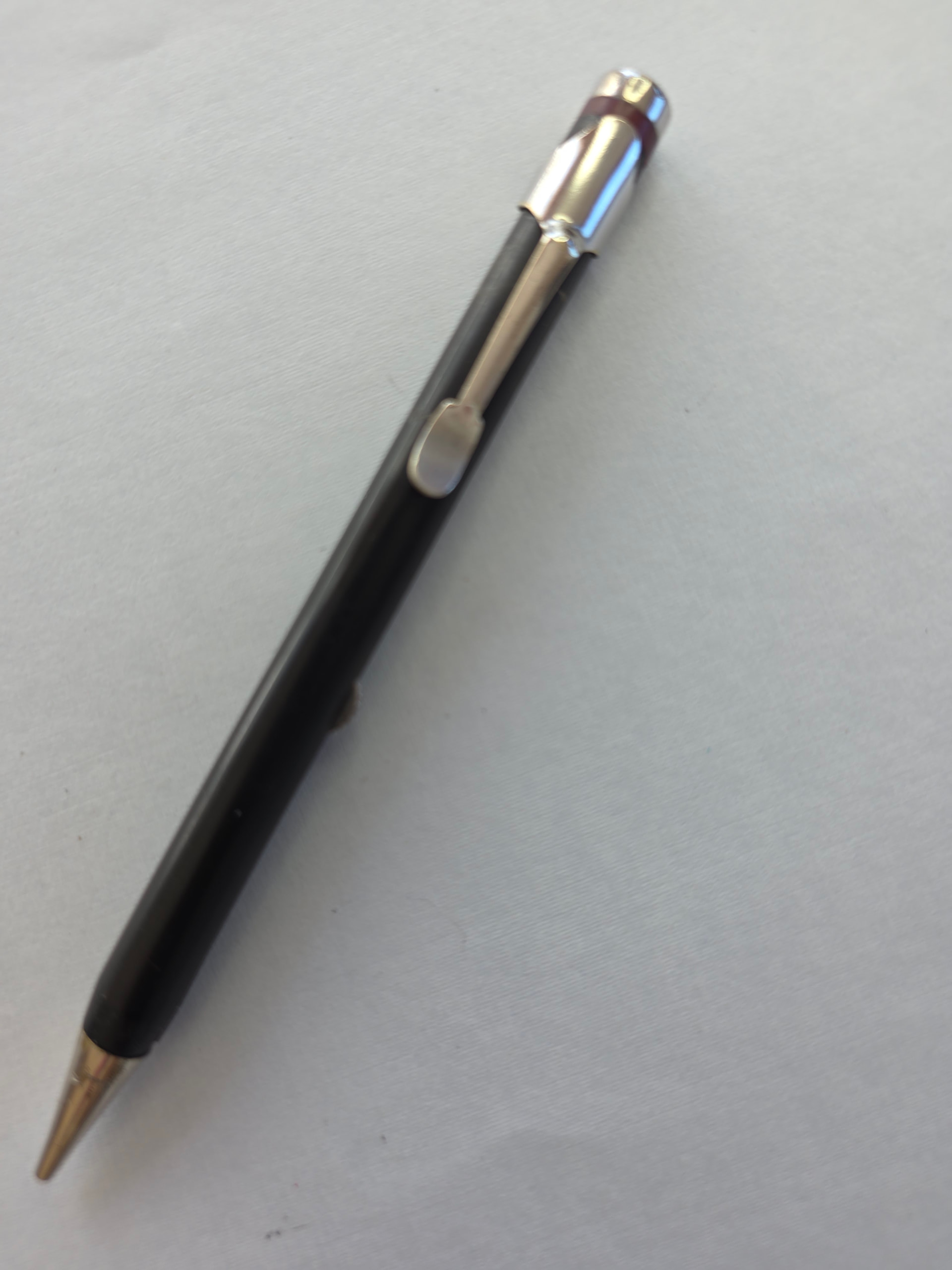
The Ritepoint "wheel" mechanism from the 1950s

“Wheel” mechanisms aren’t unheard of:

There are the Listo, the Ohto Super Promecha, the Slencil or that one flat Kanoe one;

Almost all (read the replies for an example) have in common that their wheel is mounted coaxially to the pencil.


How the Ritepoint Wheel pencil works

The Ritepoint, no model name, however, has a wheel whose center axis is perpendicular to the pencil.
The wheel, as described in the 1955 patent US2833251, is made up of a pulley, around which a long coiled spring (“spiral propelling spring”) runs. Inside the spring there is a strong metal wire that is bent around the pulley.

So when you push the coil around the wheel, the wheel turns with it, the metal wire stays in place and the coil “flows” around it. That’s how the coil never loses grip of the pulley.

In comparison to other multipencils, a lead almost half the length of the pencil is impressive.
I haven’t checked all multipencils yet, but it is a contender for the longest single lead in a multipencil.

It suffered the fate of being no more than an advertisement pencil. So let’s give it the love it deserved.


The Japanese wheel pencil

Possibly the smallest multipencil is a japanese version of this mechanism.

Noted “Japan Pat. 190058 Whisper”, it still requires research.


The unrelated(?) older German patent

DE1608148 uses a pulley mechanism, in 1948, before the Ritepoint. It is unknown if it was ever manufactured.


Hope you found it interesting!

14 Likes

This reminded so much of old lighters… Amazing!

Also, I had no idea one could ever come up with such a contraption for a pencil feed; it is a mechanical marvel in a very different sense than the convoluted pinions-and-gears complications inside a clock, and yet so close to the true meaning of the expression.

The immediate sibling in this sub-set of oddities might be the USUS Pi, with its switch-and-lever mechanism working once again against all standard arrangements, and still making for a super-cool pencil.

Love the knowledge you spread, @Wechselstift ! Thanks for this trip down oddity lane! :slight_smile:

5 Likes

Glad you enjoyed the post. As you mention pinions/gears… I will have to make a post on the Nardi in the future :smiley:

9 Likes

This gears system boggles the mind. And the pulley system is also fantastical. A tiny elevator machine inside a pencil.

The Ritepoint pulley design was developed after clutch holders and twist lock holders, so how would it afford a longer piece of lead than those other mechanisms?

2 Likes

If you are talking about this:

It remains the multipen with the longest possible lead refill to this day,

I noted multipen (or rather, multipencil), not mechanical pencil as a whole.
Or did you mean something else? Please let me know

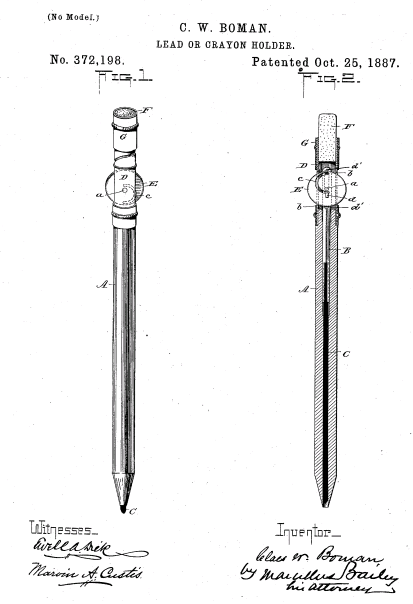
Proving once again that all things old become new again, Eagle Pencil had a wheel mechanism patented in 1887. The pencil was the Bicycle No. 345. Below is the first page of the patent (US 372,198) and an illustration from the American Stationer in October of the same year introducing the Bicyle to the trade, so it was definitely manufactured. I have yet to see one in person.

2 Likes

Thank you for the information, Kaibab! I didn’t know about this at all.

It is interesting that the wheel is not at the far rear end, but they chose to place an eraser behind it - makes sense.
While it does have a wheel, it doesn’t use a pulley system like the rest, but a cam.

The lead could only be retracted and advanced a tiny bit, and the wooden body had to be shaved away like in a regular wooden pencil. A wooden pencil with a retraction feature, amazing!

Here are some images of the Bicycle from the Jonathan Veley Blog:
https://leadheadpencils.blogspot.com/2021/05/herding-eagles.html

I assume that the "Black forest pen" wheel pen of interesting taste works in the same way.

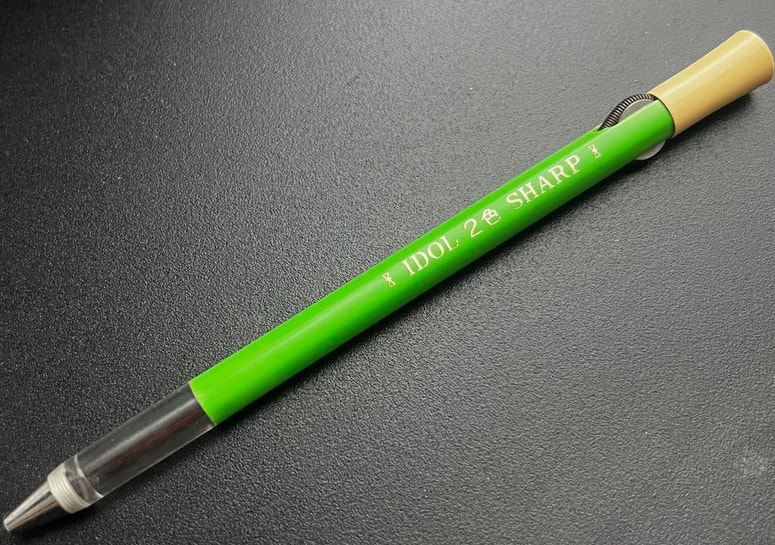
By its design, it made me think of this japanese 2 color pencil (using a pulley though):

(It currently sits at a cheap $600 on Mercari…)

2 Likes

Thanks for the additional information. It’s surprising Veley couldn’t find the patent since one of his patent books pointed me to the Bicycle’s patent.

1 Like

Then there is the EMGEE “Rollex”: British Made circa 1946/7

3 Likes

Perhaps I read it wrong. I thought there was a phrase stating the proposed improvement was that it could accept lead almost the length of the pencil. Looks like the text actually says ‘half the size of the pencil.’

You read it correctly, I edited it earlier, and just now multiple other outdated things.

I wrote this November 2025 which is when I just started writing up these texts.
At the time, I didn’t even understand the mechanism properly, in hindsight.

The length of lead was part of DE1608148 , not of the Ritepoint - I confused the goals of the invention, I just checked it to confirm.

However, it doesn’t change anything in regards to your question:

The Ritepoint pulley design was developed after clutch holders and twist lock holders, so how would it afford a longer piece of lead than those other mechanisms?

I didn’t write that it could carry an even longer lead than those systems, even assuming that the Ritepoint had a full-size lead, I mentioned these systems as example of single color ones.
Sorry for the confusion and mistakes.

Oh, I see. No worries.

I am captivated by all these wheels pulleys and gears. I was telling @TomYang that we should figure out how to put a tourbillon in a pencil for automatic lead feed…