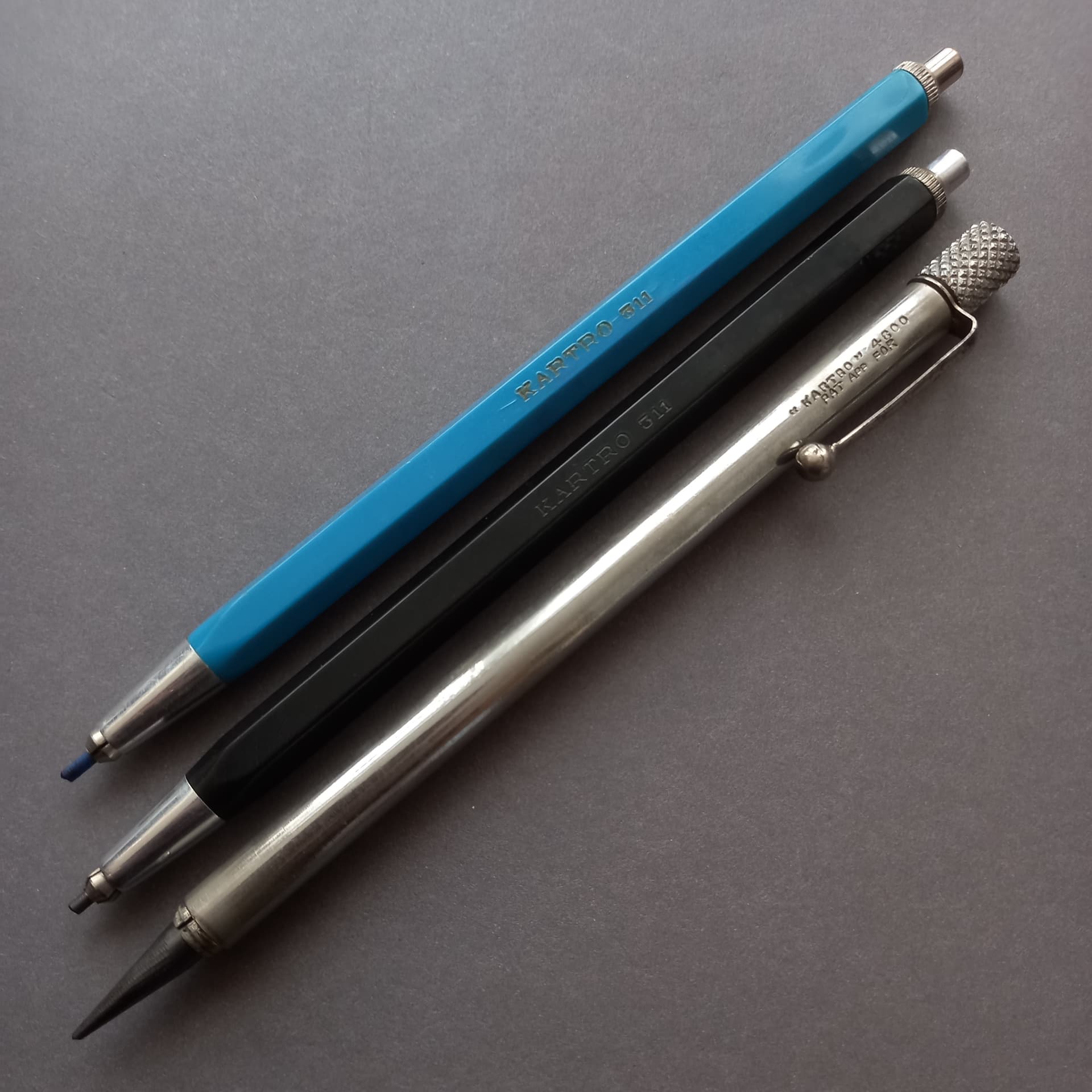
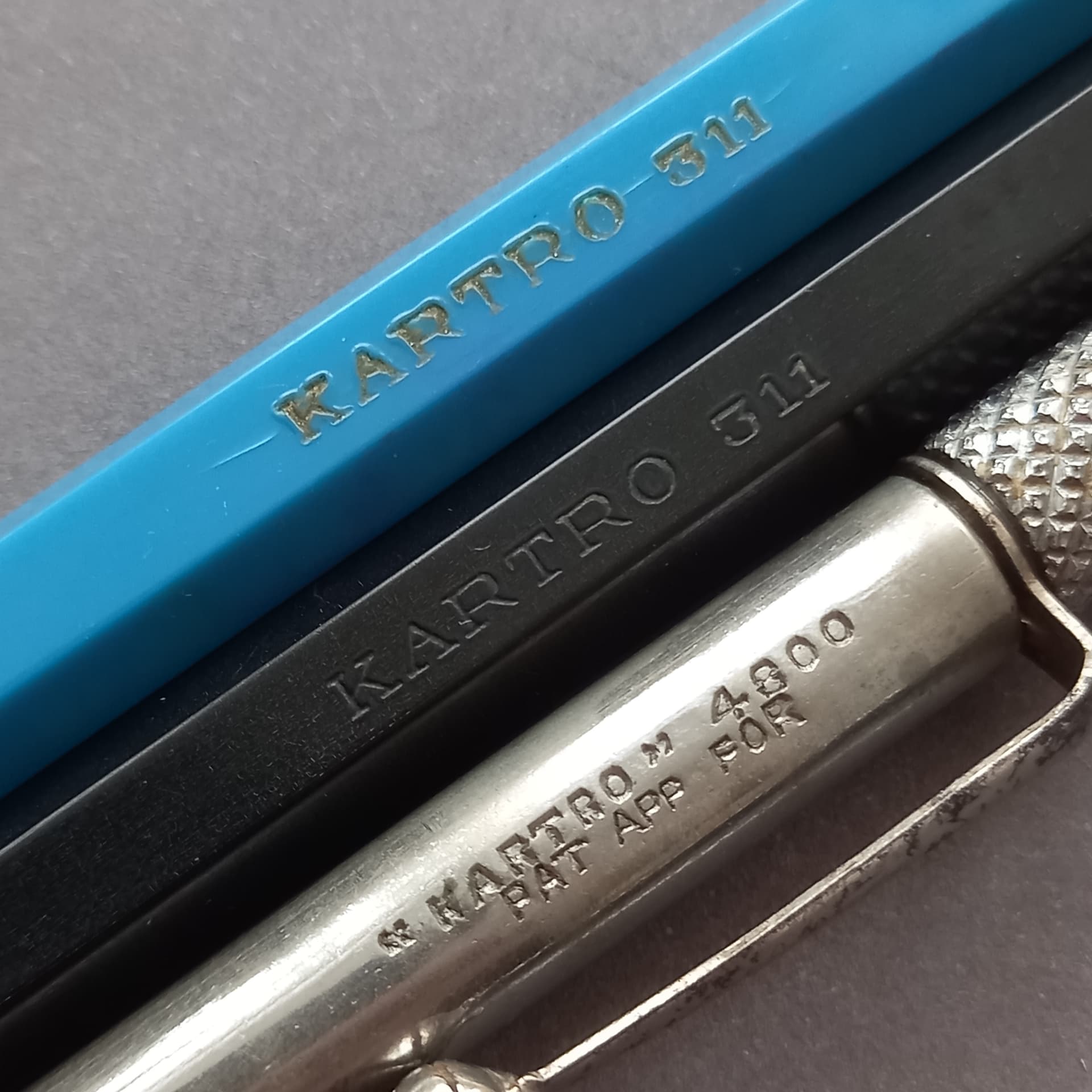
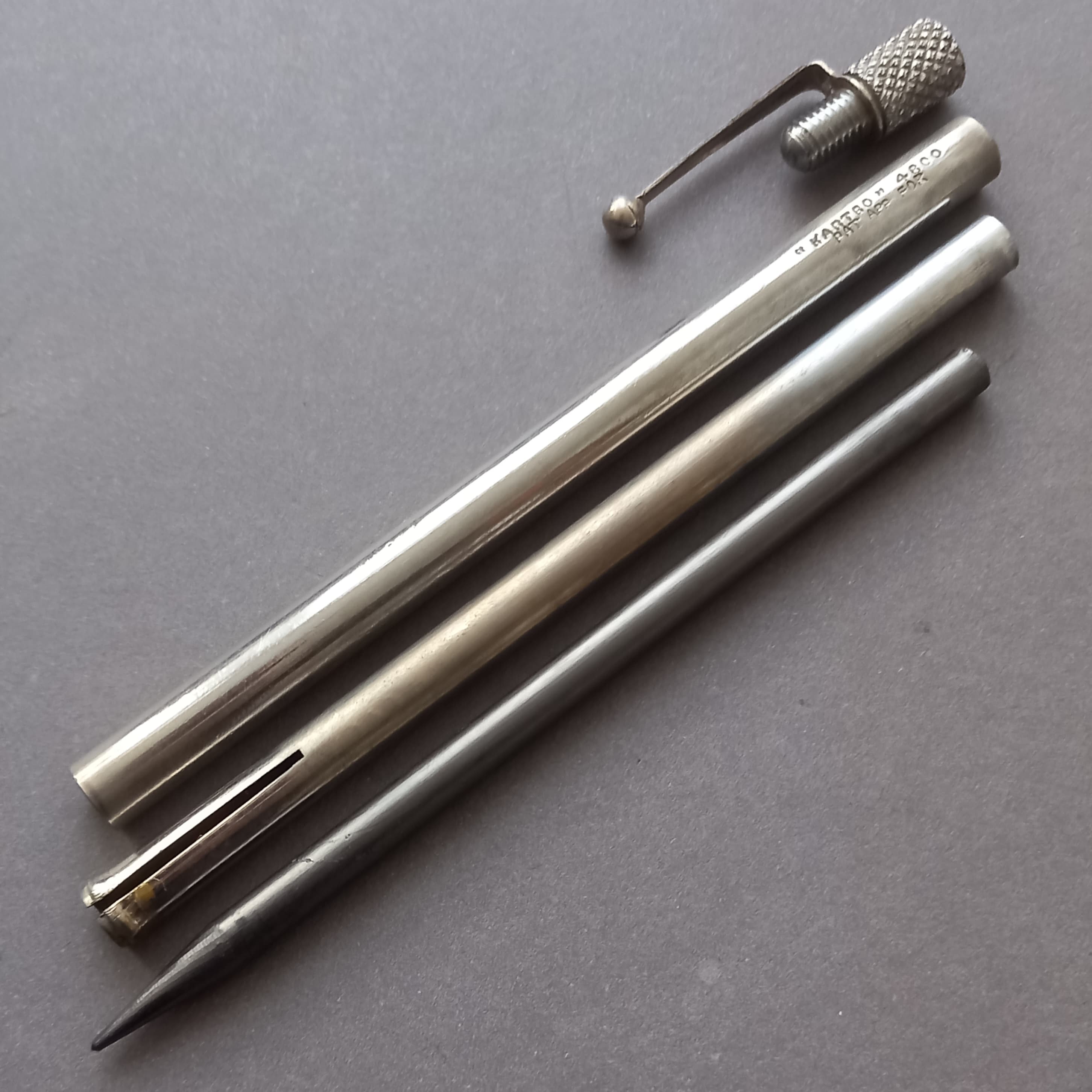
These are 1.8mm and 5.6mm pencils, with such widely different appearances that I wondered if they might not even be by one maker. Kartro appear to be an English office equipment company based in London around the 1930s. Anyone else got any other models by them?

10 Likes
I LOVE everything about that 5.6mm 4800!
1 Like
May be it has something to do with the brand Kartro-Werke?
2 Likes
Its a brutish thing. Heavy metal
I have some Kartro lead refills, but no pencils, although I have seen the 4800 for sale before.
1 Like
The Austrian Kartro appears to a portmanteau name derived from the business owner, Karl Trostli. See this box of pen nibs on ebay:
4 Likes
I am particularly surprised by the size of the Kartro 4800: most of the 5.6mm clutch pencils I own tend to present themselves with a shorter length — on average, half the size of a regular 2.00mm MP — whereas others with longer barrels typically exhibit larger girths as well.
For the shorter versions, I clearly remember a triangular-barrel specimen by KIN, and a very cool, lacquered wooden-body piece by A.G. Spalding; there is a longer KIN model (No. 48, perhaps?), still with triangular body, plus the Criterium 2520 in aluminum, and I think these four are my favourites by far.
This is a very unique case of tight-fitting, full-lenght holder; spectacular. The detachable clip with that spherical tip… chef’s kiss.
3 Likes
There is a 1936 German patent by Karl Trostli for a mechanical pencil with integral sharpening apparatus:
https://worldwide.espacenet.com/patent/search/family/003677994/publication/DE640719C?q=pn%3DDE640719
By the look of the drawing, I think it is an entirely different design to the ones in the photo.
2 Likes
I love those shorter, pocket-friendly thick lead pencils too. Great for sketching out-and-about
I love Heavy Metal - it’s my favorite music genre! 
Oh, I like my pencils and pens to be heavy as well. 
Interesting the 1.8mm size - must have been a precursor to the standard 2mm. Anyone know the history of why it changed? Yes, yes - I could google it and get some form of an educated, possibly accurate response, etc, etc…
Cheers,
Tim
2 Likes
Do the refills have any information on them other than the brand?
I don’t recall any - I will have to find them to be sure. I’d guess they were the 1.8 mm size and full length.
Full disclosure: I dont actually know. But this is an interesting question. Pure speculation, though based on experience of use, part of the answer may lie in the fact that there are no dedicated lead pointers designed for leads with a calibre below 2mm, perhaps? 1.8mm seems like a threshold for enabling a fine mark- before the 1960s polymer leads invention at least. If you go thicker, the leads mark making is unacceptably inacurate, once blunted, without pointing the lead. So perhaps a 2mm thicker lead allowed for the tolerances in the materials to enable sharpeners to be effective, without breaking the lead? Maybe that was more useful- if you cant go thinner go thicker, with the facility to sharpen?
2 Likes
Well… I would say this question should get a “yes” for an answer about 99.99% of the time, but… (of course, there is always a “but” somehow, in the strange world of pencils).
In my pursuit of the perfect pencil pointer, I ended up gathering a number of specialty tools from Faber-Castell within their “Minfix” range — see here for an almost complete catalogue. Now, most of the Minfix I have present one or two holes, allowing for sharpening the standard 2.00mm (10H to 3B) and 3.15mm (4B to 6B) lead cores. When equipped with freshly honed blades, these objects work flawlessly, and deliver what I consider the best writing tips available in the realm of palm-and-fingers-held pointers (the only exception may be a pointer from Theo Alteneder I saw in the inventory of our Dan Linn, but that is an otherworldly beautiful piece with super-short blade whose effectiveness I cannot assess, unfortunately).
There is an exception, though: model number 50/64 (not commonly seen for sale) has indeed two holes, and one opens to accommodate a typical 2.00mm diameter (with an actual section diameter of 2.15mm), but the other one, on the opposite side, is smaller; a precise measurement sets the true diameter of the hole at 1.98mm, which is in my opinion the size expected to sharpen 1.80mm or even 1.50mm lead cores.
So, while it is true that, in the common parlance, smaller diameters do not enjoy dedicated pointing tools — save perhaps the rotary sharpeners or the sandpaper sticks, but those work with any diameter — it is also true that there has been a very, very niche exception, from a company known for its super-wide range of specialty solutions. 
1 Like