@Pdunc67 your item no.1 is a sleek variant of a design which has seen a lot of evolution over time. In this picture, I can show you a bit of that history:
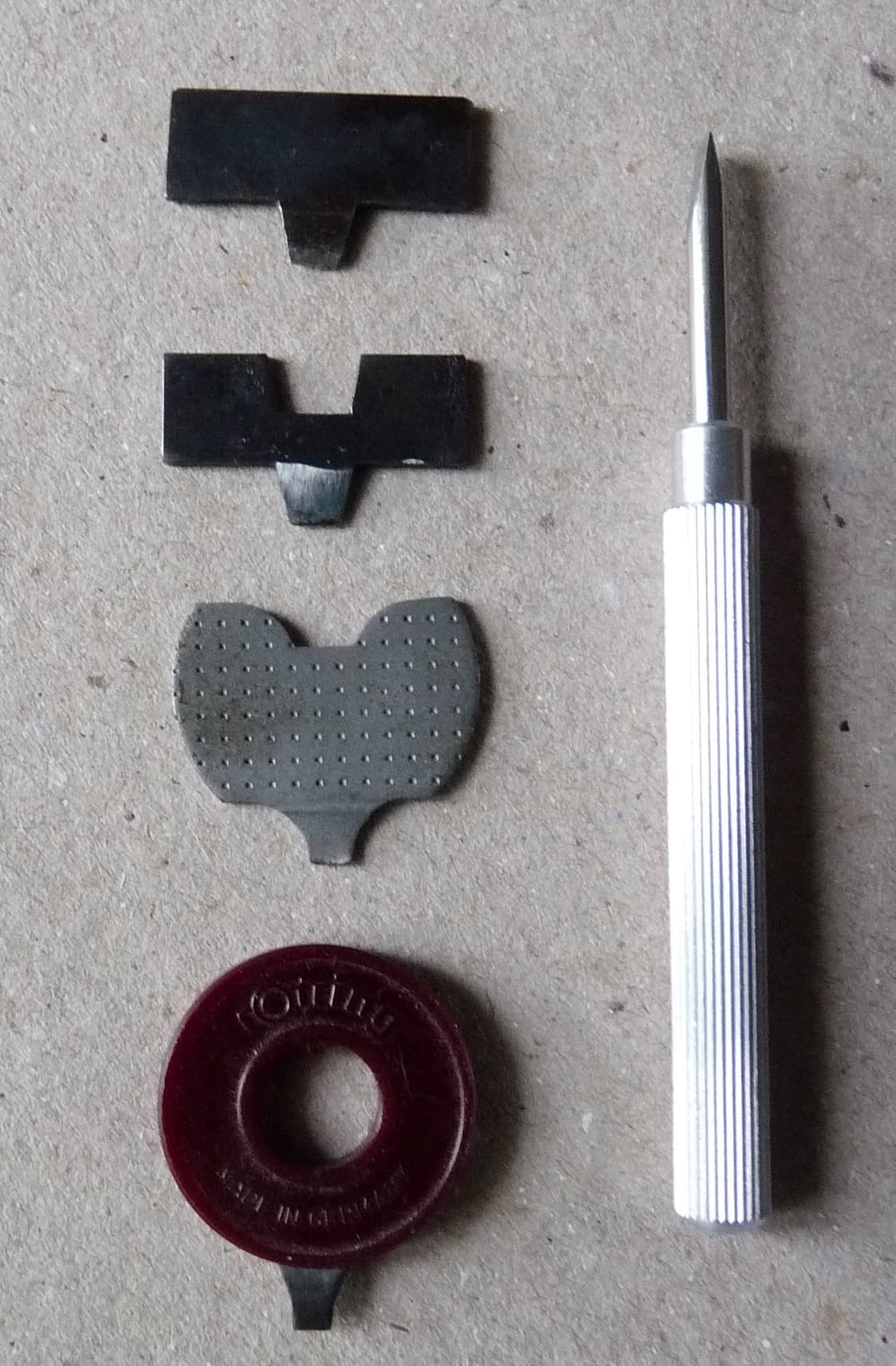
Top to bottom, left to right:
A-B: two early models (1920’s-1930’s?) from Lotter: the thumb and index fingers grab the larger portion, the protruding wedge fits into the slit of the screw to tighten it. Back in the day, even smaller compass sets used to have one of these, to allow for a finer tuning of the compass main hinge by the user.
C: A lightweight model by Riefler, from a large “Sinus/Cosinus” compass set, with the characteristic “butterfly” profile; not sure about the date, possibly 1960’s or 1970’s.
D: A rOtring model from a mid-sized but high-quality set, with a plastic handle nicely arranged into a ring shape; very nice to have around, but delicate to use — I’m always afraid I can break the plastic or deform the wedge. Circa 1980’s, I believe.
E: on the right side, a small screwdriver made entirely from aluminum by Haff: many manufacturers started to include such items in their lager sets, especially when such sets had various types of accessories requiring frequent tiny adjustments; variations exist with plastic handle.
As for item no.2, instead, below is a small gathering of centre-finders I found over many years of scouting; they were also used whenever one had to draw many concentric circles: by placing the centre-finder once and for all, it was possible to use the compasses many times without further damaging the paper, and ruining the spot by drilling an unusually large hole.
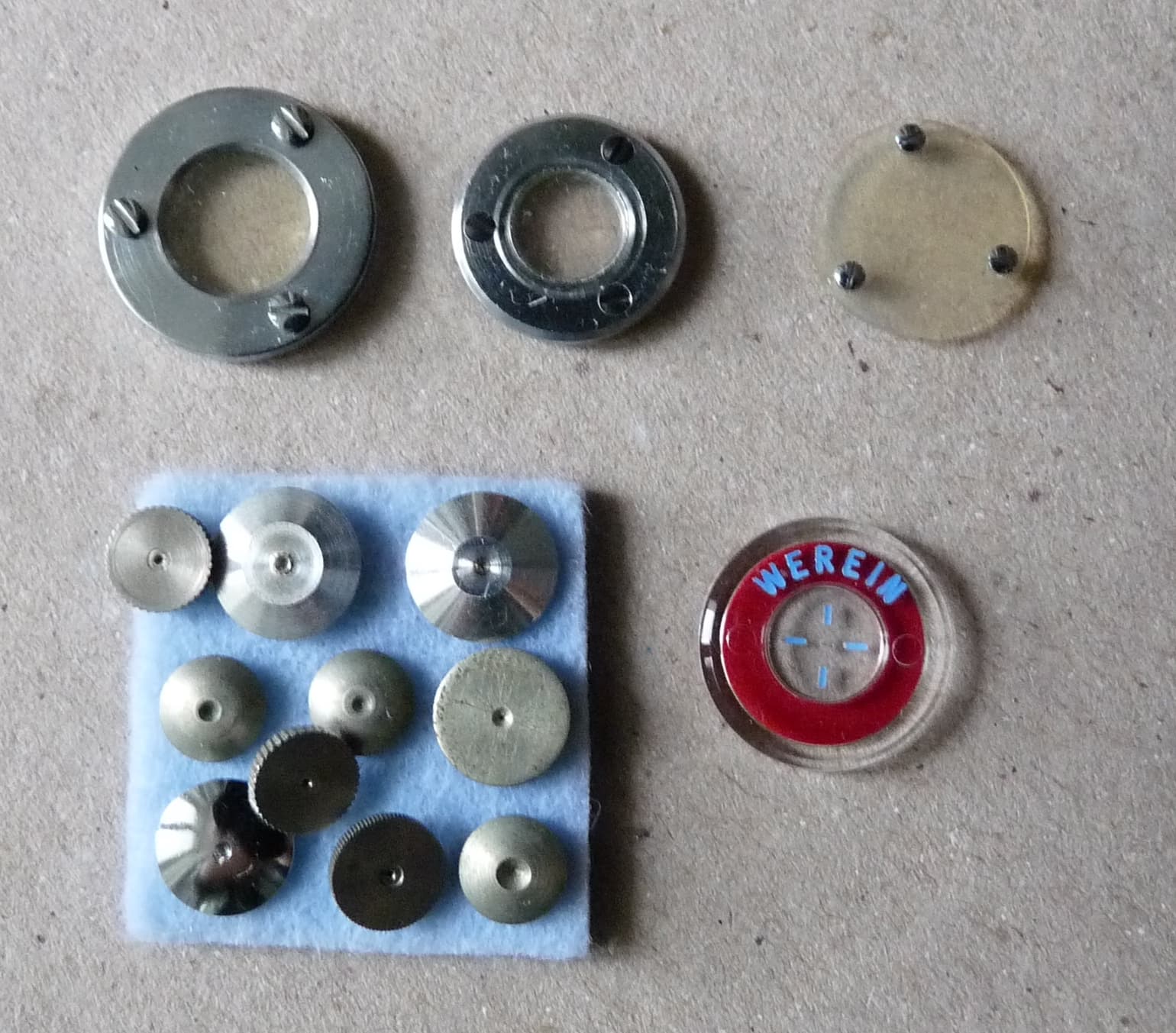
Starting top left, going clockwise:
A: Three-nails model with translucent window by Kern Swiss/Kern Aarau; the screws have super fine needle points on the other side, to grab the paper precisely and securely without significant harm to the surface they hinge onto. Diameter is around 2cm.
B: Smaller version by Haff; notice how the screws do not protrude out of the surface of the centre finder, preventing unexpected tears by a compass needle gliding over the surface and getting stuck in the outer rim.
C: Even simpler version, I think by Riefler: here the transparent layer is itself the material in which the needle screws are directly inserted: better view and less visual cluttering, but a more delicate item — with Riefler, this was always the case.
D: A relatively more modern version by Werein (1980’s maybe?): the needles are traded for a thin red rubber band ensuring full contact between the centre-finder and the paper; this is what can usually be found in Staedtler’s later compass sets and in all major Japanese manufacturers’ boxes, like the one by Uchida you have there. I prefer the needles, as the rubber band can easily slip out of its intended position.
D: A piece of light-blue felt upon which I have pinned all the smaller, non-transparent versions of the centre-finders I have: every one has a small needle-like point below the round gear (various manufacturers and production ages imply different levels of precision in the pointy tip), and works as stated earlier; I believe that these were used when you started a drawing with many concentric circles, and in principle you could choose where to put the common centre; the transparent ones were instead meant to be used when you were forced to find the center somewhere, and the limited freedom required a better way to exactly pinpoint the spot for the required centre.
Thanks for sharing that Uchida set, looks gorgeous!