From the Knockology archives
This post revisits conversations from our smaller community before we moved to this forum. I’ve brought the discoveries and memorable moments together, with credit to the members who contributed. These discussions reflect what we knew at the time. Please add any newer information, corrections, or photos below!
There are relaxing ways to spend time with a mechanical pencil collection.
Trying to read tiny markings hidden under pocket clips is not always one of them.
In January 2022, I was working through parts of my Pentel Clic family, comparing the date codes I could uncover with the physical features we had been discussing. It was slow work, but it started changing the timeline I had in my head.
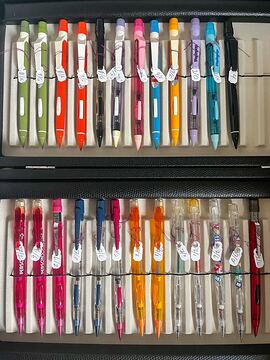
My Clic-family pencils with the little research labels attached. Original photograph shared during the January 20 discussion. The surviving image gives an overview; it is not sharp enough to independently read every code.
The first clue wasn’t the date code
I had first noticed the small-hole/big-hole difference on PD335 and PD345 examples. Heath then helped investigate it, comparing his own pencils, openings, date markings, and photographs.
That physical difference gave us another way to interrogate a date. A short code without a clear decade can leave room for interpretation; a code considered alongside a construction change can be more informative.
One little difference had given several collectors a reason to pull out their pencils. Now we could compare the clues instead of trying to make one faint code tell the whole story.
The January 20 update
My update to the group began:
“Slowly making progress on dating some of the Clic family pencils.”
Then came the part that would make anyone with a pristine example hesitate: reaching the code meant removing the pocket clip on the examples I was examining.
I reported that the Disney DPD355 examples were pointing to the late 1990s, rather than the 1980s I had associated them with. I also described the PD355s and related examples I had been checking as falling in the mid-to-late 1990s.
Those are the findings from my examined pencils at that stage. They shouldn’t be stretched into a statement that every Disney Clic is a DPD355, or that every related variant must fit the same dates. The model distinction matters just as much as the decade.
Knocktype11 immediately asked the useful question: how were we deciding which decade a code belonged to?
Heath brought the opening sizes back into the discussion. His working comparison was small openings before roughly 1993 and wider openings afterward. The wider opening on the DPD examples supported a later reading. Changes around the eraser were part of the conversation too.
That was a working chronology assembled from the examples we had, not a factory-issued date table. The hole size was supporting evidence, rather than a universal decoder that could settle any Clic on its own.
February tightened the picture—and left a question open
When the PD359 and the introduction period came up again in February, I said:
“All of the ones I have are dated 1997”
In that follow-up, I also said the PD355-style examples I had been able to date weren’t older than 1997. That was a more specific observation than my broader January wording.
I floated the possibility that the rubber-grip transition came around 1998, partly because I wasn’t finding later examples of the earlier style in my group. I also remembered buying a non-rubber version at Walmart in 1999.
That last detail is exactly why these conversations need to be preserved with their uncertainty intact. A remembered purchase date is a date of sale, not automatically a date of manufacture. Older inventory could still be on a shelf. Equally, a gap in my sample couldn’t establish a final production year by itself.
By February, we had recorded 1997 examples and sharpened the next question: when exactly did the rubber-grip version arrive?
The cost of getting one more data point
Dry asked about putting clips back. I said they did go back on, but I had to take my time. “Way too much time,” as I put it.
Heath asked about removing PD335 clips. My answer was:
“Yes. It sucks.”
When the risk of damage came up, I was more direct:
“Yes. Not worth it.”
Please keep that part with the research. This isn’t an invitation to prise the clip off your nicest pencil for the sake of a spreadsheet. A date code is useful; an undamaged, documented example is useful too.
What would help move this forward
The most useful comparison would pair an already-visible code with a clearly identified model, opening size, eraser arrangement, and photographs. Packaging or a dated catalog reference could add a separate line of evidence. A lone year guess attached to a barrel color wouldn’t do the same job.
I love this discussion because it records the process: notice something small, compare examples, challenge the date, revise the idea, and occasionally decide that one more stubborn clip simply isn’t worth it.
Do you have a Clic example with a code or construction detail already visible that adds to—or challenges—these early observations?
From January 20 and February 5, 2022 discussions. Initial PD335/PD345 opening-size observation: Thomas. Follow-up research: Thomas, Heath, Knocktype11, Jimmy Simpson, and Dry. Photograph: Thomas.
Knock on!