A.W. Faber Sharpeners and Pointers

I have a soft spot for lead holders and a soft spot for lead pointers. For a while I was focused on finding the smallest, highest quality, vintage lead pointers.

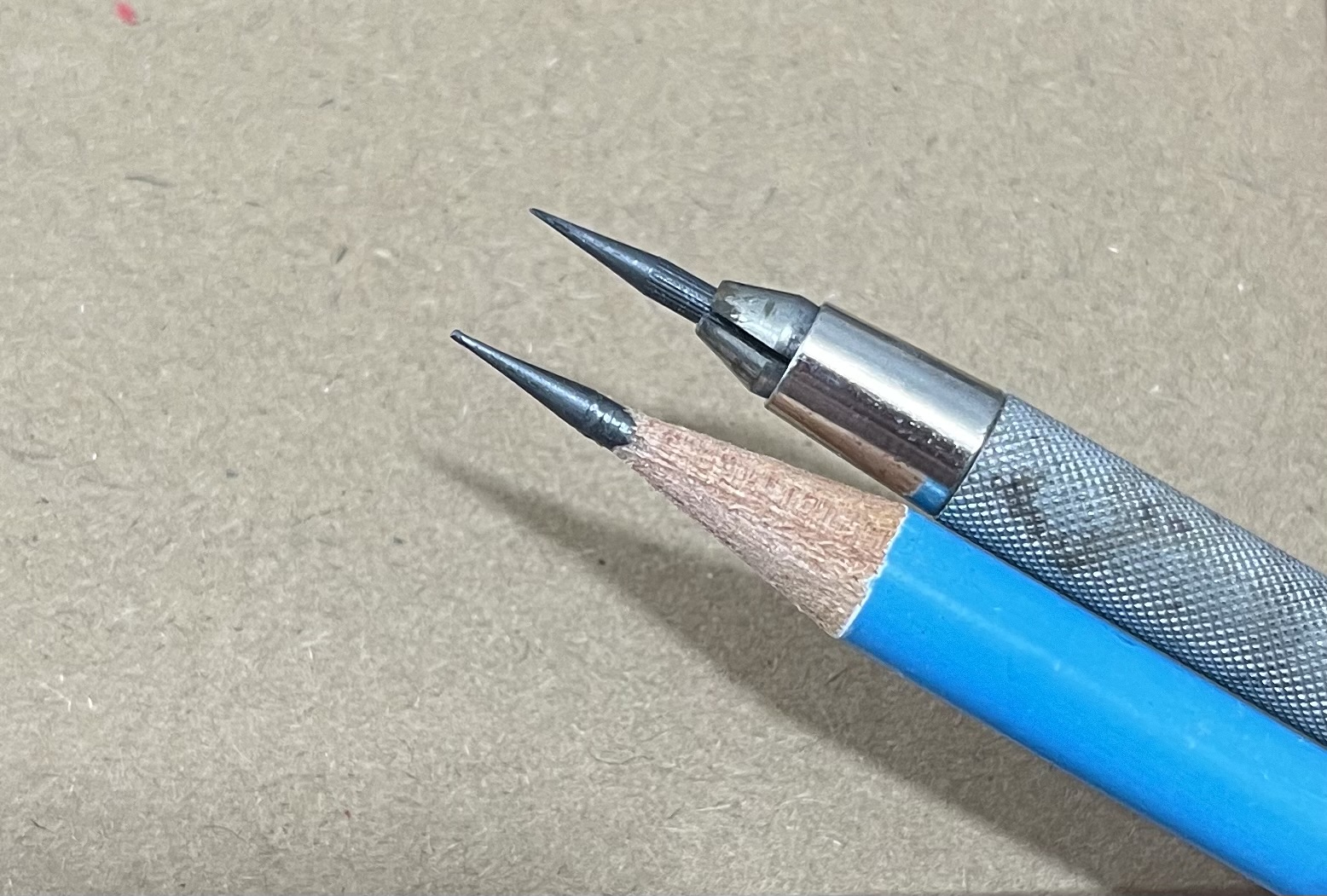
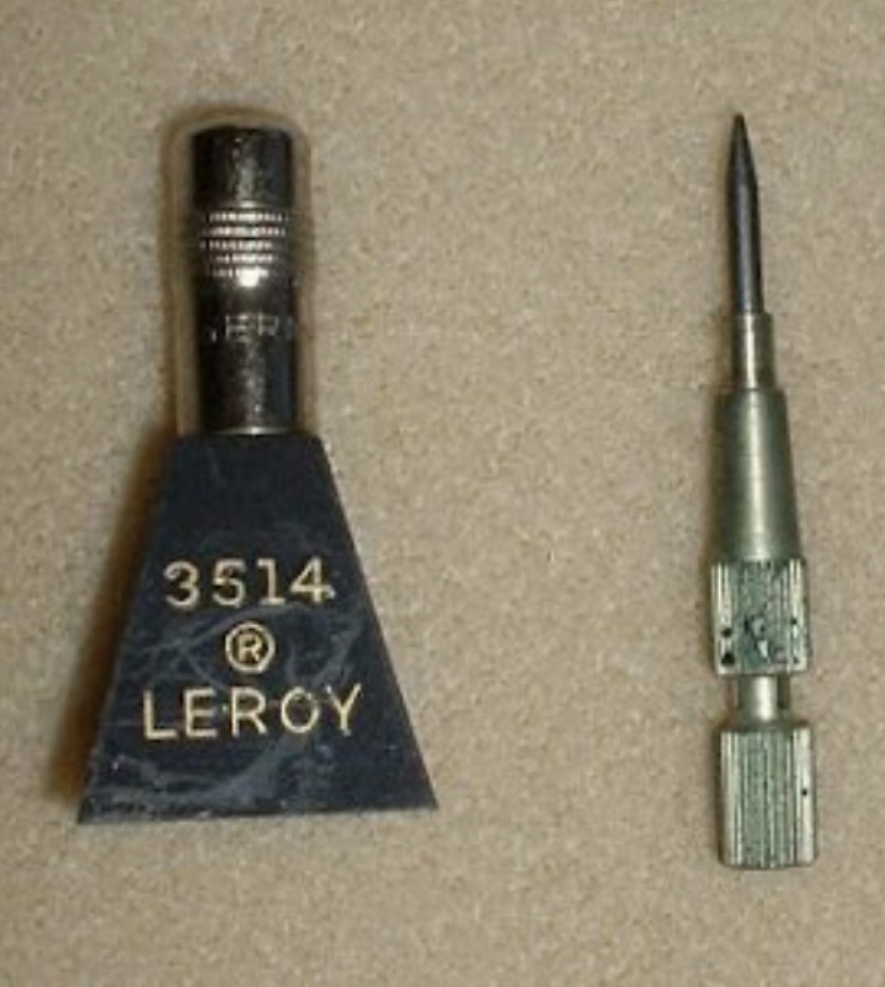
One of the smallest is a K+E item similar to the Ohto Brass, but smaller. It is essentially a lead holder cap pointer on a little plastic stand. Mine is in deep storage and I can’t find an image online today, unfortunately. Perhaps one of you has one to share?

The highest quality is perhaps this wonderful piece by DJ Fugle. It retains the shavings, which is convenient if you are not on the go and can keep the pointer vertical on your desktop. If you are on the go and it tips upside down, the shavings will fall out the insert hole.

As one would expect, A.W. Faber has a variety of offerings, but their brass sharpeners and pointers really caught my eye so I sourced a few that stood out.
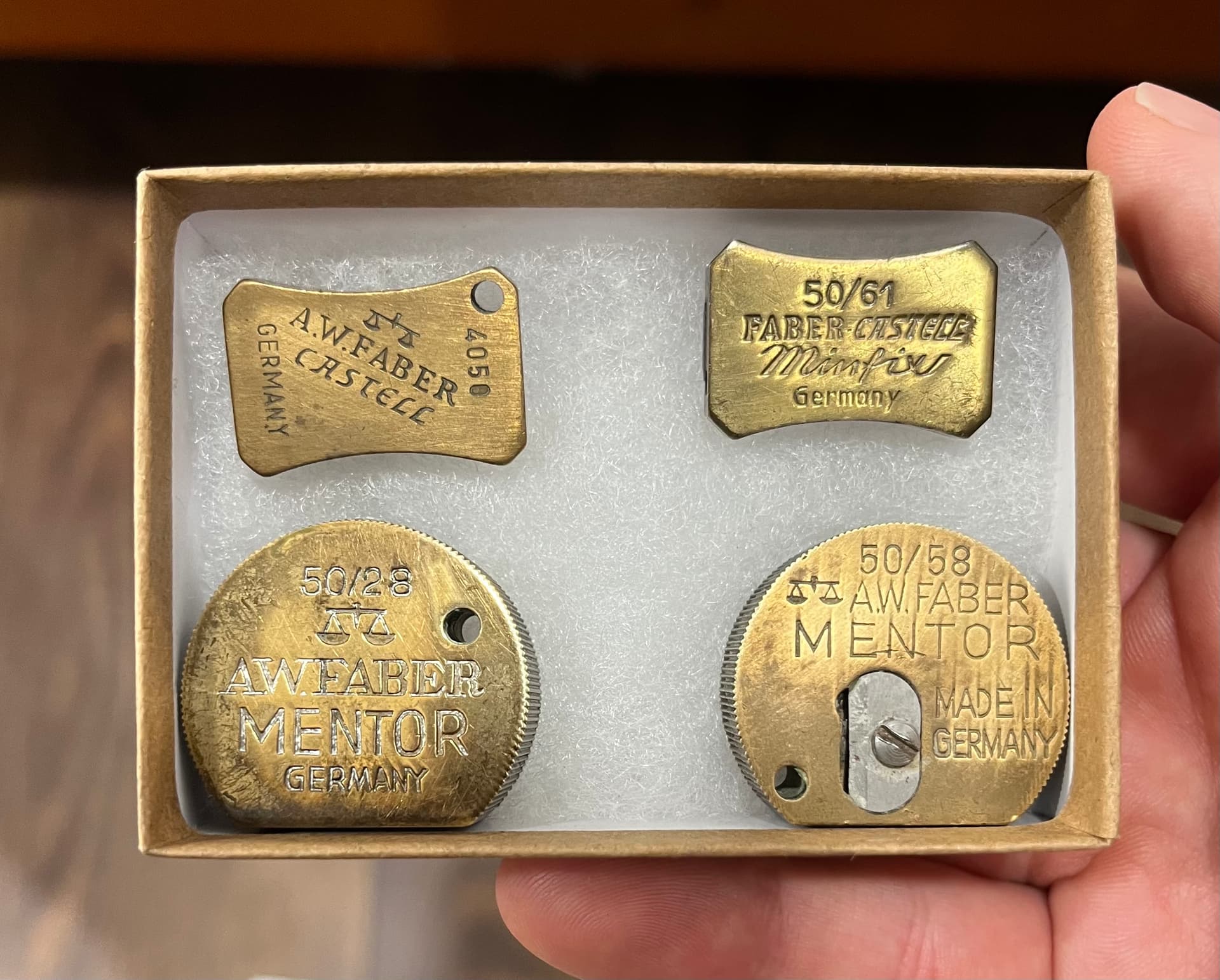
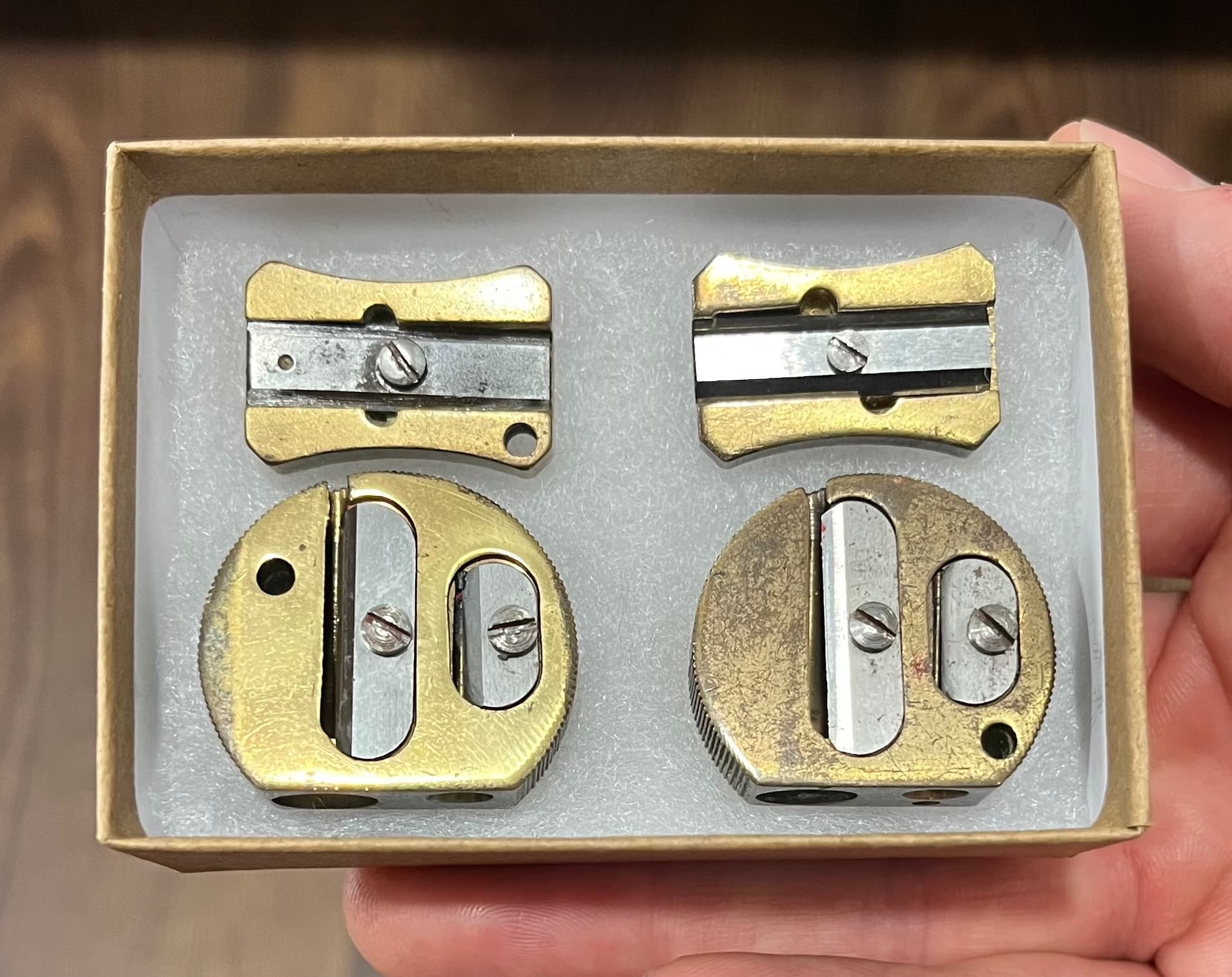
The rectangular pointers here use one double-sided blade to sharpen 2mm and 3mm lead through two different holes. The 4050 has both holes on one end and the 50/61 has one hole at either end.
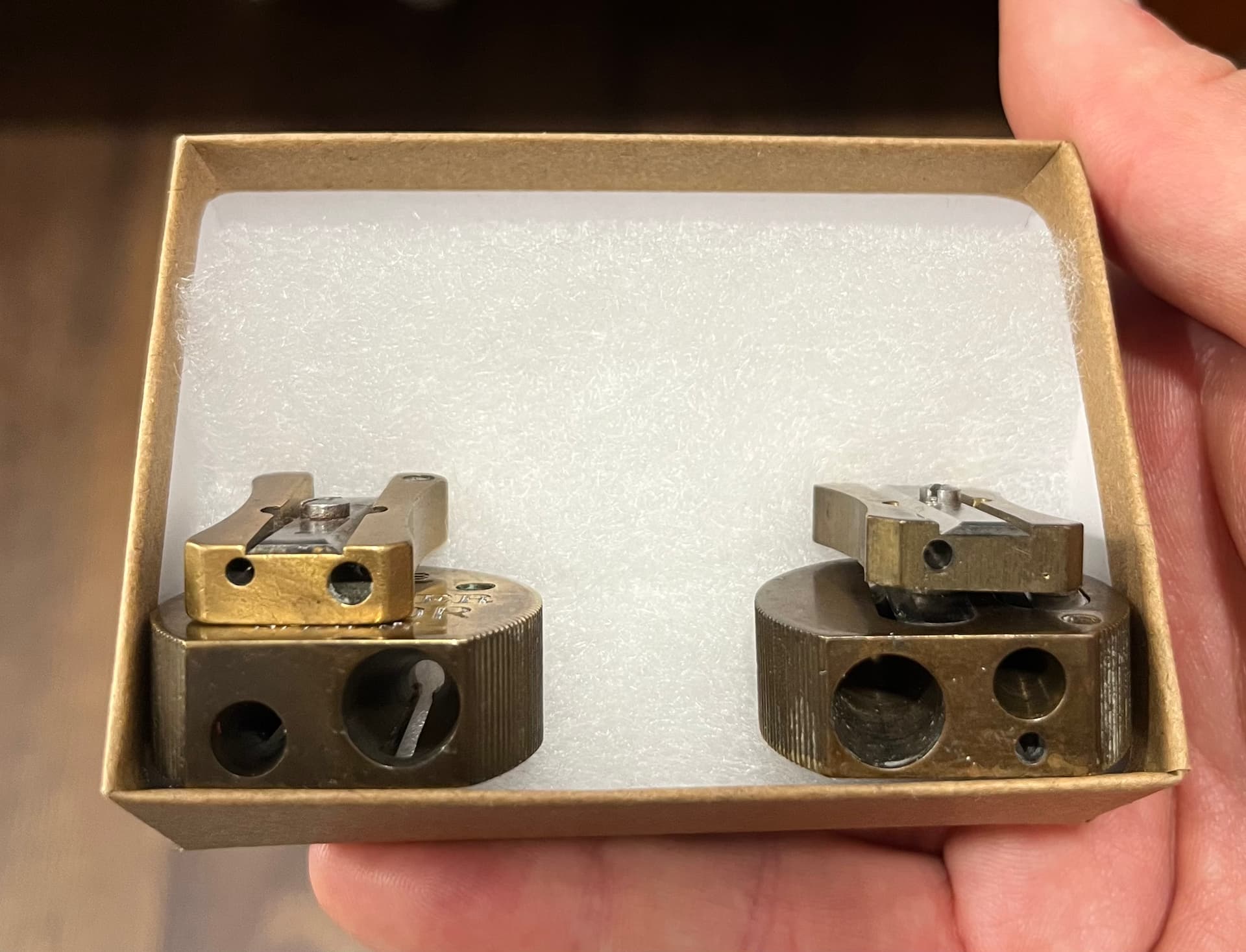
The round sharpeners are heavy. They are two step sharpeners - first step is to shave off the wood in the larger hole with a first blade and the second step is to point the lead in the smaller hole with a second blade.
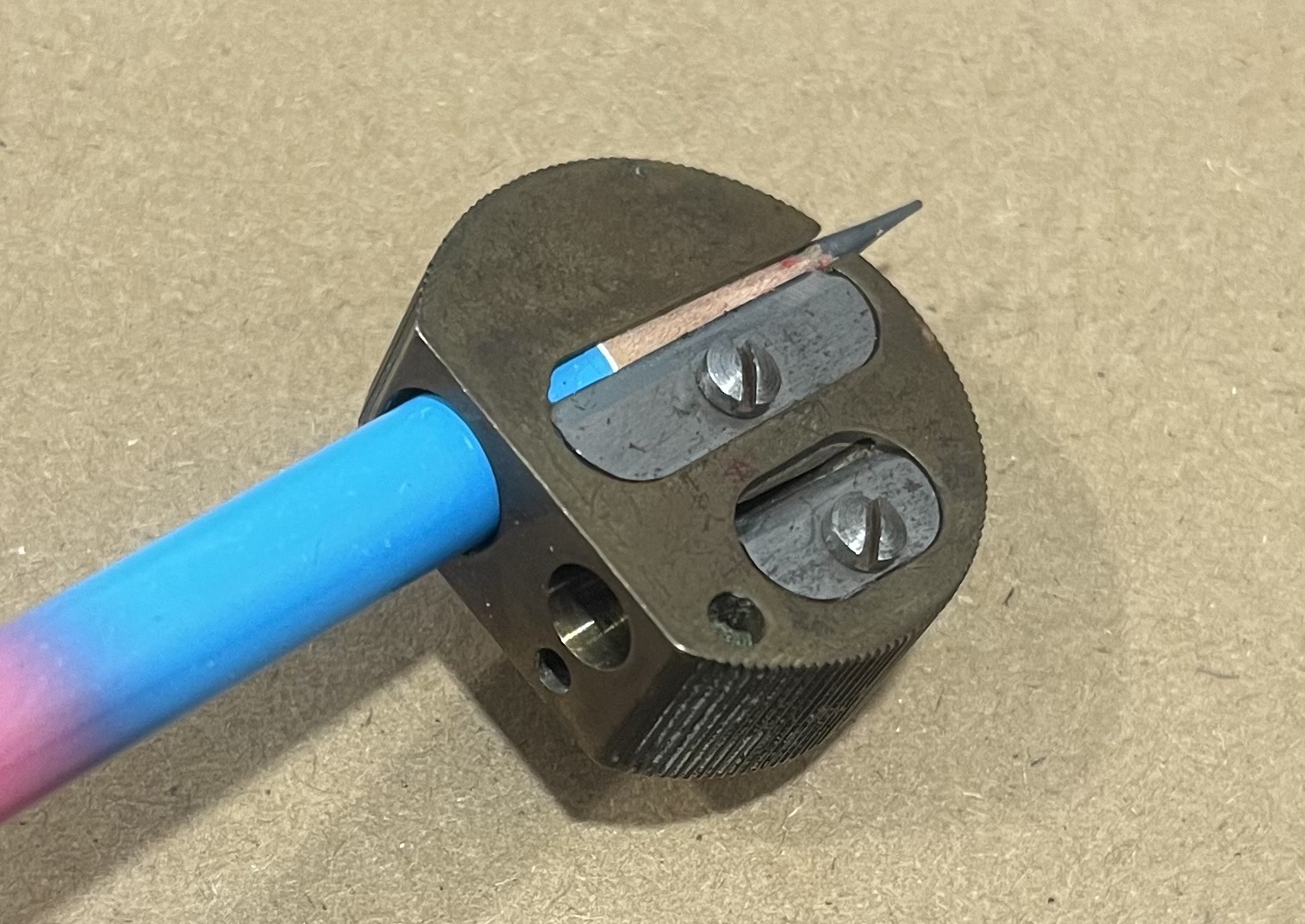
The 50/28 is only a sharpener. The 50/58 additionally features a 2mm lead pointer hole served by a dedicated third blade on the text side.

They all do a fine job sharpening and/or pointing. A rewardingly slow task.
Three of the four have a hole running through them, presumably for a lanyard string.

They are all nice to use, but the 4050 is my favorite. This example has a great patina, beautiful fonts, the lanyard hole, and both pointing holes on the same end. It is also slightly thicker than the 50/61, which helps to recess the protruding blade screw. Runner up is the 50/58. Perhaps the ugliest, but the sharpener and pointer all in one is great.
12 Likes

These are beautiful! Thank you for showing them. The 40/50 is a gem!

Do you happen to know when the 50/28 and the 50/58 were made? A few years ago I have found some patents for two-step sharpeners, namely from 1931 (M+R) and 1949 (KUM, the predecessor of the “Masterpiece”).

I find the 50/61 a little strange because it doesn’t utilise the double-edged blade properly. If you turn it 180°, you use the same parts of the blade. – By the way, there was also a 50/50 (similar to your 40/50) and a 50/65 (with two opposite holes on the same side).

2 Likes

I am no help on dates. I was also curious about production period for all of them.

Regarding the 50/61, you are right. Rotating the blade after it becomes dull would be pointless. On the 4050 you would get fresh edges after rotating the blade.

I also like how the 4050 blade is sloped to achieve the lead taper whereas the 50/61 holes are skewed to achieve the lead taper, which leads to a strange out-of-alignment feeling when inserting the lead.

1 Like

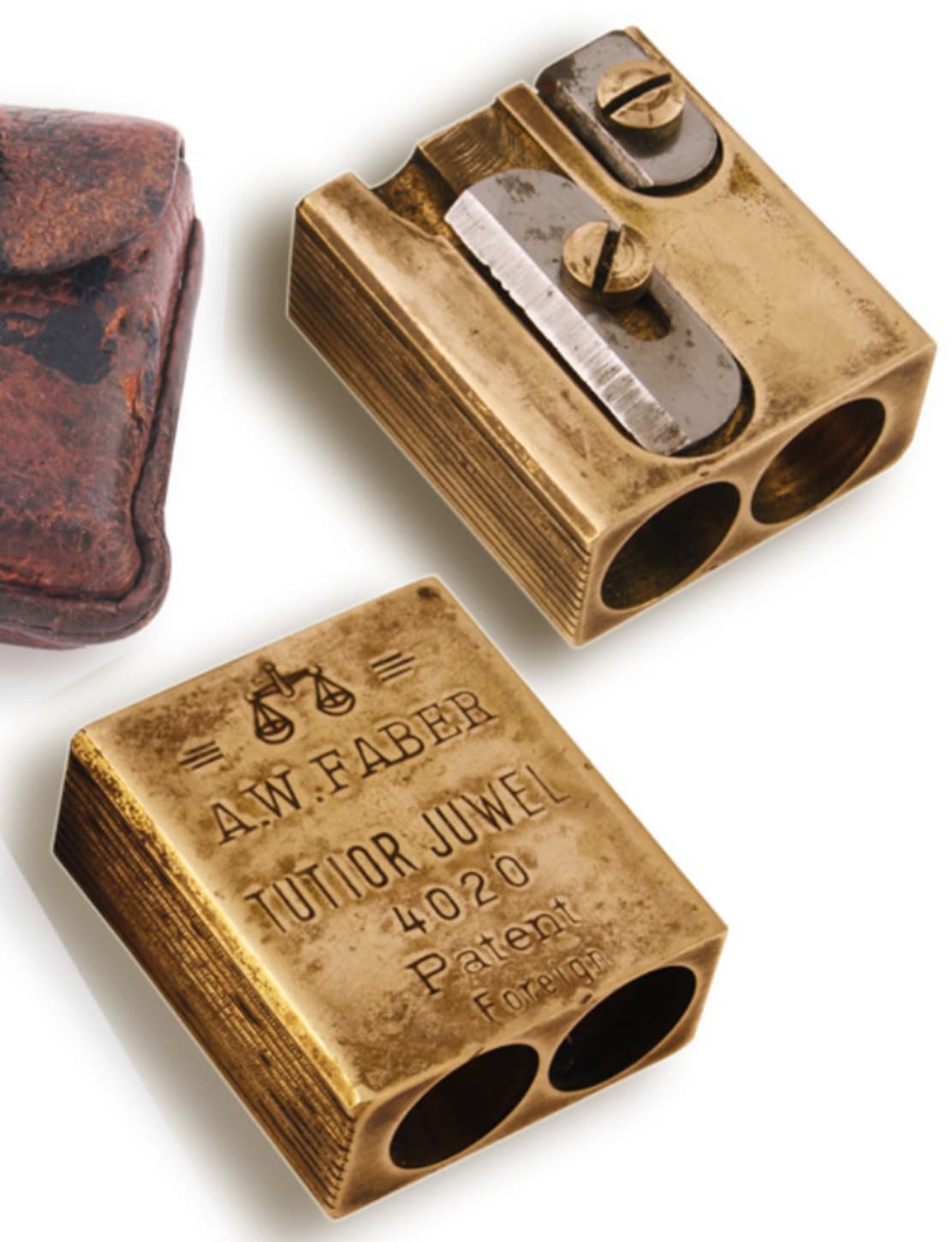
This 4020 model looks significantly older and notes a Foreign Patent.

3 Likes

That 4050 is quite something, I appreciate everything, from the slight slant of the blade placement to the keyring hole.

I myself, have a longstanding relationship with my beloved Minfix 50/65: when it comes to lead shaving, it is by far the best — even though, for practical use, many contestants are available, from the old plastic Eberhard Faber 233 (with butterfly tail/grip area) to the recent M+R “Minofix” in solid brass. I also got a Dahle 99 desk lead pointer with planetary burr which works great, but I cannot make full use of it because I do not have stable spot for that sharpener on my working surface.

Needless to say, when it comes to pencil sharpening, nothing really compares to the “Janus” by Faber-Castell (both the brass and aluminum models), at least in my opinion — I have not tried yet other models like the Saphir, the Kosmos, or the Acme. Still, the conical point and precise tip I can achieve with those old gems is unbeatable, and can surpass even the miracle which is the famed El Casco double burr planetary sharpener.

3 Likes

I found a pic online of the twin of the tiny K+E style pointer I mentioned. Here is the Leroy version:

5 Likes

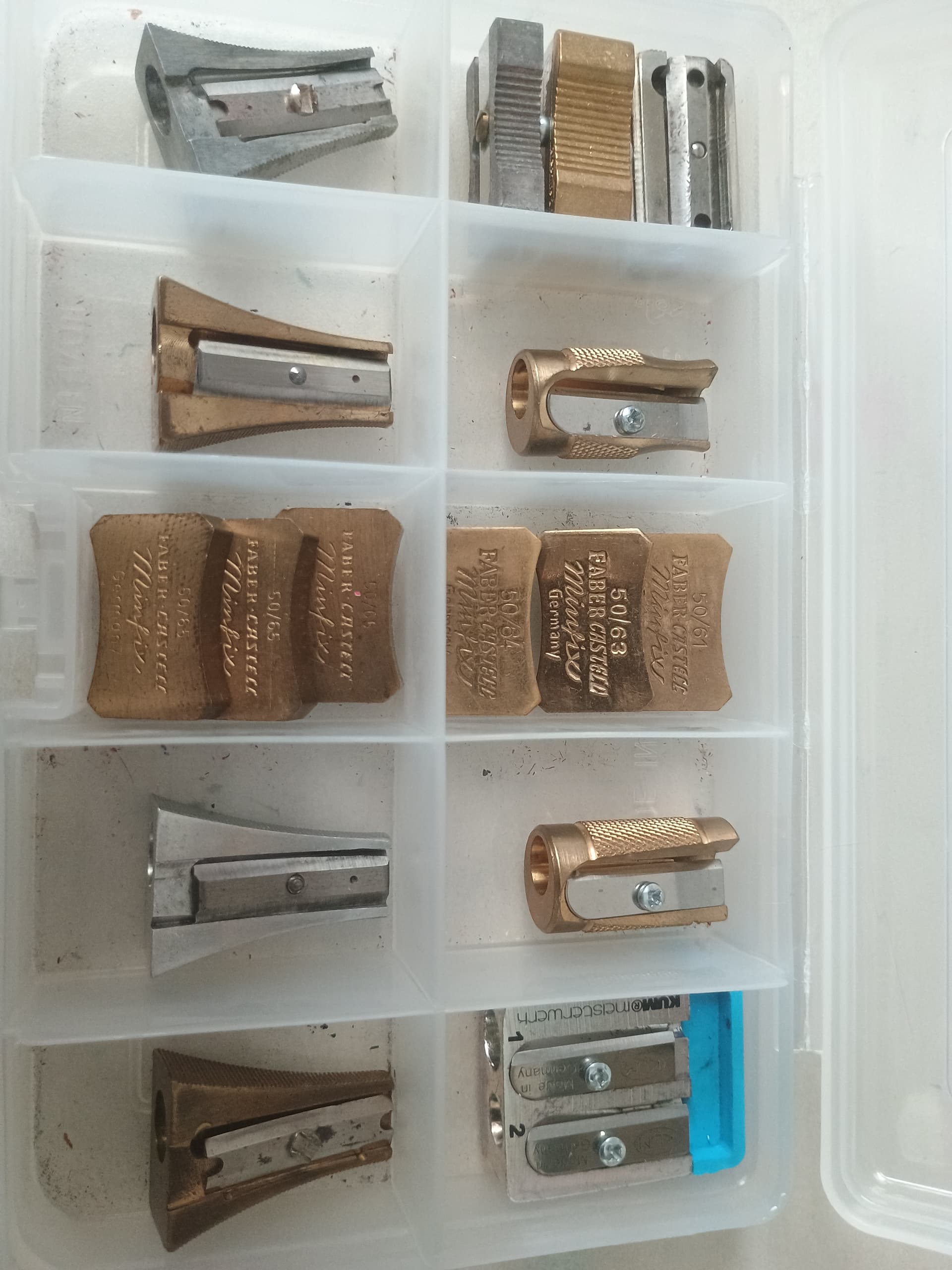
This is my current toolbox for manual sharpening of pencils and lead cores…

As you can probably see, the left column is devoted mostly to pencil sharpeners; top to bottom you can see:

• FC Janus 4048 in aluminum (straight blade which gets curved by the pressure of the screw);
• FC Janus 4048 in brass (same solution for curving the blade);
• three FC Minfix 50/65, but only the last two on the left have two holes on the same side of the brass slate; the on on the rightmost position in the cell has two separate holes, one on each side of the slate;
• FC Janus 4046 in aluminum (curved blade sitting on a curved bed, and tightened from below with a screw);
• FC Janus 4046 in brass (same solution with a curved blade)

The right column, instead, hosts more modern items, with some notable exceptions; top to bottom, you can spot:

• A trio of models, namely: •• El Casco manual sharpener, probably with dull blade which I am trying to replace; •• M+R “Minofix”, in solid brass with two blades for both 2.00 and 3.15mm lead cores; •• A unusual M+R “No.215” in aluminum, which seemed a pencil sharpener at first glance, but turned out to be a lead pointer (sharp as a tack)
• M+R Pollux, one of the greatest manual sharpeners, thanks to @Gunther who talked about this in his blog and made me aware of its existence;
• A trio of lesser known FC Minfix: 50/61 (two holes, one on each side, for 2.00 and 3.15 mm); 50/63 (four holes, two on each side, two 2.00mm holes on one side, two 3.15mm on the other, probably for left-handed draughtsmen); 50/64 (two holes, one on each side, one for 2.00 mm and the other one for smaller lead, probably 1.5mm — a companion to the DS 9450 lead holders?);
• M+R Castor, another excellent modern sharpener for pencils;
• KUM Masterpiece, which in light of the other specimens in the box is not that great, and can harm some fine tips (I’d rather use the brass, round M+R 0802, or the DUX with tip lenghth adjuster).

And now, let me get my Citomin…

7 Likes

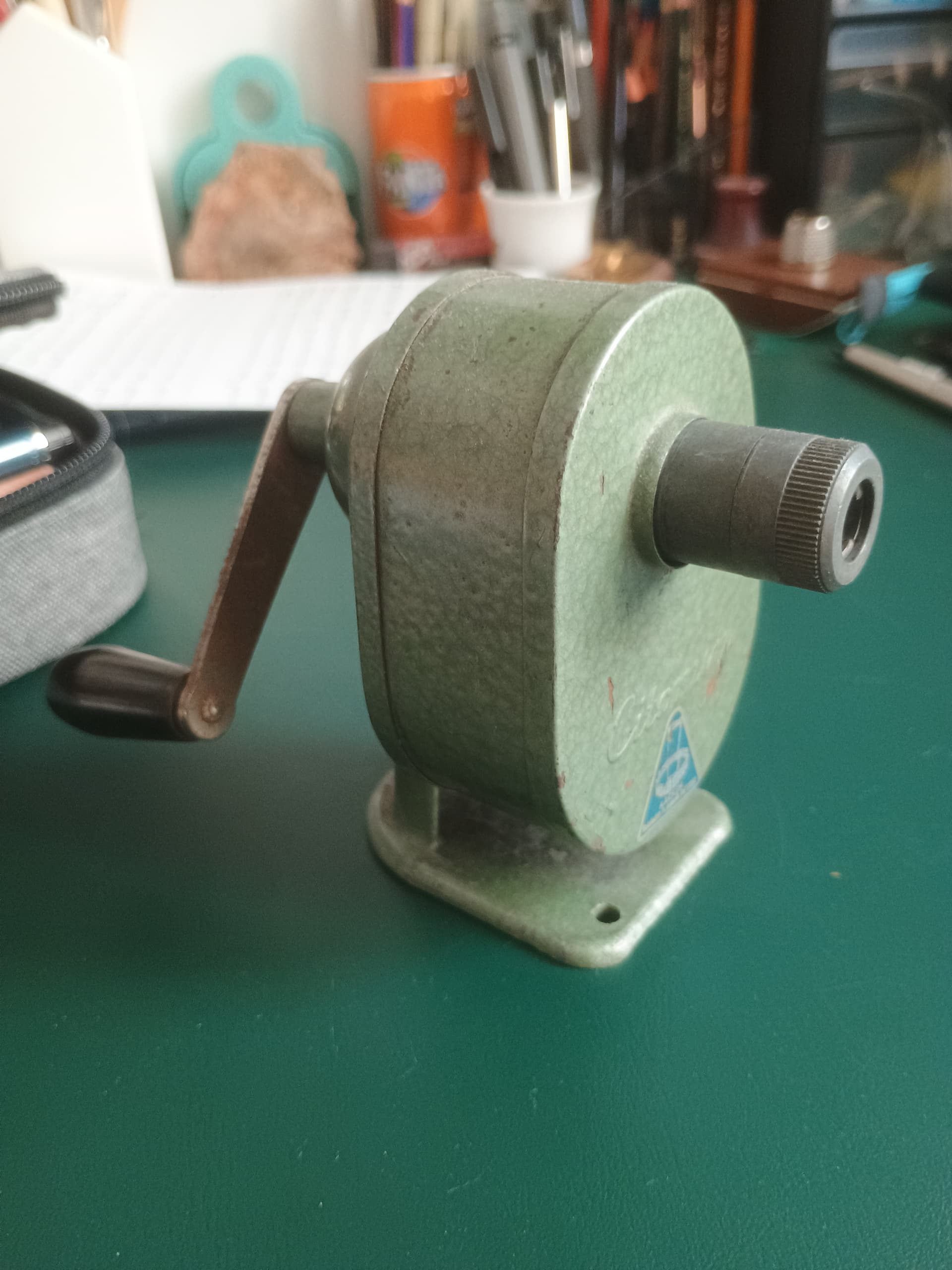
This instead is the Citomin…


It really seems an old American pencil sharpener, but it works only for lead cores, which need be extended outside the clutch (which instead is secured inside the grey opening, and inside its three short prongs).

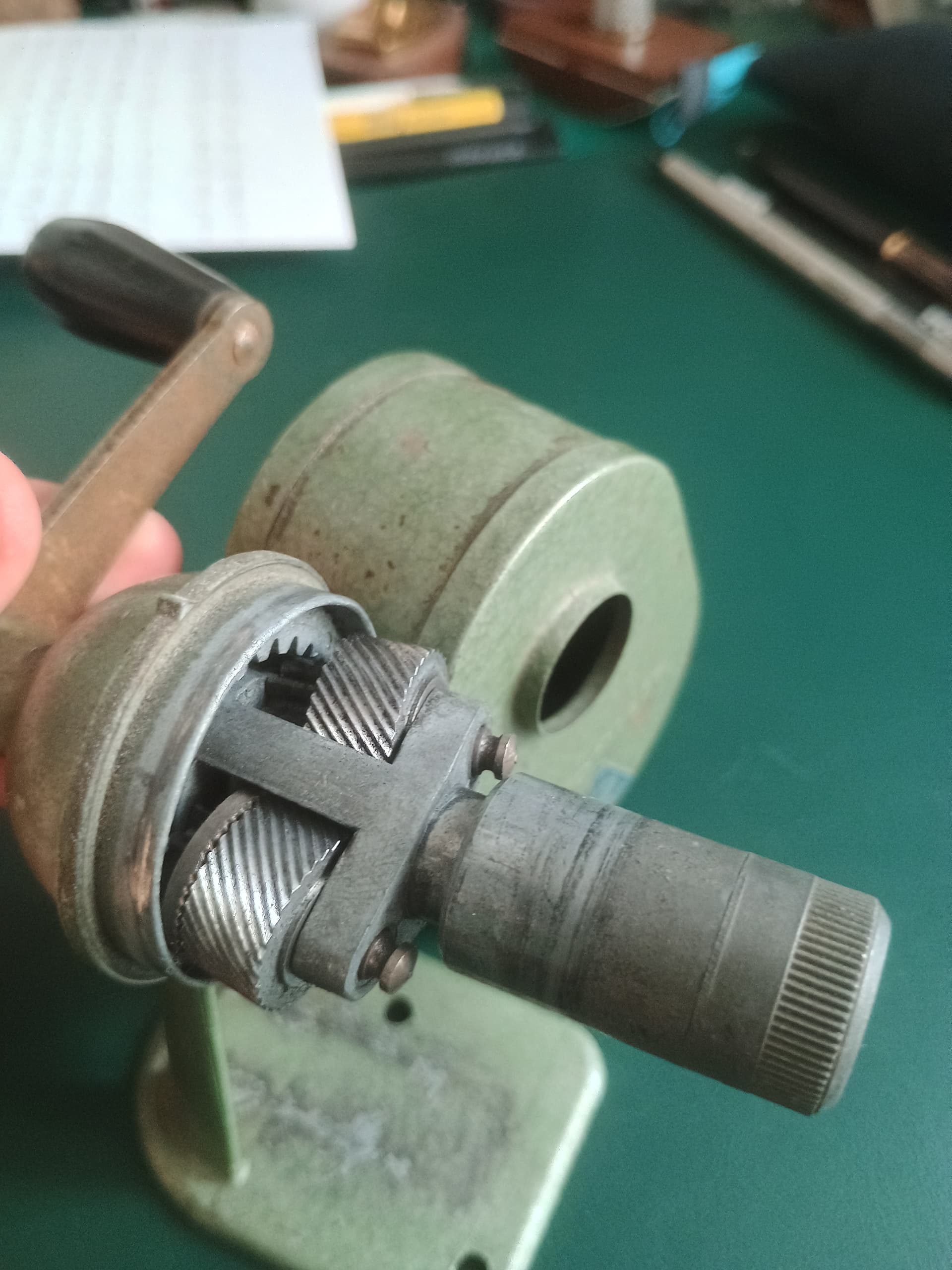
The fun part is under the hood: a double-burr, planetary crank allowing for a twin action of the milling wheels (second picture): it is, basically, the equivalent of the “El Casco”, just for lead.

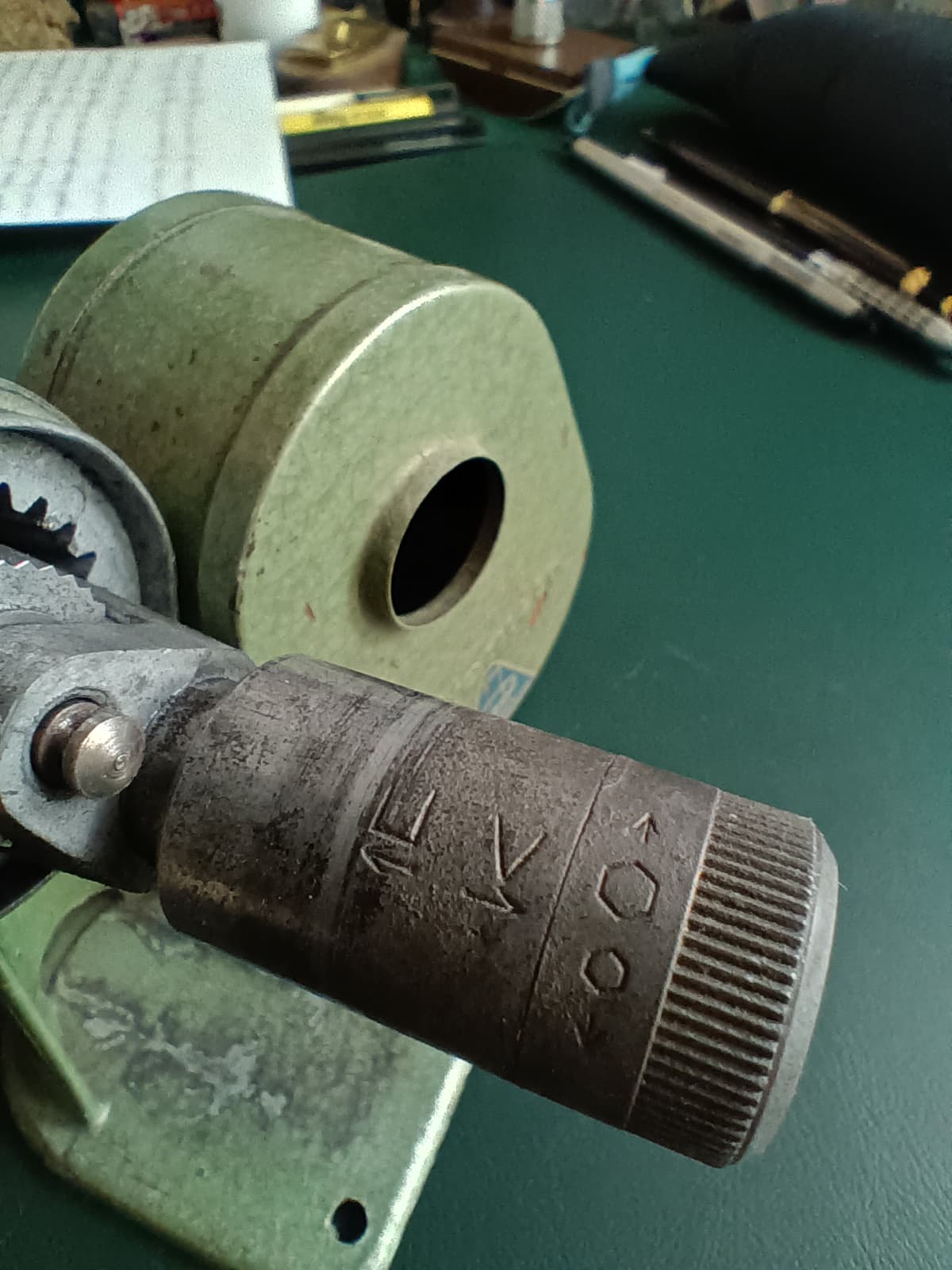
The last picture shows you the fine tuning mechanism, which is very basic: the whole gripping section can be moved towards the burrs or away from them, to produce a finer/longer or more coarse/shorter tip, whereas the grip area at the end of the grey section can be rotated to select the size of the clutch pencil holding the lead, from a slimmer model to a bulkier one.

All in all, a nice little object… :slight_smile:

8 Likes

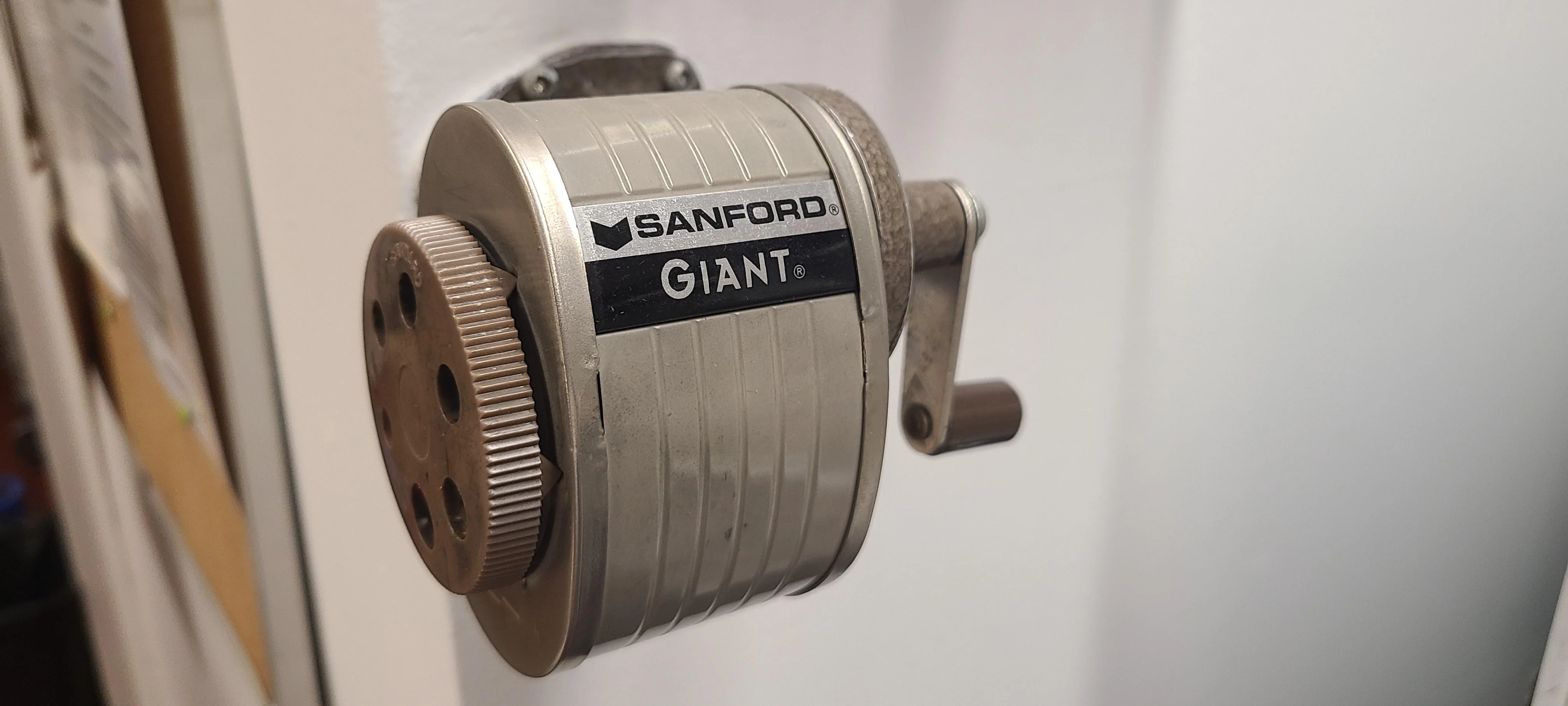
Are the hand crank ones what you’re referencing as “American”?

1 Like

No, not all hand-crank sharpeners are “American”, many are European; I refer to this particular style of hand-crank sharpener — picture from the Internet

Many similar models were available throughout the US from brands like Alvin, Sanford, X-Acto, etc., and are probably still available. That curved “belly” to save the shredded debris is something I associate in particular to the US, but maybe the original patent is European, I do not really know.

3 Likes

I have only one sharpener and it’s the one that was fastened to the wall above the rail to our basement stairs and it still smells exactly like it always did. I’m not sure I’ll go down the collecting road but I will always keep it.
It has the belly and hand crank

1 Like

Some of these had the double-burr “planetary” system (i.e., two opposite milling wheels), while others had only one burr, and that is the most common type, at least here in Europe: all models made by Dahle and similar companies have one wheel only — the sole exception I know of, in modern times, is the celebrated El Casco M-430, but it is a delicate thing and it is pretty complex to use, even if interesting for sure.

It is quite difficult to ruin the wheel of one of those old machines, but there are plenty NOS available, the only catch is to find the right size and tolerances (a Japanese desk sharpener I have of course sports cylinders with impossible measurements, and it is in fact super-hard to fix), and any old sharpener can become quickly good as new.

1 Like

Wow, what a great selection!

2 Likes

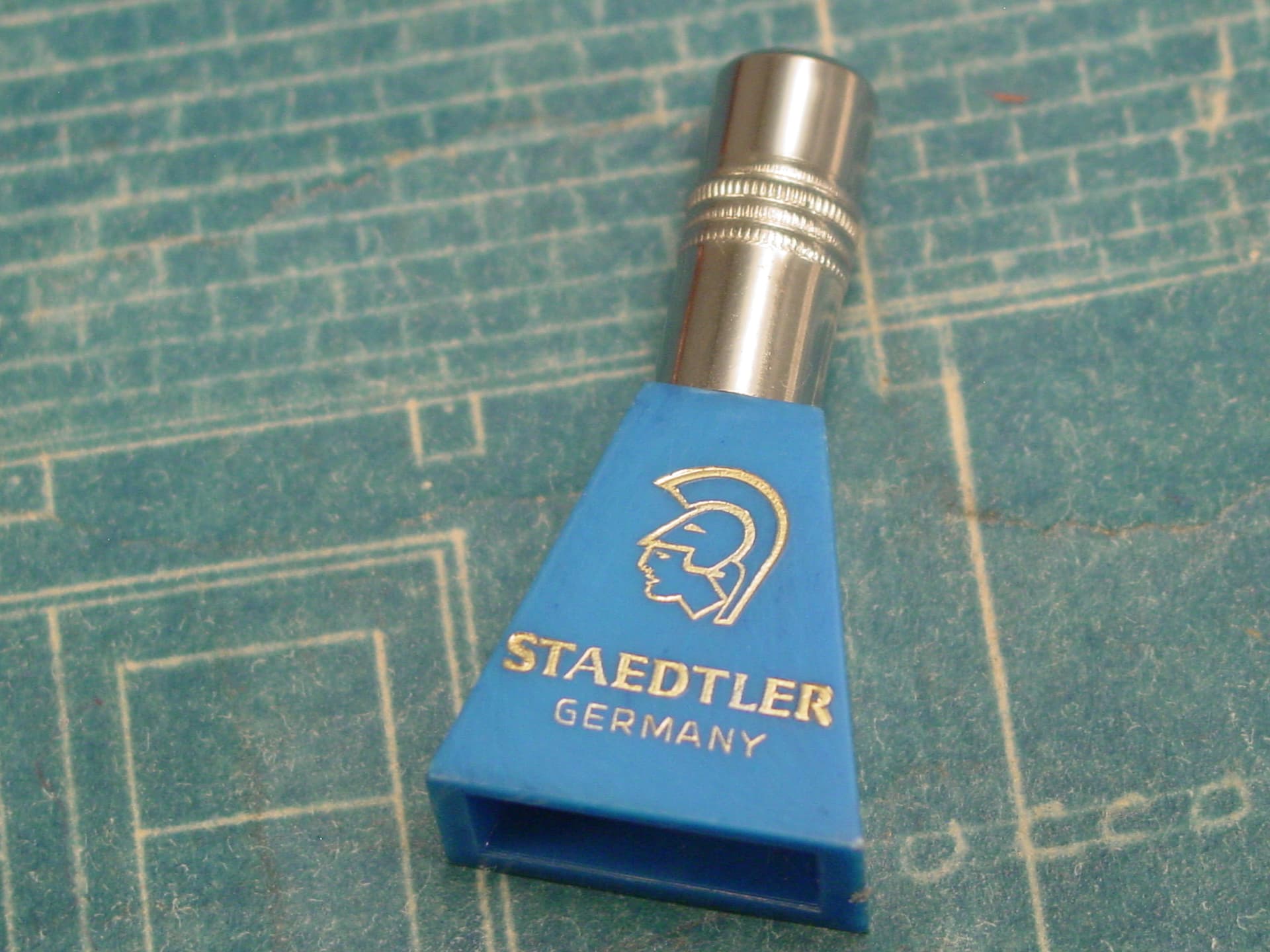
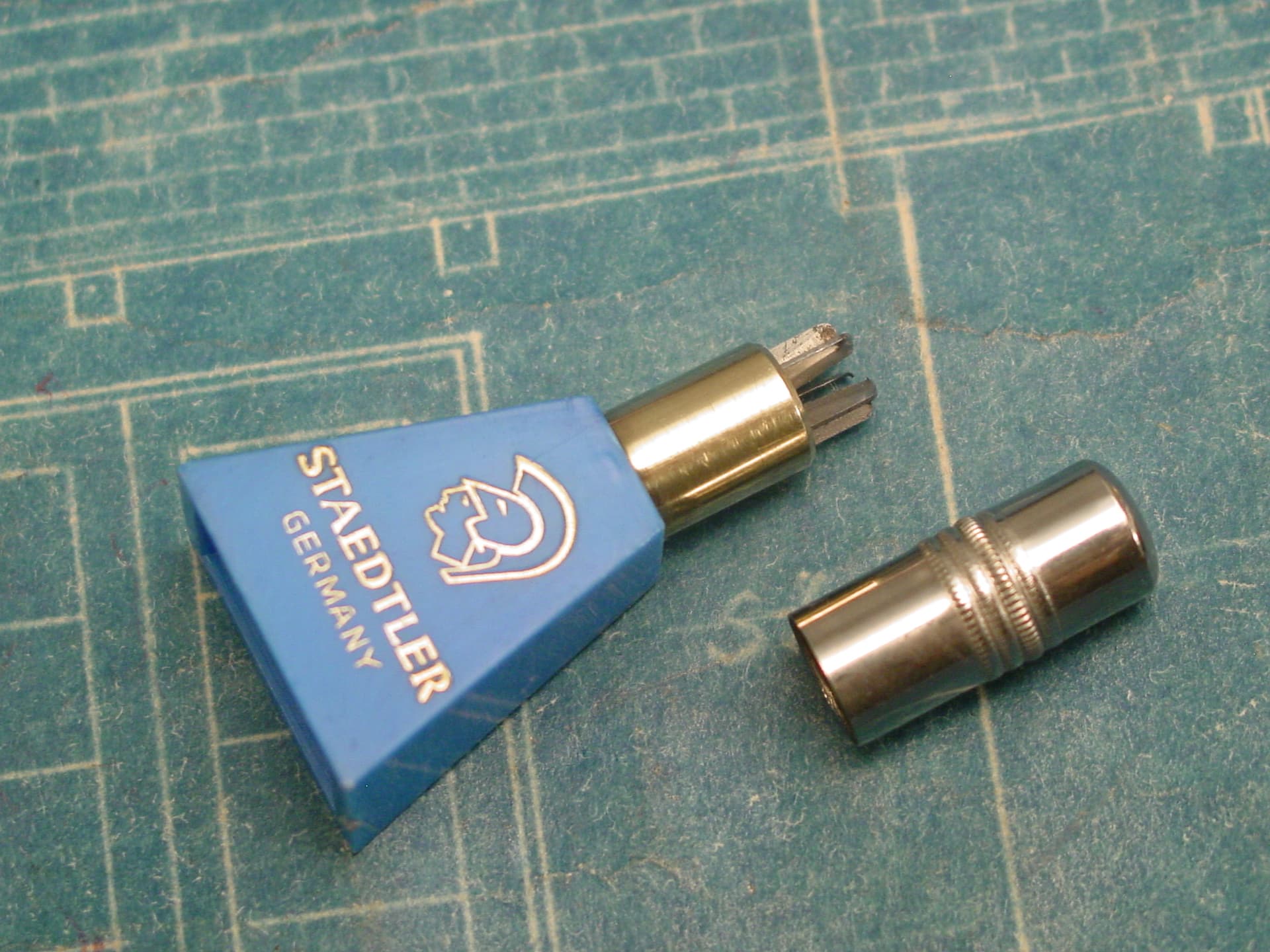
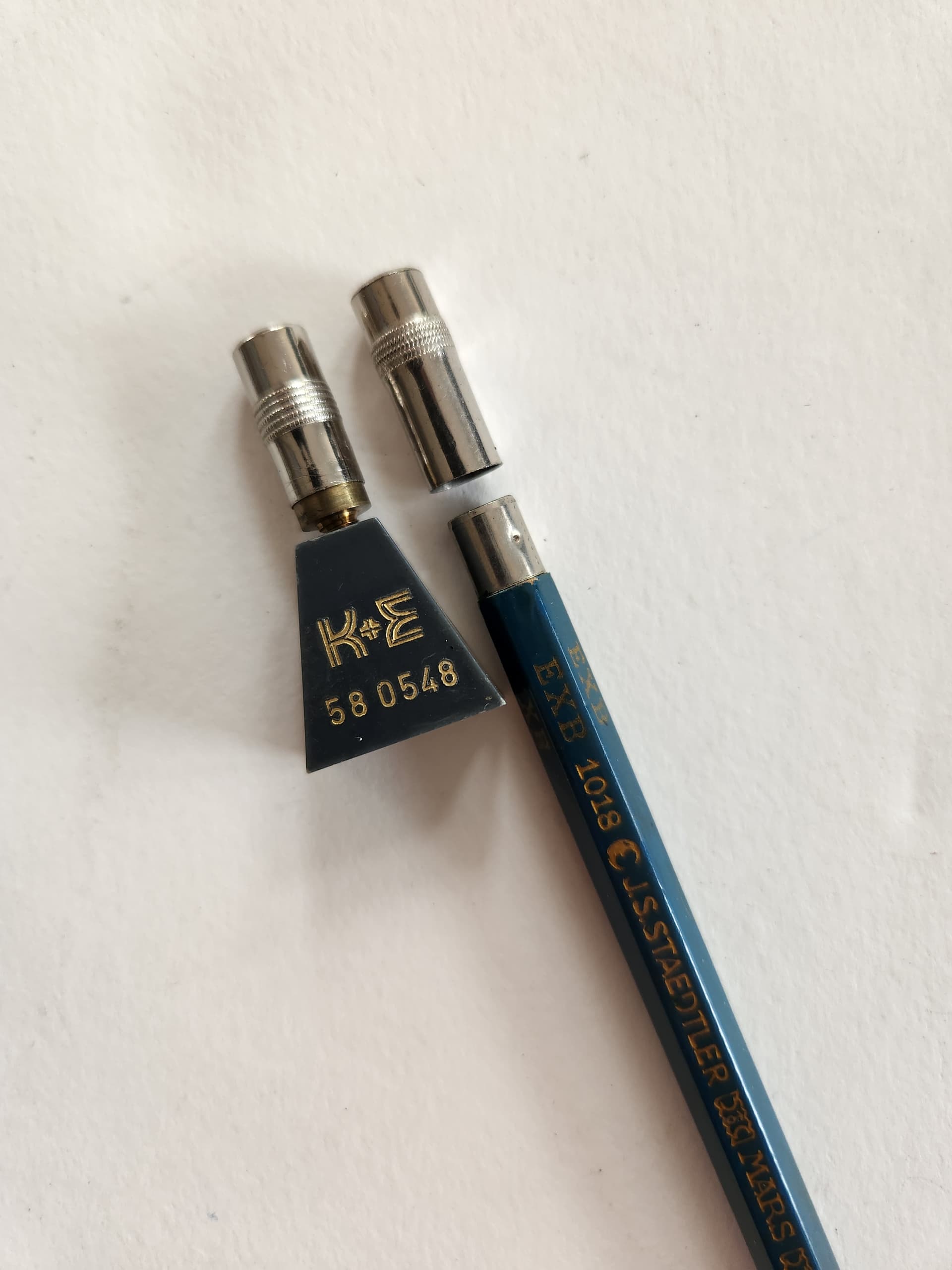
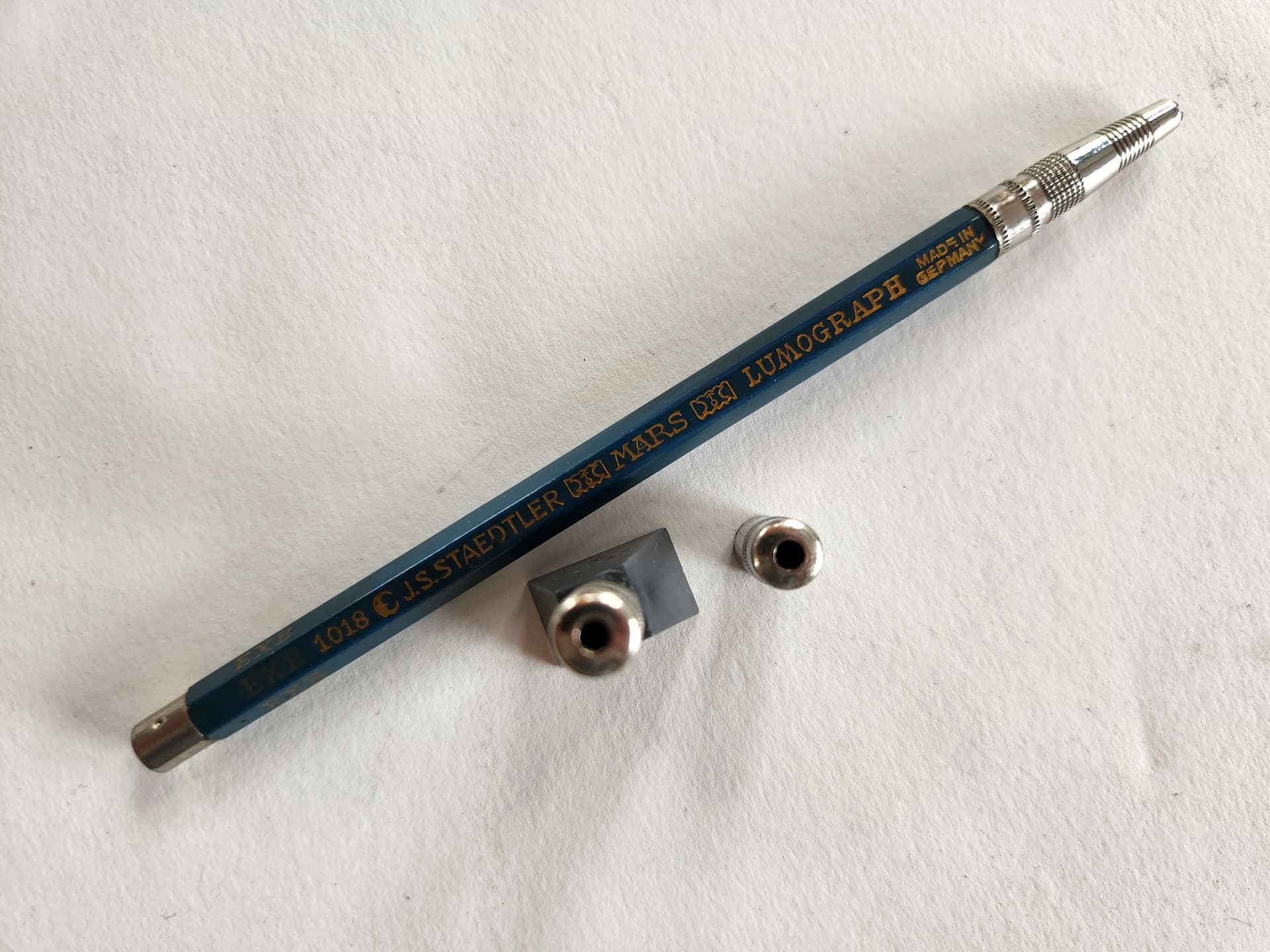
The original of this was by JS Staedtler… it was a version of what was on the tail end of their cult-ish 1018 leadholders (late '30’s ..“Bavaria” and early-mid '50’s “Germany”).
K+E rarely made their pencils ( among other of “their” items)…so many private labels…pics coming


7 Likes

Awesome. @Leonov recently sent me a Staedtler Lumograph 1018. I will have to compare it with my K+E pointer (whenever I find it).

3 Likes

Do I see an H-3005 and an Uchida Holder D in the background?

1 Like

Almost perfect eyesight! Those are, actually, an H-2005 and an Uchida Drawing Holder D, recently transferred from my “extra special” pencils pouch to another container, in order to make room for other specimens about to come… :wink:

2 Likes


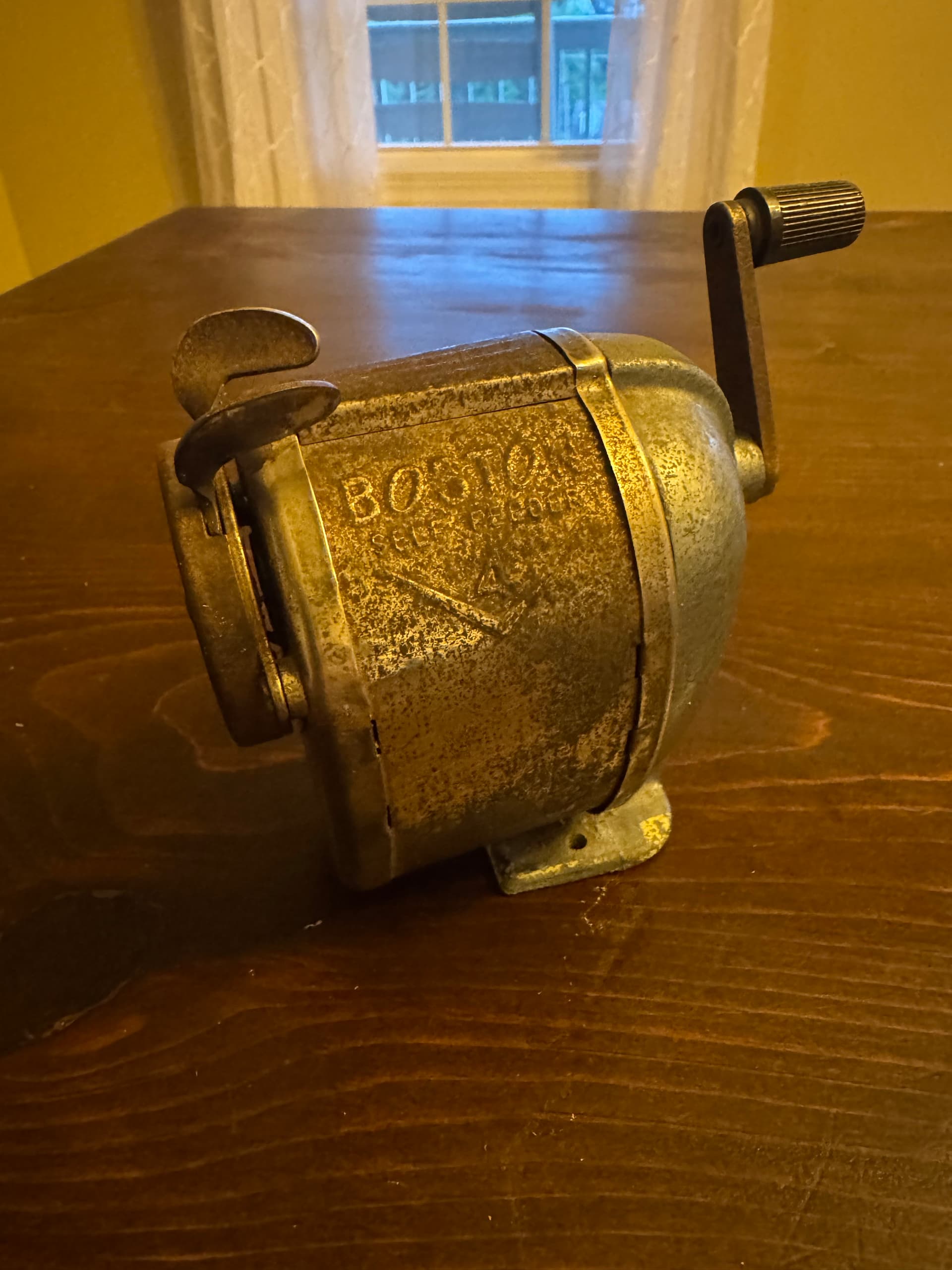
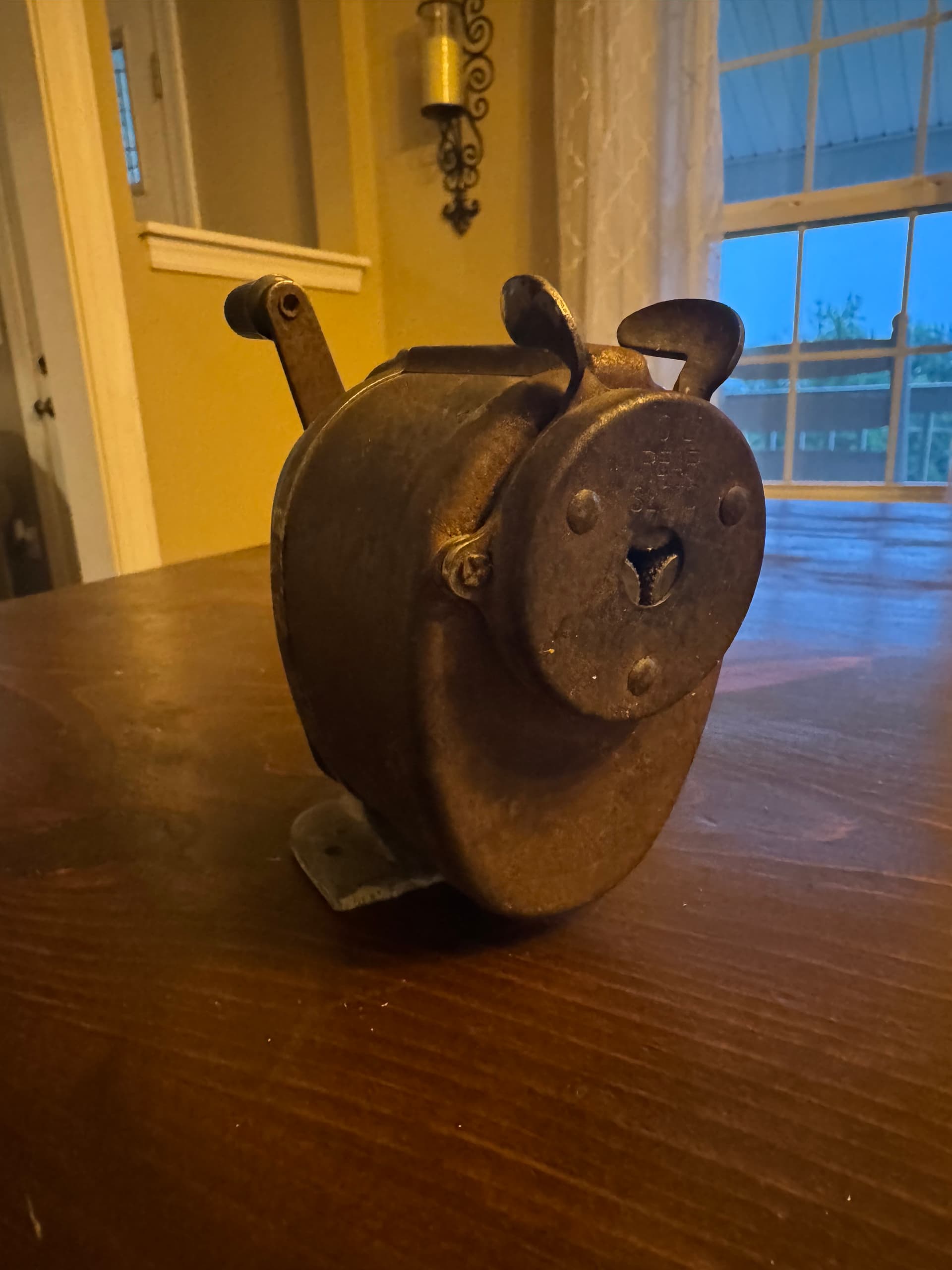
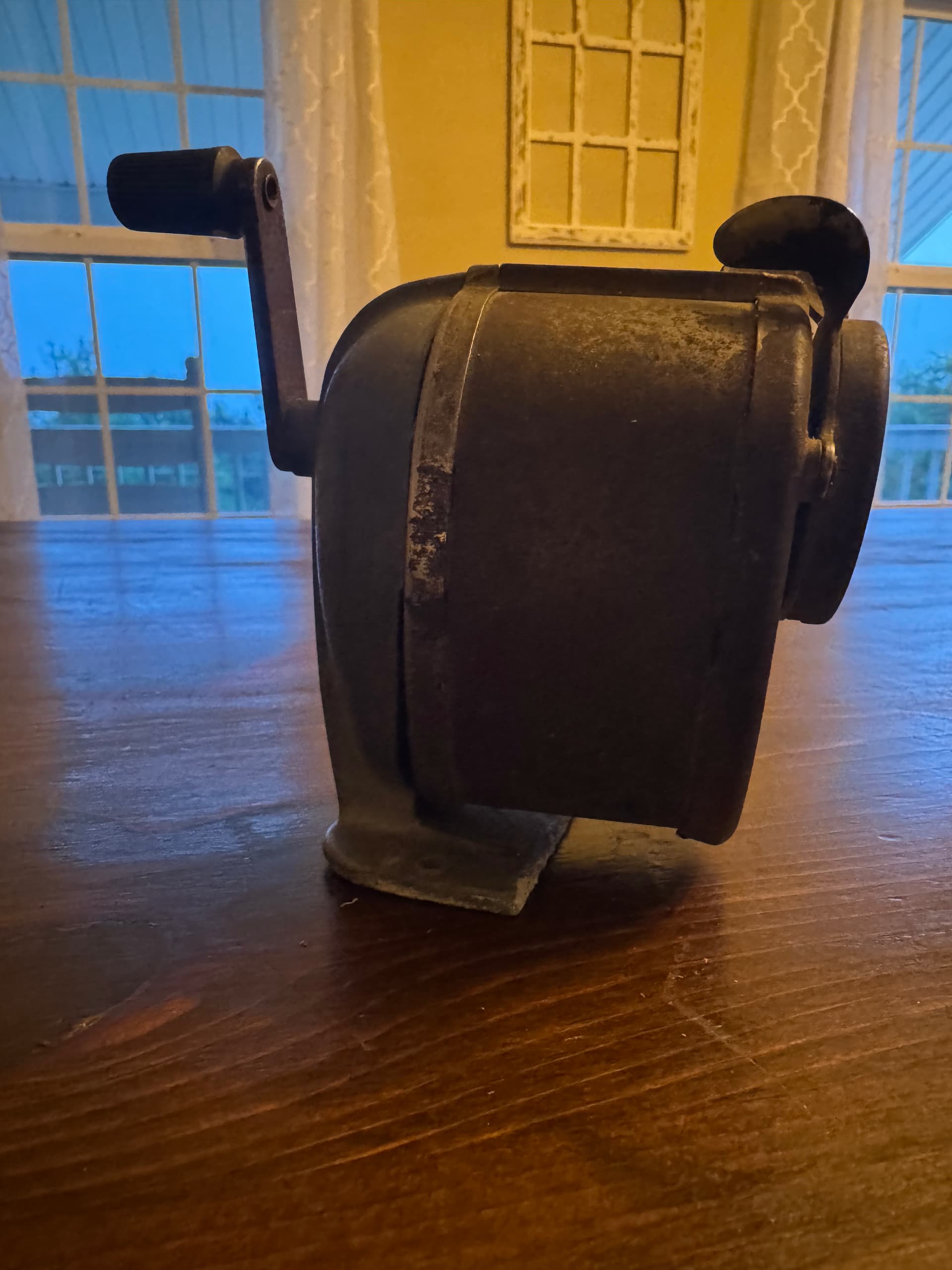
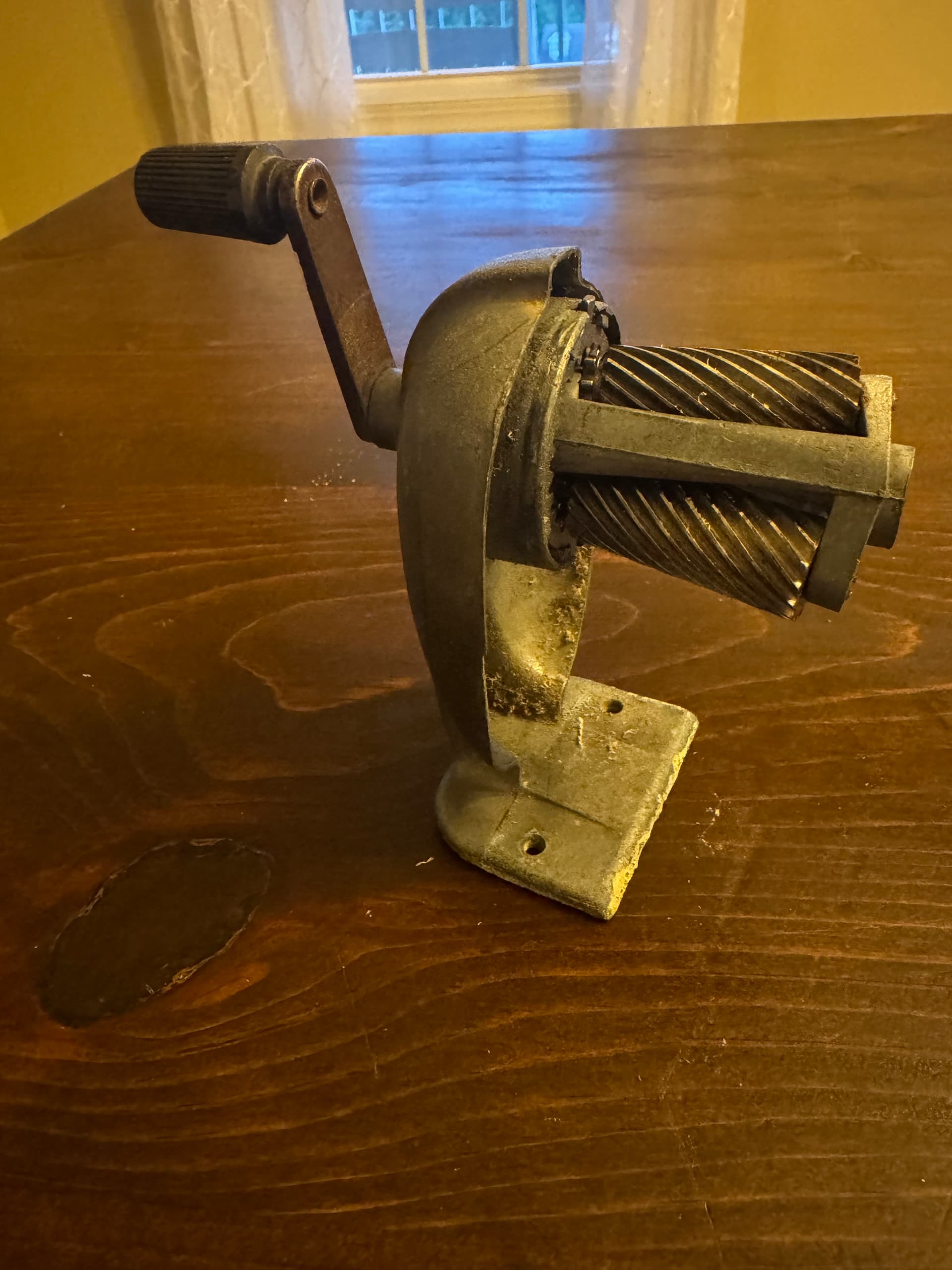
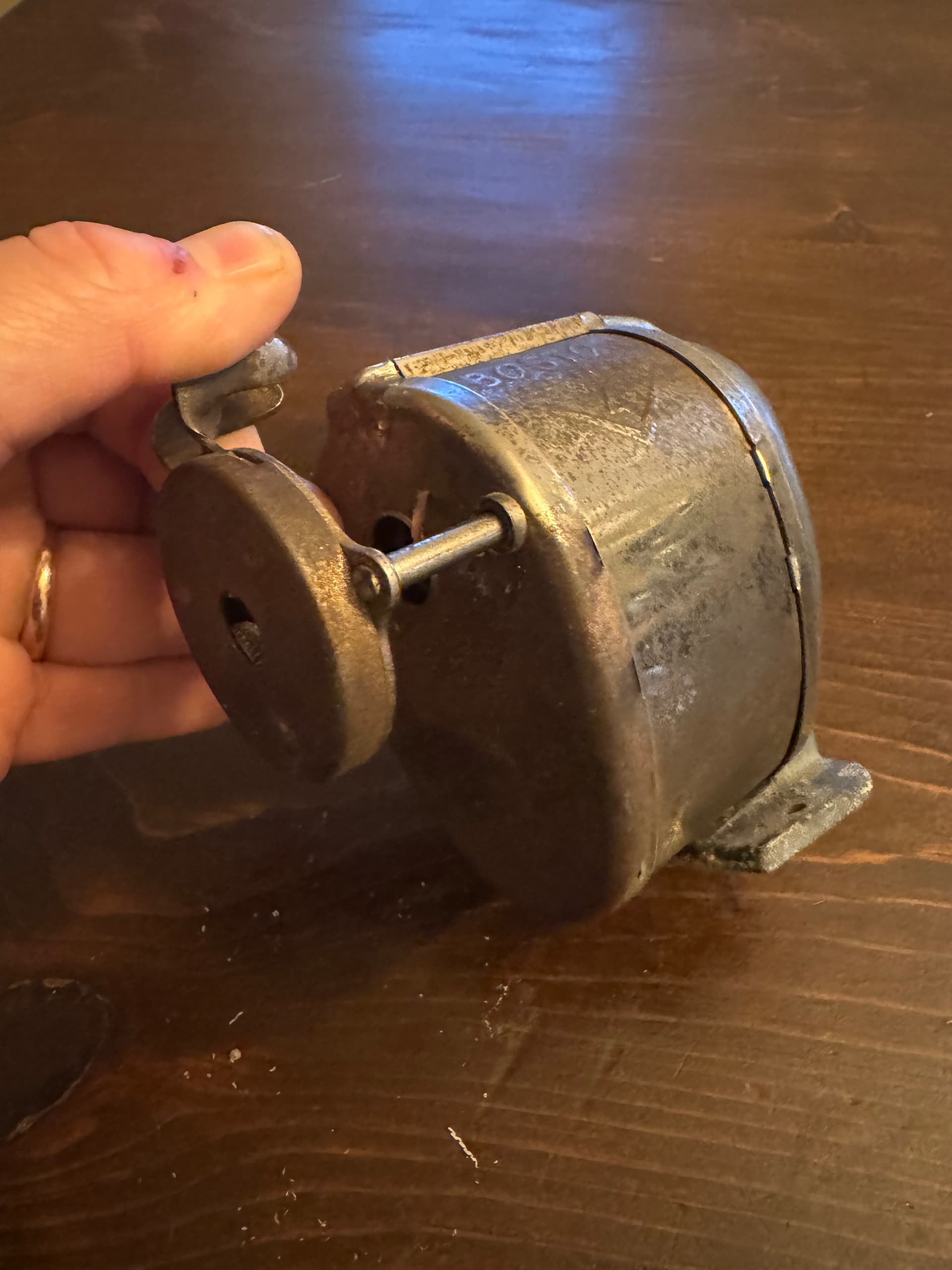
Called the “Boston Self Feeder 4”

4 Likes

It has the double burr. Those are the best of the bunch.

1 Like


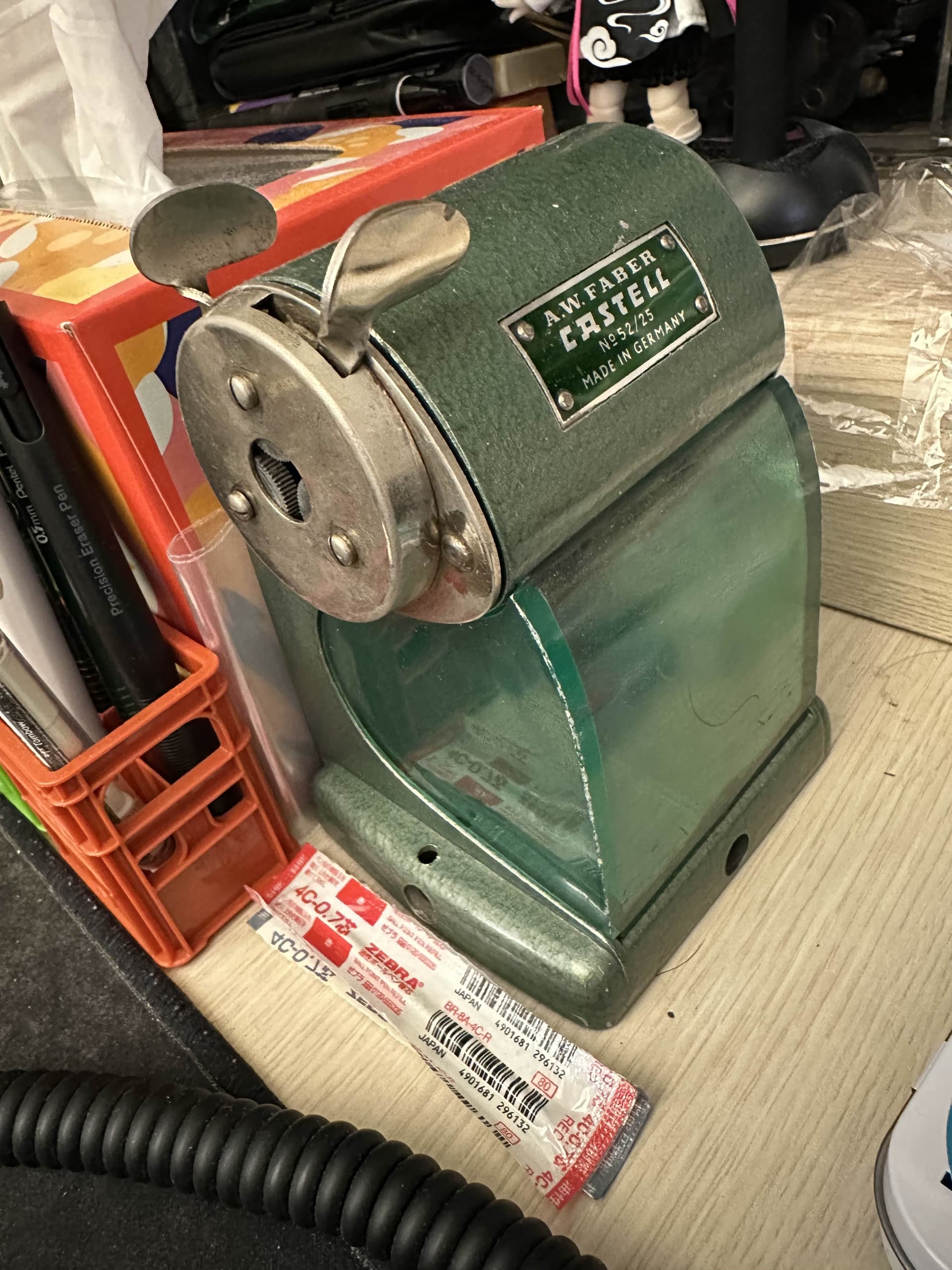
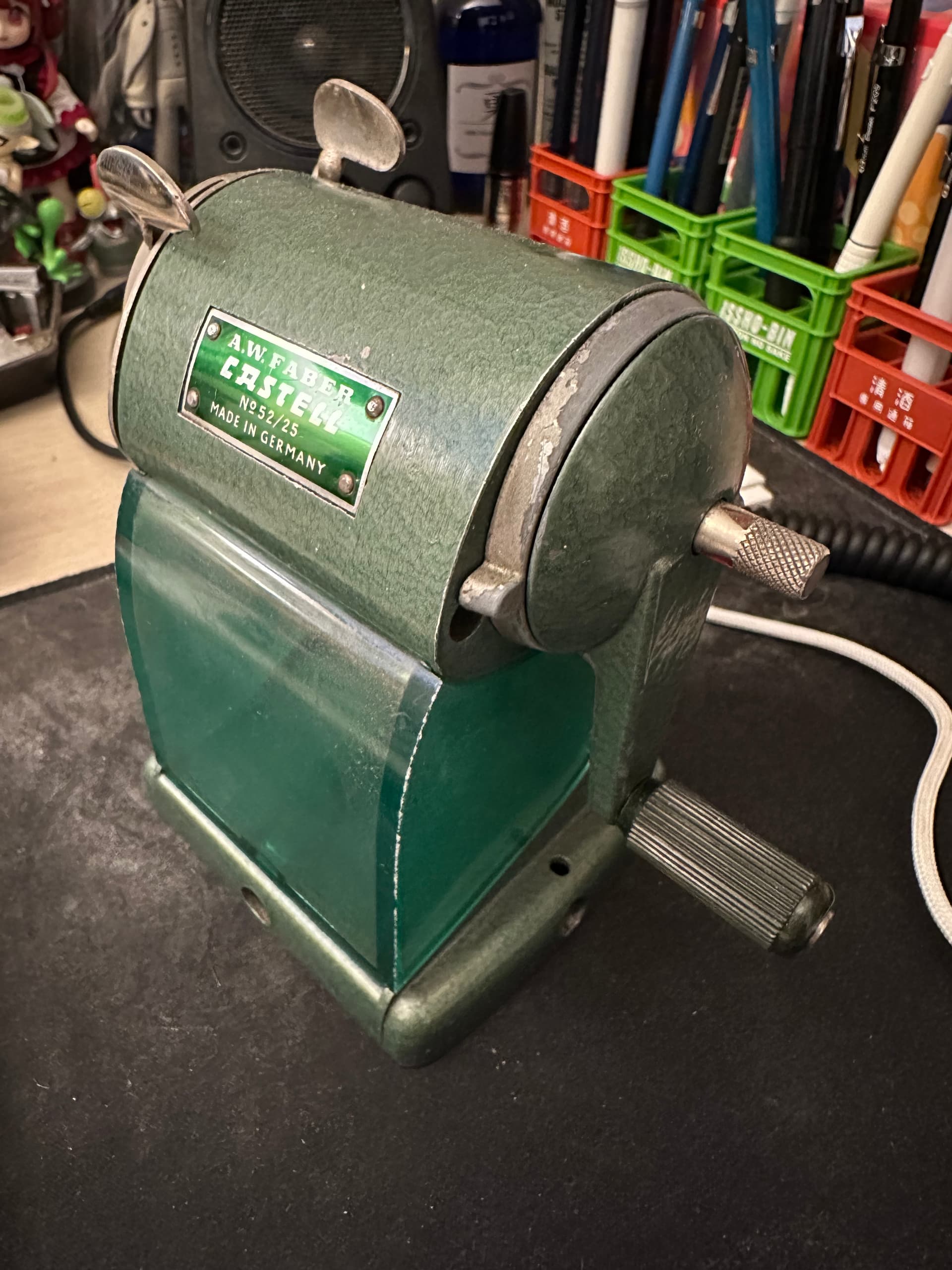
I have this one - you can adjust how long of a point you want with an adjustment on the crank axle:

4 Likes