From the Knockology archives
This post revisits conversations from our smaller community before we moved to this forum. I’ve brought the discoveries and memorable moments together, with credit to the members who contributed. These discussions reflect what we knew at the time. Please add any newer information, corrections, or photos below!
There’s a particularly satisfying moment when an old mechanical pencil starts looking cared for again. The grime comes away, a metal detail catches the light, and you begin to wonder how much more of its former glory is hiding underneath. Then comes the less glamorous question: how far can you go before you start removing something you wanted to keep?
That question brought @pearsonified , @Kiwi-d and me into a discussion about cleaning vintage pencils in the early Knockology days. Pearsonified had been working on corroded spots and dirty metal parts with Bar Keepers Friend. I wanted the details behind the results, including what could go wrong on an older finish.
So I asked him for something more useful than “this cleaner works great.”
I wanted to know when he used Bar Keepers Friend, how he used it, and—this was the important bit…the “worse case scenario/oopsies.”
He supplied all three.
The conversation is worth preserving because it includes enthusiasm, a practical result from another collector, and an admission that a cleaning method had also removed a finish. That’s a much more useful record than a perfectly lit “after” photograph with no explanation of what happened in between.
What Pearsonified was trying to remove
Pearsonified had been cleaning corroded spots and dirty metal parts. He described mixing the powdered cleaner with water, applying it with a cotton swab, and relying on both the cleaner and friction.
He also wiped the pieces repeatedly rather than letting moisture work its way into the barrel or mechanism. Soaking tips and caps, he said, hadn’t produced the results he’d hoped for.
Those are the details of his historical method. They aren’t a blanket recommendation for every vintage pencil, finish, or piece of plastic. Different finishes and materials can respond very differently, and this same conversation contains a clear example of a bad outcome.
The gold wasn’t staying gold
When I asked about mistakes, he didn’t dodge the question:
“My only ‘oopsies’ so far have involved cheaper, gold ‘plated’ pencils (like Morisons)”
He then described taking the finish back to chrome.
That’s the detail I most want a future reader to notice. If the intention is to preserve a gold-colored finish, removing it isn’t an especially successful restoration…even if the surface underneath becomes beautifully clean.
The lesson isn’t “scrub harder.” It’s know what you are trying to preserve as well as what you are trying to remove.
He also discussed a plastic polish he’d encountered, but said he hadn’t tried it on pencils. The prospect of removing material bothered him:
“the removal of anything other than rust or stray marks kinda…rubs me the wrong way lol”
A good pun, and a better reason to pause.
Two people asked for the photographs
I asked for before-and-after pictures. Kiwi-d asked the same thing almost immediately.
Kiwi-d: “Snap
”
Later that day, Kiwi-d reported cleaning two old pencils and finding the results very pleasing. He shared before-and-after images and asked the group to identify the models.
The before-and-after pair has not survived in the saved archive. Kiwi-d’s accompanying identification photo did, so we can still see the two pencils that prompted his question.
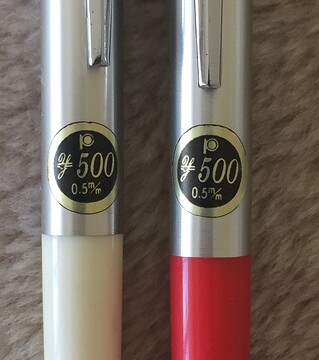
One of Kiwi-d’s surviving photographs from the cleanup discussion, showing the two pencils and their labels. This is not a before-and-after comparison. Photo: Kiwi-d.
Pearsonified didn’t know the model either, but recalled a green version. That gave the group another lead without resolving the identification.
The other cleanup story belongs beside this one
In a separate discussion, Knocktype11 described spending half an hour patiently removing tape residue from a Staedtler Retro. Eventually, he decided it had reached the “good-enough zone.”
I admitted that I’d accidentally used an industrial-strength adhesive remover on a pencil and immediately damaged the plastic.
Knocktype11 stopped when the improvement was enough. I found out, rather abruptly, how easy it is to go too far. Between those two experiences is the awkward part of cleaning vintage pencils: the unwanted residue is sitting on a finish or plastic you very much want to keep.
Nor can a cleaner replace metal that has already been lost to pitting. A surface can look much better without the underlying damage having vanished.
A record worth leaving for the next owner
My takeaway is to document the starting condition, the exact product and finish involved, what changed, and where you stopped. A tested result on one specimen is useful evidence. It becomes less useful when retold as something that is safe on everything.
If you’re unsure what the surface is, the conservative choice is to leave it alone until you have better information. An honest old finish has a lot going for it.
Knock on!