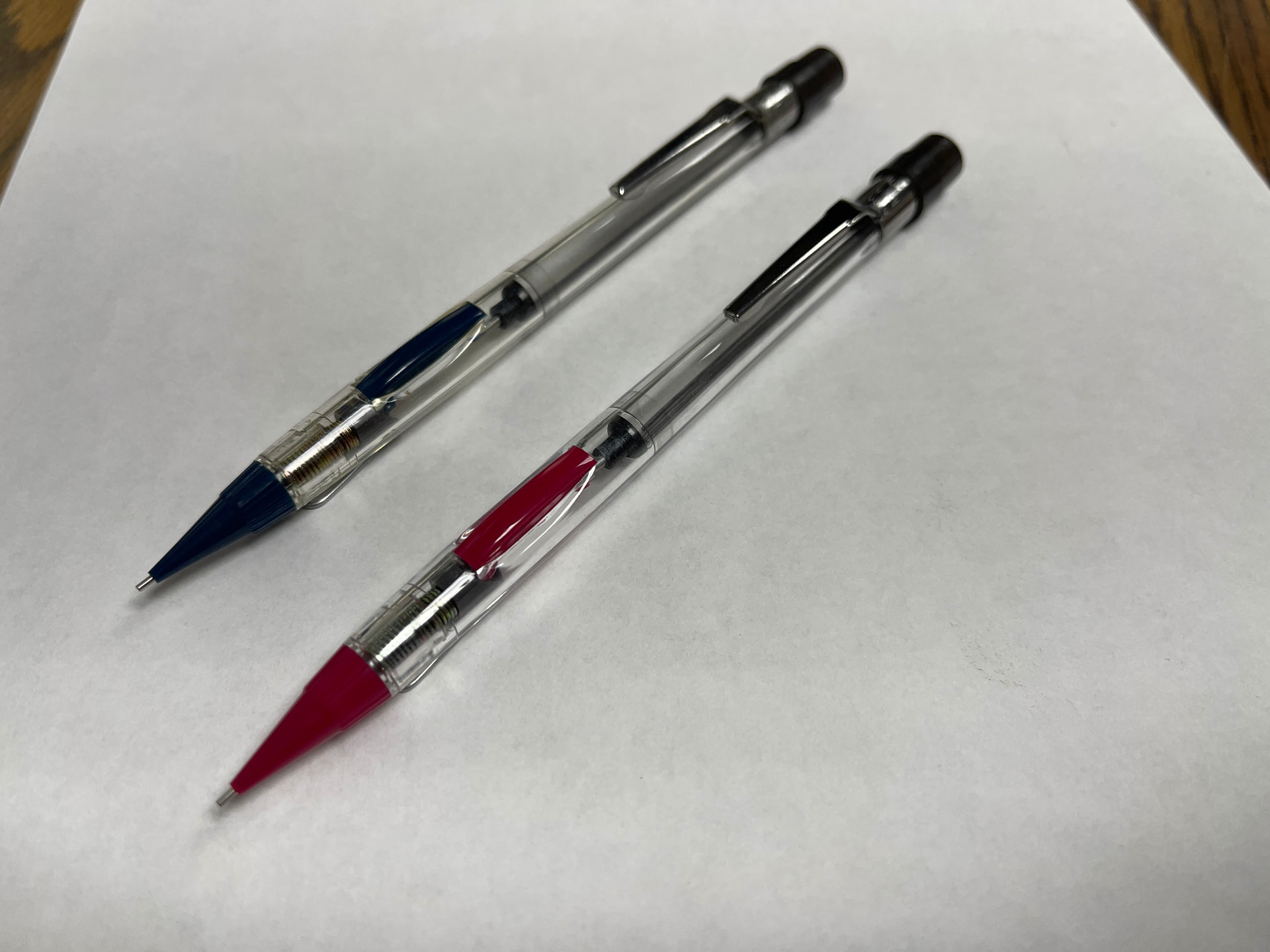
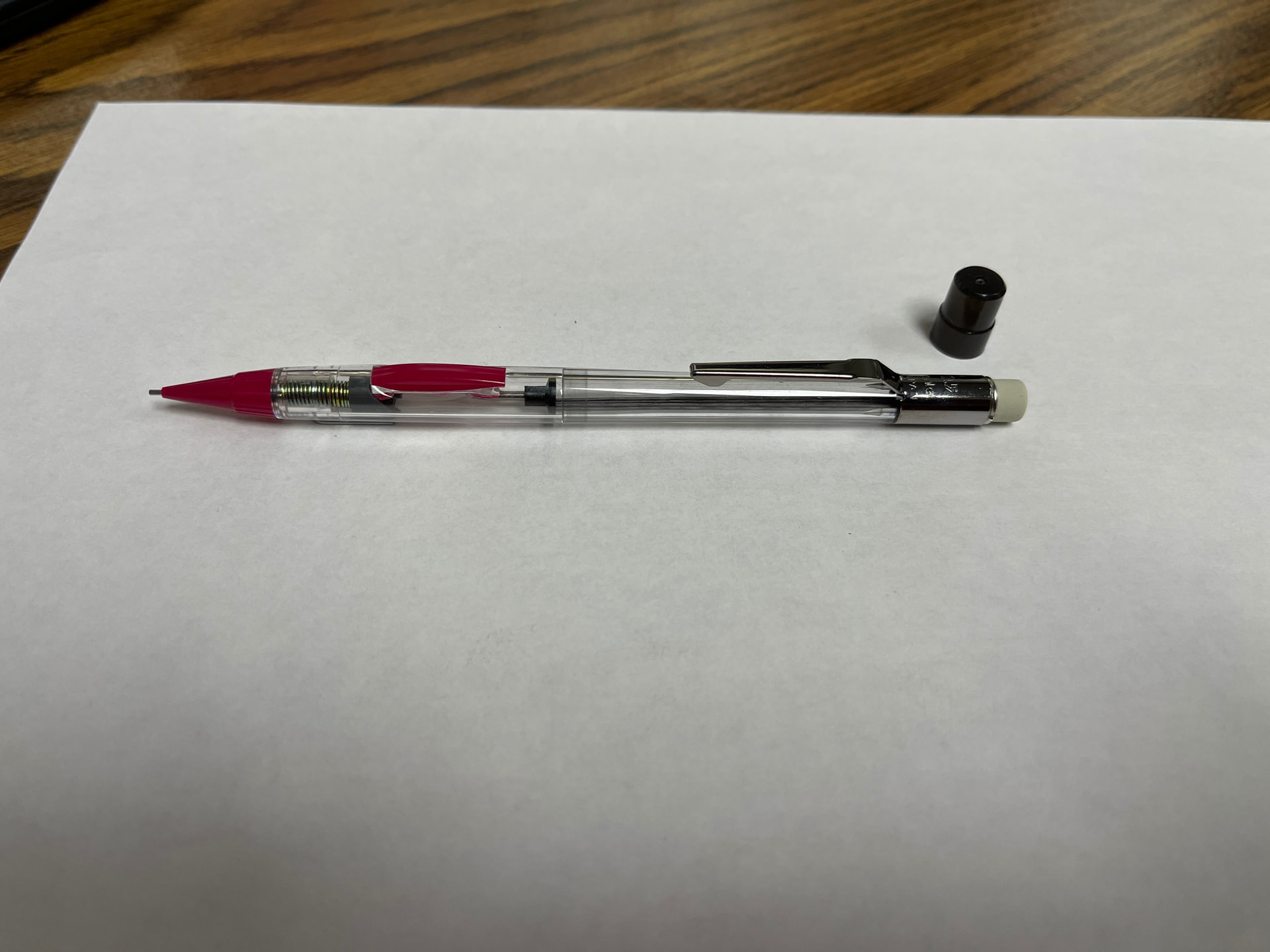
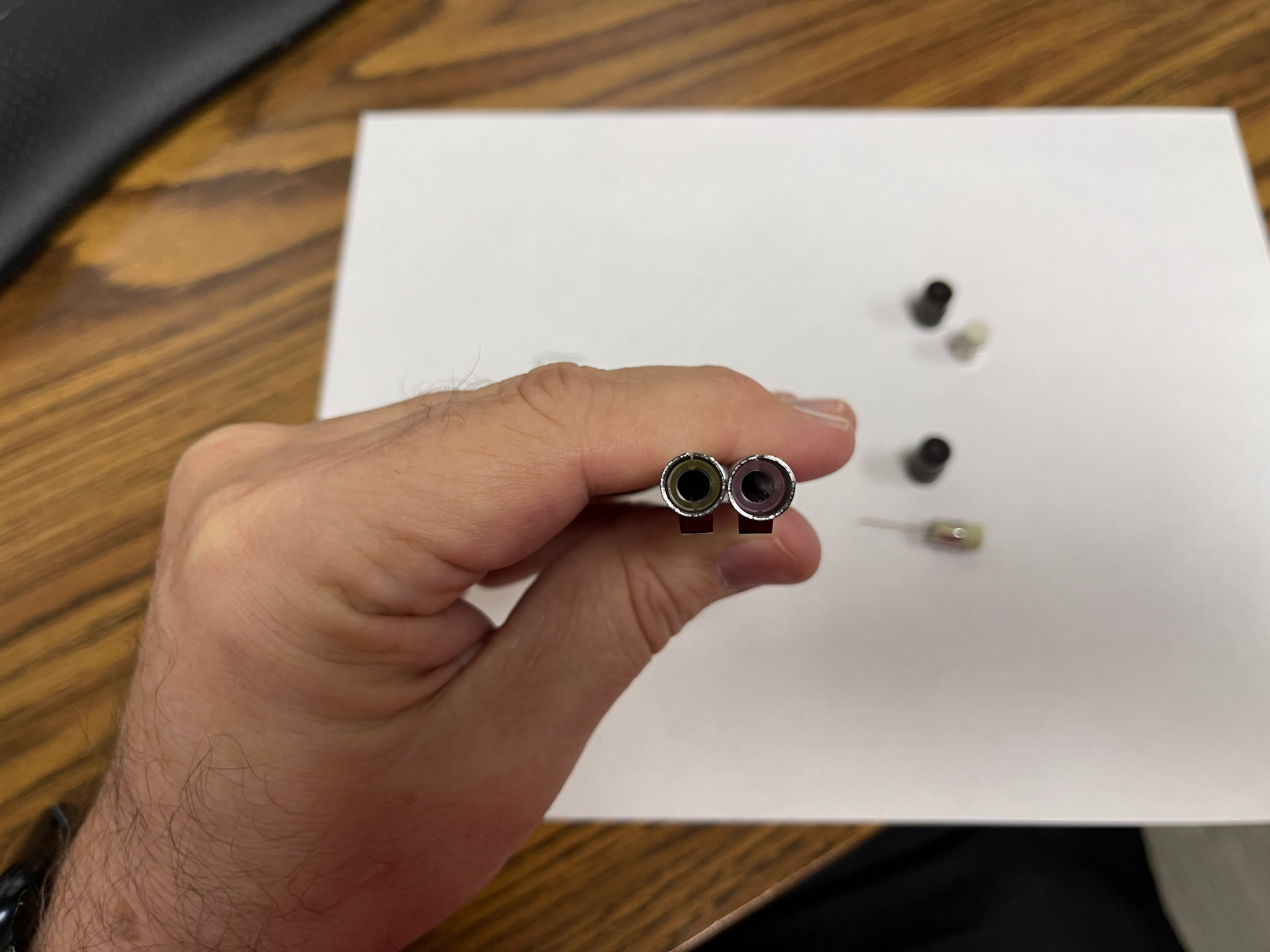
From the Knockology archives
This post revisits conversations from our smaller community before we moved to this forum. I’ve brought the discoveries and memorable moments together, with credit to the members who contributed. These discussions reflect what we knew at the time. Please add any newer information, corrections, or photos below!
How many collectors does it take to look into a hole?
At Knockology, apparently enough to start comparing catalogs, question the decade, and discuss whether somebody owns a spectroscope.
The hole, in this case, was the lead-loading opening under a Pentel Quicker Clicker’s eraser. And it turned out to be worth looking into.
I first noticed that the lead-loading openings on my PD335 and PD345 examples weren’t all the same size. Some were narrow. Others were noticeably wider. @Heath then followed up with comparisons and photographs of his own Quicker Clickers, giving us more examples to investigate.
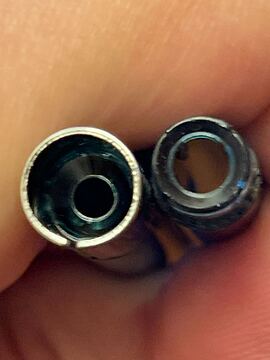
Heath’s original comparison: narrow opening on the left, wider opening on the right.
That sent us looking through our own collections. Could this help distinguish older barrels from newer ones?
What we found
When I checked my examples, this was the pattern:
| Examples in my collection | Loading opening |
|---|---|
| PD335s | Small |
| PD345s with green erasers and clearing needles | Small |
| Solid PD347s and PD349s with green erasers and clearing needles | Small |
| PD345s and solid PD347s/PD349s with white erasers and no clearing needles | Large |
| Transparent PD347s and PD349s | Large |
| PD355s and Clear Clic PD345s | Large |
These were observations from our specimens, not a guarantee that every example follows the same pattern.
The working theory was that the change happened around 1993, near the transition from green erasers to white ones. @nimrodd added catalog and date-code observations to the discussion, but we didn’t pin down a definitive changeover date. Some of the Disney variants complicated the picture, too.
The appeal of this clue is simple: an eraser can be replaced. The molded opening stays with the barrel.
It still needs to be considered alongside other details. A date code ending in a particular digit doesn’t necessarily tell you the decade, and a narrow opening alone won’t give you an exact year.
Why the opening was more useful than the date code alone
Heath was also examining the small date and mold markings on his pencils. That sounds like it should make dating easy. In practice, it gave us another puzzle.
One blue transparent PD345 had a 3G marking. Was that 1983 or 1993? Another narrow-hole example carried what Heath read as 0b. Was that 1980 or 1990? Even reading a faint letter could provoke a second opinion.
Jimmy put the problem neatly:
“Yes, unfortunately, you need to know roughly when it was made to identify when it was made.”
This is where several clues together become more useful than one promising-looking code. The body style, original purchase history, eraser assembly, catalog appearances, and loading opening could help narrow the possibilities. None should be asked to do all the work on its own.
Heath had one particularly useful point of comparison: a wide-hole transparent blue pencil he remembered buying during college, after 1993. That supported a later date for that example. It didn’t, by itself, establish the first year Pentel used the wider opening.
How firm was the 1993 theory?
My notes put the Quicker Clicker switch to white erasers and removal of the clearing needle in 1993. But I also admitted that I hadn’t recorded the source for that date.
Jimmy found green eraser refills in the 1990–91 Pentel of America catalog and white ones in the 1994 catalog. He also compared green- and white-eraser P210 examples and their date codes. That supported the general early-1990s picture, although evidence from the P210 family is supporting context rather than direct proof of a PD-series barrel change.
Meanwhile, the Disney DPD355 examples raised uncomfortable questions: if they had wide openings, how well did that fit our assumptions about their age? We needed better documentation for those pencils before using them to settle the timeline.
So the useful thing to preserve is the observed small-hole/large-hole distinction and the evidence around it. “Around 1993” remains the working interpretation from that conversation, not a manufacturer-confirmed cutoff.
A useful way to record your own example
If you add a specimen below, these details would help:
- Model and appearance: PD345, PD347, PD349, or another PD variant; body color; solid or transparent; exact printed wording.
- Opening: a straight-on photograph with the eraser removed, so the difference is visible.
- Eraser assembly: green or white, clearing needle present or absent, and whether you know it has been replaced.
- History: when and where you acquired it, especially if you bought it new.
- Other markings: a date or mold code if already accessible, with uncertain characters recorded as uncertain.
That gives the next person something to compare rather than just another guessed year.
Enter the calipers. And possibly a spectroscope.
@knocktype11 asked Heath whether he had calipers. Heath didn’t, but said he had been looking for an excuse to buy a set.
I eventually awarded him the title:
“Most Likely to Take a Pencil Apart and Measure It”
A highly competitive honor around here.
The conversation also took a predictable turn when erasers came up. I warned:
“We better stop talking about erasers. Knocktype11 will make us measure them and run a pH test.”
Knocktype11’s response:
“A pH test would be interesting but totally not required. Spectrographic would be better. Do you have a spectroscope?”
Naturally, I said I’d check.
And when Heath was being encouraged to buy calipers, I explained my recruitment strategy:
“I only brought Heath here so you’d leave me alone”
The measuring was contagious.
From the early Knockology archives. Discussion: January 3–4, 2022. Initial small-hole/big-hole observation: Thomas, comparing PD335 and PD345 examples. Follow-up comparisons and photographs: Heath. Additional research and discussion: Jimmy Simpson (Nimrodd) and Knocktype11.
Knock on!